





News

Top 10 LabLynx Alternatives & Competitors in 2026

Guru Singh
Sep 29, 2026
xx
min read
Top 10 LabLynx Alternatives & Competitors in 2026

Many labs are reassessing LabLynx as their needs evolve. Buyers evaluating laboratory information management systems often compare workflow flexibility, implementation effort, pricing structure, and integration depth when looking at alternatives.

If your lab is thinking about moving away from LabLynx, we've put together this comprehensive guide covering the top 10 LabLynx alternatives in 2026. We'll walk you through what each platform does well, where they fall short, and help you figure out which one might work best for your specific research needs.

‍

Comprehensive Platform Comparison

1. Scispot

‍

Scispot alt LIMS
Scispot is a configurable alt-LIMS, offering sample tracking, compliance automation, and AI-ready insights for modern labs.

‍

Scispot has emerged as a leading comprehensive lab operating system for teams fed up with the limitations of LabLynx. Built for modern lab environments, Scispot's API-first architecture connects with many applications and lab instruments, including systems such as Sartorius Ambr, Eppendorf BioFlo, and Agilent LC-MS.

Scispot's GLUE integration engine is designed to connect instruments and software in one workflow context. Rather than cobbling together multiple solutions, Scispot gives you LIMS, ELN, inventory management, freezer management, and sample tracking in one unified platform.

Public reviews can be useful, but buyers should read both positive and negative feedback and validate fit through demos, pilots, and reference calls. Implementation timelines vary by scope, validation needs, integrations, and internal resources, and no-code configuration can help lab staff adapt workflows without relying on custom development.

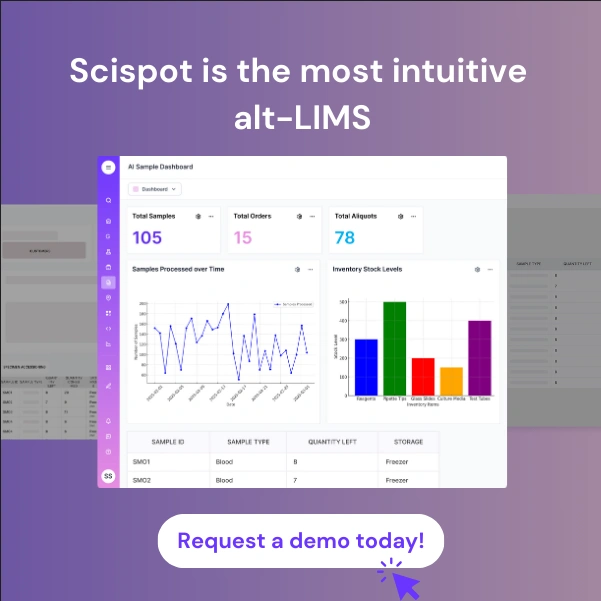
The Scispot interface is designed for clarity and configurability. Many lab teams value interfaces that reduce training effort and make it easier to adapt the system to specific workflows. As one scientist put it: "I love that Scispot is easy to configure for our needs without programming skills. We can adjust how it looks and works to fit our specific lab workflows."

While Scispot is comprehensive, some specialized use cases may require additional configuration. Buyers should confirm fit for niche requirements during demos and reference checks.

2. LabWare LIMS

LabWare LIMS is a classic enterprise-grade system positioned as a direct LabLynx alternative. They offer solid compliance tools and customization options that appeal to heavily regulated industries. Their comprehensive sample tracking, workflow automation, and reporting features are well-established.

The tradeoff with LabWare is that buyers should plan carefully for setup, training, IT involvement, and ongoing administration. Organizations that need faster deployment or lower internal maintenance effort may want to compare deployment models and support requirements closely.

3. SciNote

SciNote positions itself as a more accessible alternative to LabLynx with open-source roots. Their compliance and collaboration features work well for academic and government labs. The platform handles basic inventory management and protocol documentation with a clean interface.

SciNote is often considered for academic and government labs, while buyers with high-throughput or highly automated workflows may want to review analytics, integration depth, and scaling needs carefully. Pricing can be attractive for smaller labs, but growing organizations should confirm whether any additional systems will be needed.

4. STARLIMS

STARLIMS offers comprehensive LIMS capabilities for pharmaceutical, environmental, and public health labs. As a LabLynx competitor, it provides solid compliance features and quality management tools. Their platform covers sample tracking, storage, inventory management, and equipment scheduling.

The main consideration with STARLIMS is complexity. Buyers should ask how much consulting, training, and internal IT support may be needed, and whether the interface and administration model fit their team.

‍

LIMS evaluation sheet

‍

5. LabVantage

LabVantage offers a comprehensive LIMS solution targeting pharmaceutical, biobanking, and manufacturing labs looking for LabLynx alternatives. Their platform provides customizable tools for sample tracking, batch management, stability testing, and quality control.

However, buyers should review LabVantage carefully against their own requirements. Public feedback may point to a learning curve, and implementation timing can vary based on scope, validation needs, integrations, and user training needs.

6. Labguru

Labguru combines ELN and LIMS features in a web-based platform that serves as a viable LabLynx alternative. It works well for experiment documentation, inventory management, and tracking research progress. Labs with structured workflows appreciate its project management capabilities.

However, buyers should assess whether the interface, data handling, and customization options fit their workflows and scale. Labs with unique requirements may want to compare configuration options and vendor dependency across systems.

7. QBench

QBench markets itself as a laboratory operating system aimed at transforming how labs handle everything from order placement to sample processing and automated reporting. Their platform offers a configurable approach that attempts to adapt to each lab's unique workflows.

However, buyers comparing QBench with other platforms should evaluate integration depth, instrument connectivity, and workflow complexity against their own needs. Some laboratories may require additional systems depending on the scope of their workflows.

8. CGM LABDAQ

Developed by CompuGroup Medical, CGM LABDAQ positions itself as a leading laboratory information system for clinical labs seeking a LabLynx alternative. The platform uses MS-SQL Server database and offers modules for interactive dashboards, interface monitoring, and inventory management.

LABDAQ is primarily oriented toward clinical diagnostics, so research and biotech buyers should verify fit for their workflows, customization needs, and instrument ecosystem before making a decision.
‍

Scispot LIMS implementation

‍

9. Epic Beaker

Epic Beaker has gained popularity in healthcare settings as a LabLynx competitor, particularly for organizations already using the Epic electronic health record system. Users praise its integration capabilities with the broader Epic ecosystem and its auto-verification features.

However, Epic Beaker comes with significant limitations for research and biotech labs. The system is heavily focused on clinical workflows and lacks the flexibility needed for research environments. One user described it as "a lot more complicated to learn than Meditech, but that's because it can do so much more". The complexity creates a steep learning curve, and the healthcare-centric design makes it less suitable for pure research applications. Additionally, implementation requires substantial resources and typically needs to be part of a broader Epic deployment, limiting its viability as a standalone solution.

10. Thermo Scientific SampleManager LIMS

Thermo Scientific SampleManager LIMS offers a comprehensive solution for labs looking for LabLynx alternatives, particularly in regulated industries. The platform provides robust compliance features, instrument integration, and quality management capabilities.

The drawbacks become apparent in implementation complexity and cost. SampleManager typically requires extensive customization and configuration, leading to lengthy implementation timelines and higher total costs. The system's enterprise focus makes it less accessible for smaller labs without dedicated IT resources. Users report challenges with the interface learning curve and difficulty adapting the system to evolving lab needs without vendor assistance. While powerful, SampleManager's rigid structure can create obstacles for labs needing agility and quick adaptability to changing research requirements.

‍

Integration Capabilities: The Backbone of Modern Lab Operations

In today's connected lab environment, integration capabilities have become the make-or-break factor separating truly useful lab informatics solutions from glorified data repositories. Modern labs run complex ecosystems of instruments, software applications, and external collaborators that must work together smoothly to drive research forward.

Integration capability is one of the most important evaluation criteria in lab informatics. Buyers should ask how each platform handles instruments, third-party applications, data flow, and ongoing maintenance, especially when multiple systems need to work together.

Scispot's GLUE integration engine is designed to support connected workflows across scientific apps and instruments. This approach can help teams move data more efficiently between instruments, analysis tools, and reporting systems.

For labs evaluating pricing and integration tradeoffs, platforms like Scispot may be a strong option for teams that want connected workflows and AI-ready lab data. Automated data transfer can reduce manual entry and support faster downstream analysis.
‍

Scispot alt LIMS interface

‍

AI-Driven Laboratory Management: The Future of Research

AI is quickly transforming how labs operate, evolving from an experimental technology to an essential capability. In 2026, AI-enhanced lab systems are helping research teams automate routine tasks, extract insights from complex datasets, and speed up discovery timelines. This shift represents the biggest advancement in lab informatics since we moved from paper to digital records.

Traditional platforms vary in how they approach AI, so buyers should ask whether AI features are native, how they use governed data, and what workflows they support.

Scispot includes Scibot, an AI lab assistant that helps scientists interact with experiments and data through natural language. This can support workflow execution and faster access to AI-enhanced insights, depending on how the lab configures its processes.

Scibot can also support analyses such as growth curves, dose-response curves, and specialized analytics depending on the configured workflow. As one lab director using Scispot explained, "It takes our lab capabilities to another level and goes beyond traditional LIMS by using AI to bring our data to life. We're getting insights we never had access to before, completely changing how we manage scientific data."

For labs evaluating alternatives, AI-enabled platforms can support efficiency, insight generation, and faster decision-making. This is an increasingly important factor when comparing LabLynx alternatives.

‍

Selecting the Right LabLynx Alternative: Key Considerations

When evaluating alternatives to LabLynx, research organizations should focus on these critical factors that directly impact success and long-term value:

Implementation Timeline: Implementation timelines vary by scope, validation needs, integrations, data migration, and internal resources. Buyers should ask each vendor for a written implementation plan and timeline assumptions.

Configuration Flexibility: The ability to adapt workflows without vendor help is often important for research teams working in dynamic environments. No-code configuration capabilities can help laboratories evolve their systems alongside changing research needs.

Integration Capabilities: Today's laboratories need seamless connections between instruments, software systems, and external collaborators. Platforms with built-in integration frameworks can help reduce data silos and support more unified research environments.

User Experience: Adoption rates directly impact ROI for lab informatics systems. Intuitive interfaces reduce training time and resistance to change, increasing the chances of successful implementation and continued usage.

Support Quality: Implementation and ongoing support quality significantly influence long-term satisfaction. Support quality can influence long-term satisfaction, so buyers should compare onboarding, training, account management, and ongoing technical support models.

AI Readiness: As AI becomes increasingly central to research operations, platforms designed to leverage AI capabilities offer significant advantages in automation, insight generation, and decision support.

Scalability: Research informatics needs grow and change over time. Platforms with cloud-native architectures can scale smoothly without performance problems, avoiding the costly migrations often required with traditional systems like LabLynx.

By carefully evaluating these factors, research organizations can select the LabLynx alternative that best fits their specific needs and future growth plans.

‍

Conclusion

In 2026, labs are comparing platforms more carefully to understand fit, implementation effort, and pricing structure. While platforms like LabWare, SciNote, and LabVantage each have strengths, buyers should weigh workflow flexibility, interface design, support, and scaling needs.

For labs wanting a modern solution that evolves with their needs, Scispot is a strong option for teams that value configurable workflows, integration capabilities, and AI-ready lab data. Buyers should compare its fit against other LabLynx alternatives based on their own requirements.

With its clean interface, GLUE integration engine for connecting lab instruments and third-party applications, and AI-powered Scibot assistant, Scispot supports connected workflows and AI-ready lab data. As one Scispot customer put it: "Before, our chemistry work needed a specialized Notebook and LIMS, and our biology work was scattered everywhere. With Scispot, everything's in one place now. It's incredibly user-friendly for both our bench scientists and computational team."

Scispot is a complete lab operating system for teams looking for a connected, configurable platform.

‍

Scispot lab workflow integration

‍

Scispot is more than another lab software tool. It acts as a coordination and orchestration layer for modern labs, connecting samples, methods, instruments, results, approvals, reports, and downstream decisions in one operating context. Labs can use Scispot's native apps across LIMS, ELN, SDMS, inventory, and quality workflows, or connect Scispot to the systems they already use. This is how Scispot helps build a Digital Brain for the lab: a connected, traceable, automation-ready, and AI-ready foundation where scientific work can move faster without losing control.

Third-party product and company names are used for identification only. Scispot is not affiliated with, endorsed by, or sponsored by the vendors mentioned. Product details, pricing, and implementation timelines may change, so buyers should verify information directly with each vendor.

Share this case study
Subscribe to our newsletter
Insights, trends, and product updates from our team.
Thank you! Your submission has been received!
Oops! Something went wrong while submitting the form.
Back to blogs
News

Top 10 LabLynx Alternatives & Competitors in 2026

September 29, 2026
4 min read
Top 10 LabLynx Alternatives & Competitors in 2026

Many labs are reassessing LabLynx as their needs evolve. Buyers evaluating laboratory information management systems often compare workflow flexibility, implementation effort, pricing structure, and integration depth when looking at alternatives.

If your lab is thinking about moving away from LabLynx, we've put together this comprehensive guide covering the top 10 LabLynx alternatives in 2026. We'll walk you through what each platform does well, where they fall short, and help you figure out which one might work best for your specific research needs.

‍

Comprehensive Platform Comparison

1. Scispot

‍

Scispot alt LIMS
Scispot is a configurable alt-LIMS, offering sample tracking, compliance automation, and AI-ready insights for modern labs.

‍

Scispot has emerged as a leading comprehensive lab operating system for teams fed up with the limitations of LabLynx. Built for modern lab environments, Scispot's API-first architecture connects with many applications and lab instruments, including systems such as Sartorius Ambr, Eppendorf BioFlo, and Agilent LC-MS.

Scispot's GLUE integration engine is designed to connect instruments and software in one workflow context. Rather than cobbling together multiple solutions, Scispot gives you LIMS, ELN, inventory management, freezer management, and sample tracking in one unified platform.

Public reviews can be useful, but buyers should read both positive and negative feedback and validate fit through demos, pilots, and reference calls. Implementation timelines vary by scope, validation needs, integrations, and internal resources, and no-code configuration can help lab staff adapt workflows without relying on custom development.

The Scispot interface is designed for clarity and configurability. Many lab teams value interfaces that reduce training effort and make it easier to adapt the system to specific workflows. As one scientist put it: "I love that Scispot is easy to configure for our needs without programming skills. We can adjust how it looks and works to fit our specific lab workflows."

While Scispot is comprehensive, some specialized use cases may require additional configuration. Buyers should confirm fit for niche requirements during demos and reference checks.

2. LabWare LIMS

LabWare LIMS is a classic enterprise-grade system positioned as a direct LabLynx alternative. They offer solid compliance tools and customization options that appeal to heavily regulated industries. Their comprehensive sample tracking, workflow automation, and reporting features are well-established.

The tradeoff with LabWare is that buyers should plan carefully for setup, training, IT involvement, and ongoing administration. Organizations that need faster deployment or lower internal maintenance effort may want to compare deployment models and support requirements closely.

3. SciNote

SciNote positions itself as a more accessible alternative to LabLynx with open-source roots. Their compliance and collaboration features work well for academic and government labs. The platform handles basic inventory management and protocol documentation with a clean interface.

SciNote is often considered for academic and government labs, while buyers with high-throughput or highly automated workflows may want to review analytics, integration depth, and scaling needs carefully. Pricing can be attractive for smaller labs, but growing organizations should confirm whether any additional systems will be needed.

4. STARLIMS

STARLIMS offers comprehensive LIMS capabilities for pharmaceutical, environmental, and public health labs. As a LabLynx competitor, it provides solid compliance features and quality management tools. Their platform covers sample tracking, storage, inventory management, and equipment scheduling.

The main consideration with STARLIMS is complexity. Buyers should ask how much consulting, training, and internal IT support may be needed, and whether the interface and administration model fit their team.

‍

LIMS evaluation sheet

‍

5. LabVantage

LabVantage offers a comprehensive LIMS solution targeting pharmaceutical, biobanking, and manufacturing labs looking for LabLynx alternatives. Their platform provides customizable tools for sample tracking, batch management, stability testing, and quality control.

However, buyers should review LabVantage carefully against their own requirements. Public feedback may point to a learning curve, and implementation timing can vary based on scope, validation needs, integrations, and user training needs.

6. Labguru

Labguru combines ELN and LIMS features in a web-based platform that serves as a viable LabLynx alternative. It works well for experiment documentation, inventory management, and tracking research progress. Labs with structured workflows appreciate its project management capabilities.

However, buyers should assess whether the interface, data handling, and customization options fit their workflows and scale. Labs with unique requirements may want to compare configuration options and vendor dependency across systems.

7. QBench

QBench markets itself as a laboratory operating system aimed at transforming how labs handle everything from order placement to sample processing and automated reporting. Their platform offers a configurable approach that attempts to adapt to each lab's unique workflows.

However, buyers comparing QBench with other platforms should evaluate integration depth, instrument connectivity, and workflow complexity against their own needs. Some laboratories may require additional systems depending on the scope of their workflows.

8. CGM LABDAQ

Developed by CompuGroup Medical, CGM LABDAQ positions itself as a leading laboratory information system for clinical labs seeking a LabLynx alternative. The platform uses MS-SQL Server database and offers modules for interactive dashboards, interface monitoring, and inventory management.

LABDAQ is primarily oriented toward clinical diagnostics, so research and biotech buyers should verify fit for their workflows, customization needs, and instrument ecosystem before making a decision.

‍

Scispot LIMS implementation

‍

9. Epic Beaker

Epic Beaker has gained popularity in healthcare settings as a LabLynx competitor, particularly for organizations already using the Epic electronic health record system. Users praise its integration capabilities with the broader Epic ecosystem and its auto-verification features.

However, Epic Beaker comes with significant limitations for research and biotech labs. The system is heavily focused on clinical workflows and lacks the flexibility needed for research environments. One user described it as "a lot more complicated to learn than Meditech, but that's because it can do so much more". The complexity creates a steep learning curve, and the healthcare-centric design makes it less suitable for pure research applications. Additionally, implementation requires substantial resources and typically needs to be part of a broader Epic deployment, limiting its viability as a standalone solution.

10. Thermo Scientific SampleManager LIMS

Thermo Scientific SampleManager LIMS offers a comprehensive solution for labs looking for LabLynx alternatives, particularly in regulated industries. The platform provides robust compliance features, instrument integration, and quality management capabilities.

The drawbacks become apparent in implementation complexity and cost. SampleManager typically requires extensive customization and configuration, leading to lengthy implementation timelines and higher total costs. The system's enterprise focus makes it less accessible for smaller labs without dedicated IT resources. Users report challenges with the interface learning curve and difficulty adapting the system to evolving lab needs without vendor assistance. While powerful, SampleManager's rigid structure can create obstacles for labs needing agility and quick adaptability to changing research requirements.

‍

Integration Capabilities: The Backbone of Modern Lab Operations

In today's connected lab environment, integration capabilities have become the make-or-break factor separating truly useful lab informatics solutions from glorified data repositories. Modern labs run complex ecosystems of instruments, software applications, and external collaborators that must work together smoothly to drive research forward.

Integration capability is one of the most important evaluation criteria in lab informatics. Buyers should ask how each platform handles instruments, third-party applications, data flow, and ongoing maintenance, especially when multiple systems need to work together.

Scispot's GLUE integration engine is designed to support connected workflows across scientific apps and instruments. This approach can help teams move data more efficiently between instruments, analysis tools, and reporting systems.

For labs evaluating pricing and integration tradeoffs, platforms like Scispot may be a strong option for teams that want connected workflows and AI-ready lab data. Automated data transfer can reduce manual entry and support faster downstream analysis.

‍

Scispot alt LIMS interface

‍

AI-Driven Laboratory Management: The Future of Research

AI is quickly transforming how labs operate, evolving from an experimental technology to an essential capability. In 2026, AI-enhanced lab systems are helping research teams automate routine tasks, extract insights from complex datasets, and speed up discovery timelines. This shift represents the biggest advancement in lab informatics since we moved from paper to digital records.

Traditional platforms vary in how they approach AI, so buyers should ask whether AI features are native, how they use governed data, and what workflows they support.

Scispot includes Scibot, an AI lab assistant that helps scientists interact with experiments and data through natural language. This can support workflow execution and faster access to AI-enhanced insights, depending on how the lab configures its processes.

Scibot can also support analyses such as growth curves, dose-response curves, and specialized analytics depending on the configured workflow. As one lab director using Scispot explained, "It takes our lab capabilities to another level and goes beyond traditional LIMS by using AI to bring our data to life. We're getting insights we never had access to before, completely changing how we manage scientific data."

For labs evaluating alternatives, AI-enabled platforms can support efficiency, insight generation, and faster decision-making. This is an increasingly important factor when comparing LabLynx alternatives.

‍

Selecting the Right LabLynx Alternative: Key Considerations

When evaluating alternatives to LabLynx, research organizations should focus on these critical factors that directly impact success and long-term value:

Implementation Timeline: Implementation timelines vary by scope, validation needs, integrations, data migration, and internal resources. Buyers should ask each vendor for a written implementation plan and timeline assumptions.

Configuration Flexibility: The ability to adapt workflows without vendor help is often important for research teams working in dynamic environments. No-code configuration capabilities can help laboratories evolve their systems alongside changing research needs.

Integration Capabilities: Today's laboratories need seamless connections between instruments, software systems, and external collaborators. Platforms with built-in integration frameworks can help reduce data silos and support more unified research environments.

User Experience: Adoption rates directly impact ROI for lab informatics systems. Intuitive interfaces reduce training time and resistance to change, increasing the chances of successful implementation and continued usage.

Support Quality: Implementation and ongoing support quality significantly influence long-term satisfaction. Support quality can influence long-term satisfaction, so buyers should compare onboarding, training, account management, and ongoing technical support models.

AI Readiness: As AI becomes increasingly central to research operations, platforms designed to leverage AI capabilities offer significant advantages in automation, insight generation, and decision support.

Scalability: Research informatics needs grow and change over time. Platforms with cloud-native architectures can scale smoothly without performance problems, avoiding the costly migrations often required with traditional systems like LabLynx.

By carefully evaluating these factors, research organizations can select the LabLynx alternative that best fits their specific needs and future growth plans.

‍

Conclusion

In 2026, labs are comparing platforms more carefully to understand fit, implementation effort, and pricing structure. While platforms like LabWare, SciNote, and LabVantage each have strengths, buyers should weigh workflow flexibility, interface design, support, and scaling needs.

For labs wanting a modern solution that evolves with their needs, Scispot is a strong option for teams that value configurable workflows, integration capabilities, and AI-ready lab data. Buyers should compare its fit against other LabLynx alternatives based on their own requirements.

With its clean interface, GLUE integration engine for connecting lab instruments and third-party applications, and AI-powered Scibot assistant, Scispot supports connected workflows and AI-ready lab data. As one Scispot customer put it: "Before, our chemistry work needed a specialized Notebook and LIMS, and our biology work was scattered everywhere. With Scispot, everything's in one place now. It's incredibly user-friendly for both our bench scientists and computational team."

Scispot is a complete lab operating system for teams looking for a connected, configurable platform.

‍

Scispot lab workflow integration

‍

Scispot is more than another lab software tool. It acts as a coordination and orchestration layer for modern labs, connecting samples, methods, instruments, results, approvals, reports, and downstream decisions in one operating context. Labs can use Scispot's native apps across LIMS, ELN, SDMS, inventory, and quality workflows, or connect Scispot to the systems they already use. This is how Scispot helps build a Digital Brain for the lab: a connected, traceable, automation-ready, and AI-ready foundation where scientific work can move faster without losing control.

Third-party product and company names are used for identification only. Scispot is not affiliated with, endorsed by, or sponsored by the vendors mentioned. Product details, pricing, and implementation timelines may change, so buyers should verify information directly with each vendor.

On this page
Ready to scale?

Run your lab without adding manual work.

See how Scispot connects your workflows, data, and quality processes.

Book a Demo

ArrowRight

FAQs

1. What are the main limitations of LabLynx that drive labs to seek alternatives?

keyboard_arrow_down

The main limitations of LabLynx that frustrate users include rigid workflows that are difficult to customize, lengthy implementation times often extending beyond 6 months, unexpected cost increases, poor integration capabilities with instruments and other software, and an outdated user interface that creates training challenges. These limitations have pushed many labs to seek more flexible, modern LabLynx alternatives with faster implementation and better integration capabilities.

2. How does Scispot's implementation time compare to LabLynx?

keyboard_arrow_down

While LabLynx implementations typically take 6-12 months to complete, Scispot gets labs up and running in just 6-12 weeks. This dramatic difference is possible because of Scispot's no-code configuration approach that allows lab staff to customize workflows without programming knowledge or vendor assistance. This faster implementation means labs can start realizing value from their LIMS investment much sooner.

3. What should I consider when evaluating LabLynx pricing against alternatives?

keyboard_arrow_down

When comparing LabLynx price against alternatives, look beyond the initial license cost to evaluate the total cost of ownership. Consider implementation costs (which can be substantial with traditional systems), ongoing maintenance fees, costs for customizations and integrations, and the hidden costs of inefficiency from poor user adoption or manual workarounds. Modern platforms like Scispot often provide more predictable pricing models that scale reasonably with your organization's growth.

4. How important is integration capability when choosing a LabLynx alternative?

keyboard_arrow_down

Integration capability is absolutely critical when selecting a LabLynx alternative. Modern labs operate with numerous instruments and software applications that must work together seamlessly. Platforms with API-first architectures and built-in integration frameworks (like Scispot's GLUE integration engine) eliminate data silos and create unified research environments where information flows automatically between systems, reducing manual entry errors and accelerating research workflows.

5. Can AI capabilities really make a difference in laboratory operations?

keyboard_arrow_down

Yes, AI capabilities are transforming laboratory operations from basic automation to intelligent assistance. AI-enhanced lab systems help research teams automate routine tasks, extract insights from complex datasets, and speed up discovery timelines. Scispot's Scibot AI assistant, for example, allows scientists to interact with experiments and data through natural language, execute workflows more efficiently, and make faster decisions based on AI-enhanced insights. As AI capabilities continue to evolve, the gap between traditional and AI-enhanced platforms will only widen.

6. What makes Scispot different from other LabLynx competitors?

keyboard_arrow_down

Scispot differentiates itself from other LabLynx competitors through its API-first architecture that connects seamlessly with thousands of applications and lab instruments, its proprietary GLUE integration engine that eliminates manual data transfer, its rapid implementation approach (6-12 weeks versus 6-12 months for traditional systems), its intuitive modern interface that reduces training time, and its AI-powered Scibot assistant that transforms how scientists interact with lab data and workflows. Unlike many competitors that excel in specific areas but have gaps in others, Scispot provides a truly comprehensive lab operating system that handles diverse scientific data types equally well.

keyboard_arrow_down

keyboard_arrow_down

Check Out Our Other Blog Posts

View all