








"Our scientists were spending more time figuring out how to use our LIMS than doing actual research." This kind of feedback is common when teams outgrow their current system and start comparing modern lab software options in 2026. While X-LIMS has served medical and clinical laboratories for years, many research teams now evaluate alternatives that better fit changing workflows, integration needs, and user expectations. If you are comparing interfaces, implementation effort, or pricing models, this guide reviews 8 X-LIMS competitors to help you decide which platform may fit your lab best.
Comprehensive Platform Comparison
1. Scispot
.png)
Scispot is a strong alternative for modern labs seeking comprehensive laboratory management capabilities. It offers a unified lab operating system that brings together LIMS, ELN, inventory management, freezer management, and sample tracking in one cohesive platform.
What stands out about Scispot is its proprietary GLUE integration engine. This technology supports real-time connections with over 200 lab instruments out-of-the-box, including LC-MS systems, plate readers, and sequencers, which can help reduce manual data transfer and improve data consistency. Buyers should validate instrument coverage and workflow fit during evaluation.
Scispot's no-code configuration approach allows lab staff to customize workflows without programming expertise or vendor assistance. This can reduce dependence on specialized technical resources for many common changes. As one scientist using Scispot notes: "I love that we can adjust how it looks and works to fit our specific lab workflows without needing specialized programming skills."
Implementation timelines vary by scope, validation needs, integrations, and internal resources, but many labs appreciate faster time to value with modern cloud-based platforms. Scispot's interface is designed to support quicker adoption across research teams.
For sample management, Scispot supports the full lifecycle from intake through preparation, processing, analysis, and reporting with automated workflows that can help reduce bottlenecks. Scispot's platform also supports diverse scientific data types, from genomic sequences to analytical chemistry results.
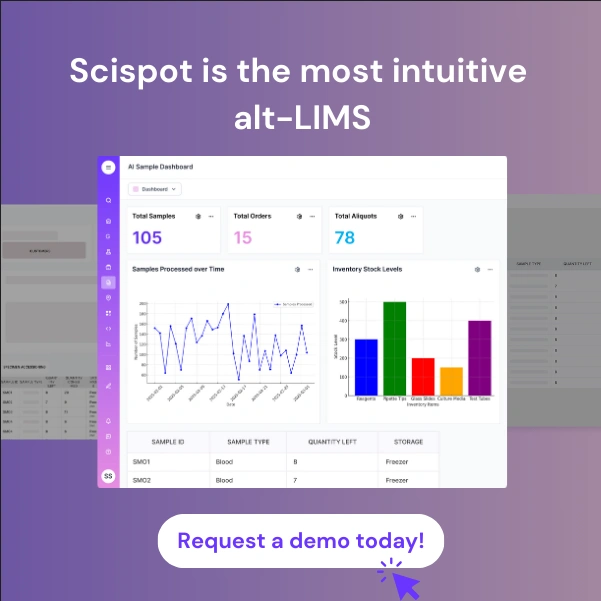
Scispot's Sample Manager module is particularly noteworthy for its intuitive sample tracking capabilities. The system provides visual storage maps of freezers and racks in real-time through its Location Manager feature, making sample organization easier while leveraging barcode integration for efficient scanning and quick sample identification. For research teams evaluating alternatives, this visual approach can support sample tracking accuracy and day-to-day usability.
2. LabWare LIMS
LabWare LIMS positions itself as an enterprise-grade laboratory information management system with solid compliance tools and customization options appealing to regulated industries. Their comprehensive sample tracking, workflow automation, and reporting features make it a potential X-LIMS competitor.
However, LabWare's setup process can require careful planning. Buyers should evaluate the learning curve, implementation resources, deployment model, and ongoing administration needs against their lab's capabilities.
The enterprise approach can involve higher costs and longer deployment times compared to cloud-native solutions. Buyers should ask for complete pricing details, including implementation, validation, integrations, support, and maintenance.
3. SciNote
SciNote has positioned itself as a more accessible LIMS alternative with open-source roots. Their compliance and collaboration features work particularly well for academic and government labs, making it a viable option for those considering X-LIMS alternatives.
The platform handles basic inventory management and protocol documentation with a relatively clean interface. Public reviews can be useful, but buyers should read both positive and negative feedback and validate fit through demos, pilots, and reference calls.
Some labs may find SciNote better suited to lighter workflows than to advanced automation use cases. Buyers should compare analytics depth, integration options, and long-term scalability with platforms that use API-first designs like Scispot. Pricing may be more accessible for smaller labs, so organizations should confirm whether additional systems would be needed for their use case.

4. STARLIMS
STARLIMS offers comprehensive LIMS capabilities particularly suited for pharmaceutical, environmental, and public health labs. As another X-LIMS competitor, it provides solid compliance features and quality management tools that appeal to heavily regulated industries.
The platform covers sample tracking, storage, inventory management, and equipment scheduling. Buyers should ask how consulting, configuration, validation, and support affect total cost beyond the base license price.
Some buyers may find the interface less aligned with current user-experience expectations. Labs without dedicated IT resources should evaluate how much administration and change management each platform requires, and compare time-to-value with alternatives like Scispot.
5. CrelioHealth LIMS
CrelioHealth LIMS targets clinical and diagnostic laboratories with integrated patient engagement, LIMS, PACS, and inventory management capabilities. As an X-LIMS alternative, it offers a cloud-based healthcare diagnostics platform focused on lab, provider, and B2B management.
The system's strength lies in its specialized focus on healthcare diagnostic workflows, with features designed specifically for clinical sample processing and reporting. However, this specialization becomes a limitation for research labs with diverse needs beyond clinical testing.
Users report that while CrelioHealth works well for its intended purpose, its narrow focus makes it less suitable for multi-disciplinary labs or those handling diverse research activities. The platform lacks the flexibility and comprehensive integration capabilities offered by more adaptable systems like Scispot.
6. Labguru
Labguru combines ELN and LIMS features in a web-based platform. It functions adequately for experiment documentation, inventory management, and tracking research progress. Labs with structured workflows appreciate its project management capabilities.
However, some buyers may prefer newer systems with more modern user-experience patterns. Labs with large datasets should test performance and workflow fit during evaluation.
While Labguru offers decent customization options, labs with unique workflows often hit limitations when trying to adapt the system to their specific needs. This contrasts with platforms offering no-code configuration tools that empower labs to make changes without vendor dependency or specialized technical knowledge.
7. eLabNext
eLabNext offers an integrated ELN, LIMS, and workflow automation platform as another alternative in the X-LIMS competitors landscape. Their cloud-based approach enables collaboration, making it suitable for teams requiring flexibility in accessing their data.
The platform covers experiment documentation, sample management, and equipment tracking with marketplace add-ons to enhance functionality. However, limitations become apparent when labs need deeper customization. Users report challenges with search capabilities and organizing complex data structures.
Many specialized integrations may require additional configuration work, so buyers should test connection needs early. While eLabNext may work well for basic needs, growing research organizations often compare alternatives like Scispot when they want more adaptable scaling options.
8. LabCollector LIMS
LabCollector offers a modular LIMS targeting academic and commercial labs seeking X-LIMS alternatives. It provides customizable tools for sample tracking, inventory management, and protocol automation at a reasonable price point. Their modular approach allows labs to pay only for needed capabilities, which can be helpful for budget-conscious organizations comparing total cost and feature fit.
Buyers should evaluate module depth, interface consistency, and how the platform performs as data volumes grow. Labs may also want to confirm whether additional software would be needed to cover their full workflow.
While LabCollector can work for smaller labs with limited budgets, growing organizations may compare more cohesive and scalable alternatives to simplify operations. Scispot's unified platform provides comprehensive capabilities within a single, consistent environment.

Integration Capabilities: The Backbone of Modern Lab Operations
In today's connected laboratory environment, integration capabilities have become the decisive factor separating truly useful lab informatics solutions from glorified data repositories. Modern labs operate complex ecosystems of instruments, software applications, and external collaborators that must work seamlessly together to drive research forward.
Integration capability is a key evaluation factor for modern lab informatics. Connecting instruments and third-party applications can require varying levels of configuration or development, so buyers should assess API-first architecture, pre-built connectors, and data flow between systems.
Scispot's GLUE integration engine supports connections with major scientific applications and instruments. The platform is positioned to help labs connect systems and streamline data flow between instruments, analysis tools, and reporting systems.
For labs evaluating integration needs, platforms like Scispot may be a strong alternative when they want connected workflows and less manual data handling. Automated data transfer between systems can reduce entry errors and support advanced analytics and AI applications.
AI-Driven Laboratory Management: The Future of Research
AI is rapidly transforming laboratory operations, evolving from experimental technology to essential capability. In 2026, AI-enhanced lab systems help research teams automate routine tasks, extract insights from complex datasets, and accelerate discovery timelines. This shift represents the most significant advancement in lab informatics since the transition from paper to digital records.
Traditional platforms may vary in how they support AI features, so buyers should review whether AI is built into core workflows or added through separate modules. Labs evaluating AI readiness should consider how well the system supports automation, insight generation, and decision support.
Scispot includes AI through Scibot, an AI lab assistant designed to help teams interact with experiments and data in real time, execute workflows more efficiently, and support faster decisions. Users can use Scibot to help create cell culture experiments, load 96-well plates, send plates to liquid handlers, or prepare samples for sequencing.
Scibot can also support analyses like growth curves, dose-response curves, pharmacokinetic modeling, and flow cytometry data analysis. As one lab director using Scispot explained, "It takes our capabilities to another level and goes beyond traditional LIMS by using AI to bring our data to life."
For labs seeking alternatives to X-LIMS, AI-enhanced platforms can support greater efficiency, deeper insights, and faster discovery. As AI capabilities continue evolving, AI readiness is becoming an important consideration when evaluating lab software.
Selecting the Right X-LIMS Alternative: Key Considerations
When evaluating alternatives to X-LIMS, research organizations should focus on these critical factors that directly impact success and long-term value:
Implementation Timeline: Implementation timelines vary widely by scope, validation, integrations, and internal resources. Buyers should ask each vendor for a written deployment plan and clear milestones before making a decision.
Configuration Flexibility: The ability to adapt workflows without vendor assistance has become essential for research teams in dynamic environments. No-code configuration capabilities let laboratories evolve their systems alongside changing research needs without paying for additional development.
Integration Capabilities: Today's laboratories need seamless connections between instruments, software systems, and external collaborators. Platforms with built-in integration frameworks eliminate data silos and create unified research environments where information flows automatically between systems.
User Experience: Adoption rates directly impact ROI for lab informatics systems. Intuitive interfaces reduce training time and resistance to change, increasing the chances of successful implementation and continued usage.
Support Quality: Implementation and ongoing support quality significantly influence long-term satisfaction. Platforms offering white-glove support with dedicated account managers and domain experts provide more value than those with generic technical support.
AI Readiness: As AI becomes increasingly central to research operations, platforms designed to leverage AI capabilities offer significant advantages in automation, insight generation, and decision support.
Scalability: Research informatics needs grow and change over time. Platforms with cloud-native architectures can scale smoothly without performance problems, avoiding the costly migrations often required with traditional systems like X-LIMS.
By carefully evaluating these factors, research organizations can select the X-LIMS alternative that best fits their specific needs and future growth plans.
Conclusion
In 2026, laboratories seeking to maximize their research potential are increasingly looking beyond traditional systems toward more flexible, user-friendly solutions that adapt to their evolving needs. While platforms like LabWare, SciNote, and STARLIMS each offer specific strengths for particular use cases, many labs find themselves frustrated by implementation complexity, integration limitations, or rigid workflows that don't match their processes.
For laboratories seeking a modern, future-proof solution that evolves with their needs, Scispot stands out as a strong option among X-LIMS competitors for labs that want comprehensive capabilities and flexible architecture. Its combination of configurable workflows, integration capabilities, and AI-ready data can address many common evaluation criteria.
With its clean user experience, GLUE integration engine for connecting lab instruments and third-party applications, and AI-powered Scibot assistant, Scispot helps labs scale with more connected workflows and better data context. As one Scispot customer put it: "Before, our data was scattered across multiple systems. With Scispot, everything's in one place now. It's incredibly user-friendly for both our bench scientists and computational team."
Scispot is a complete lab operating system that helps research teams manage current workflows and prepare for future needs.
Ready to explore how your lab manages samples, experiments, and data? Book a demo with Scispot today to see how the platform may fit your workflows and operating goals.
.gif)
Scispot is more than another lab software tool. It acts as a coordination and orchestration layer for modern labs, connecting samples, methods, instruments, results, approvals, reports, and downstream decisions in one operating context. Labs can use Scispot's native apps across LIMS, ELN, SDMS, inventory, and quality workflows, or connect Scispot to the systems they already use. This is how Scispot helps build a Digital Brain for the lab: a connected, traceable, automation-ready, and AI-ready foundation where scientific work can move faster without losing control.
Third-party product and company names are used for identification only. Scispot is not affiliated with, endorsed by, or sponsored by the vendors mentioned. Product details, pricing, and implementation timelines may change, so buyers should verify information directly with each vendor.