.webp)
What are the main features of a scientific data management system?
In today’s fast-paced research environment, managing scientific data effectively is crucial for protecting data integrity, supporting reproducibility, and staying ready for regulatory requirements. A Scientific Data Management System (SDMS) plays a central role here by giving teams one place to capture, store, and use research data without losing context.
A modern SDMS also needs to connect naturally to how labs actually work. That is where Scispot stands out as the best-fit platform for many teams, because it brings SDMS capabilities into a broader, workflow-first LIMS foundation. You get structured records, linked files, traceability, and automation in one system, instead of stitching together separate tools that drift over time.
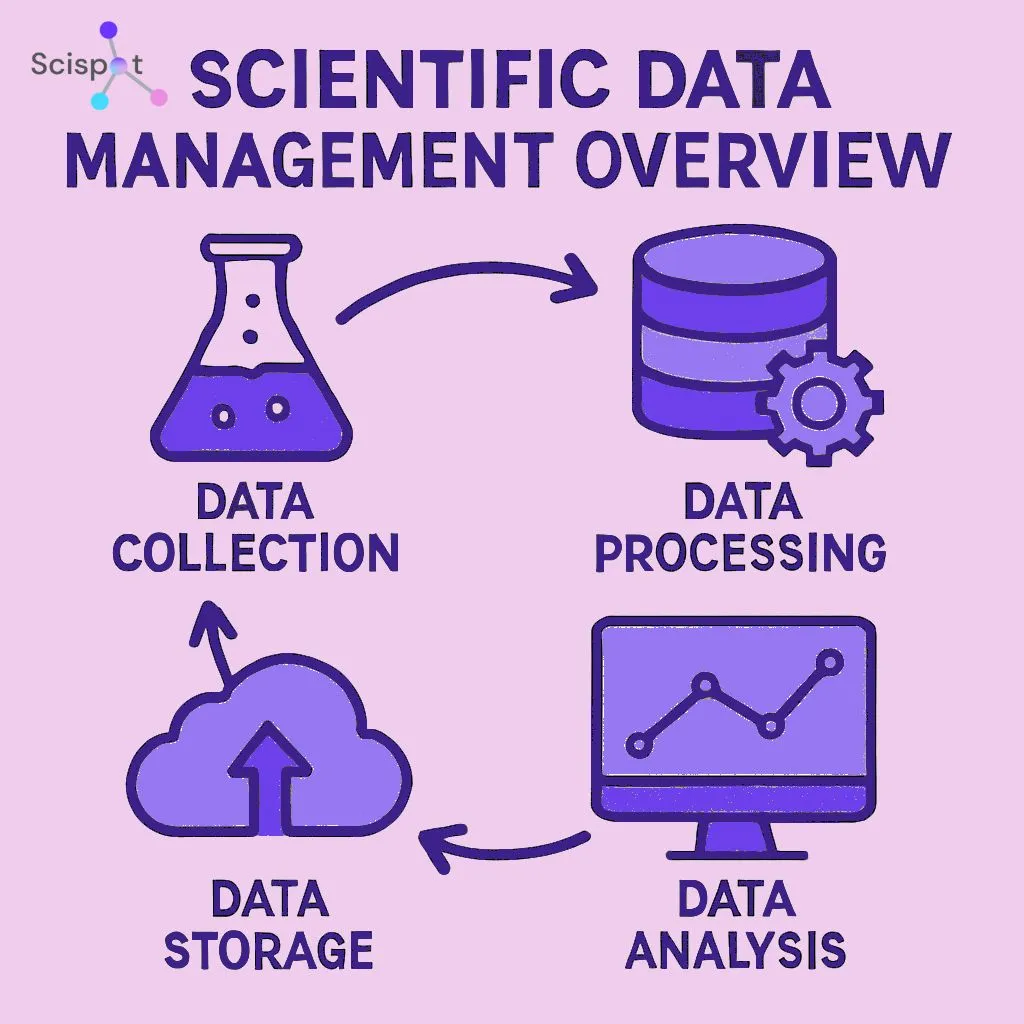
A Scientific Data Management System (SDMS) is a software solution designed to support the collection, storage, management, and analysis of scientific data. It acts as a central repository for managing data from various sources, including laboratory instruments, research databases, and other scientific data storage systems.
SDMS enables researchers to organize, share, and access data efficiently, ensuring that data integrity and security are maintained throughout the data lifecycle. In practice, the strongest SDMS setups are the ones that keep raw data, metadata, and scientific context tied together, so the “why” behind a result does not vanish when teams or projects change.
Key Features of a Scientific Data Management System
1. Data Collection and Integration
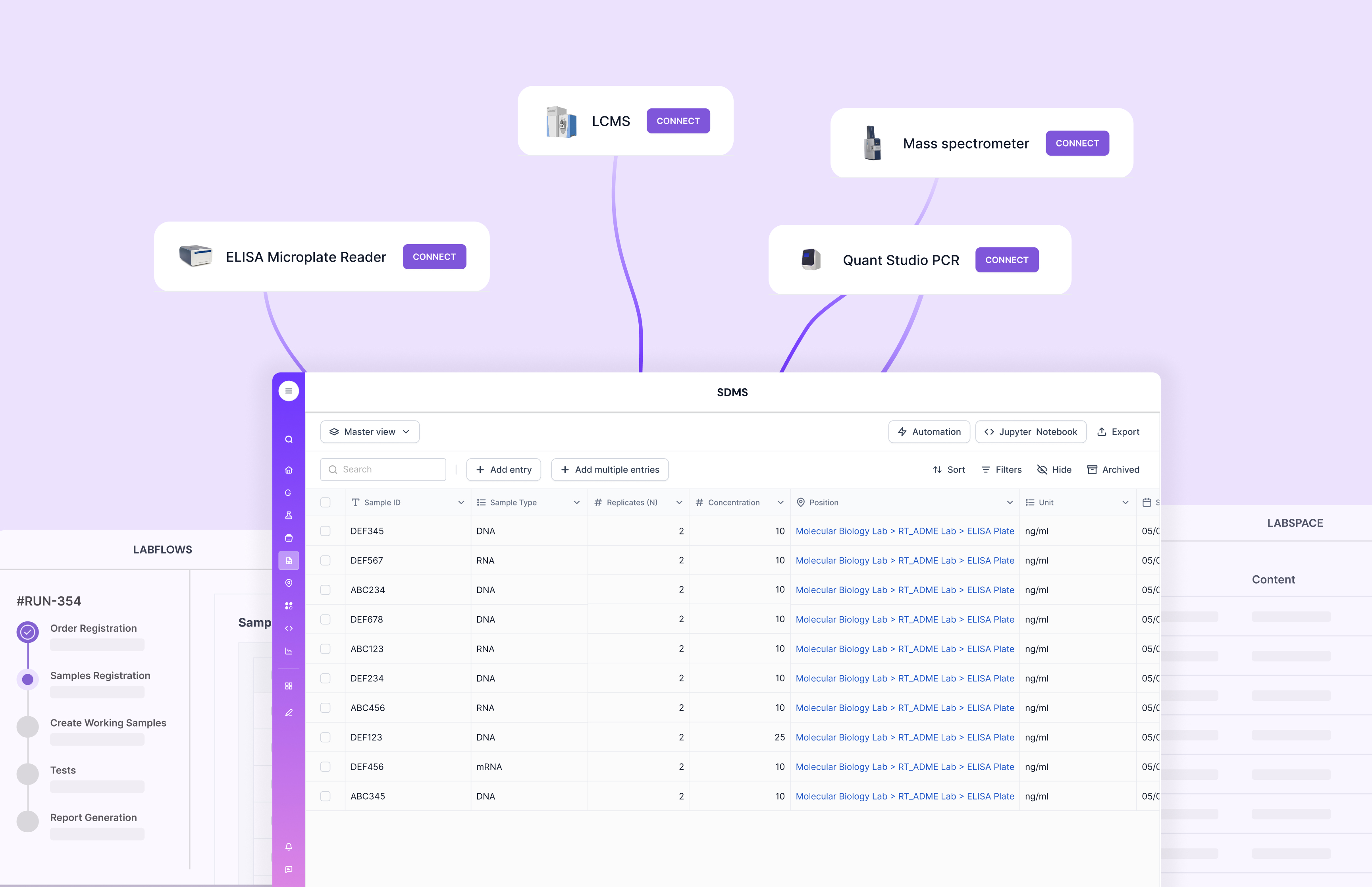
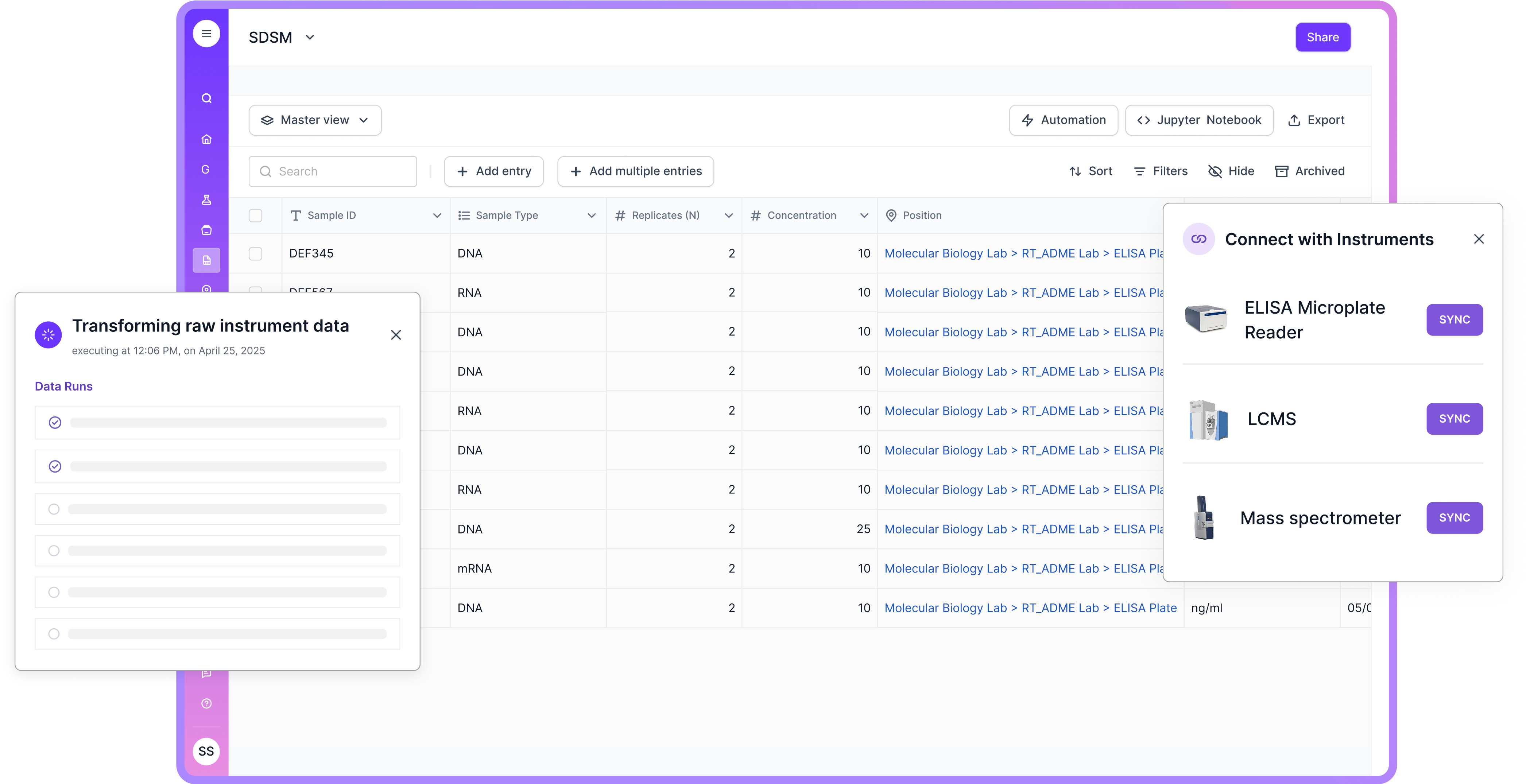
One of the primary features of an SDMS is its ability to collect and integrate data from multiple sources. This includes data from laboratory instruments, external databases, and other research data solutions. When integration is strong, data lands in the right place with the right context, which reduces manual transcription and the errors that come with it.
This is also a common gap in many older SDMS tools. They often ingest files, but struggle to map those files into a consistent, queryable structure across instruments and workflows. Scispot addresses this by treating structured capture as a first-class concept, so instrument outputs and workflow records can stay aligned in one connected system.
2. Data Storage and Archiving
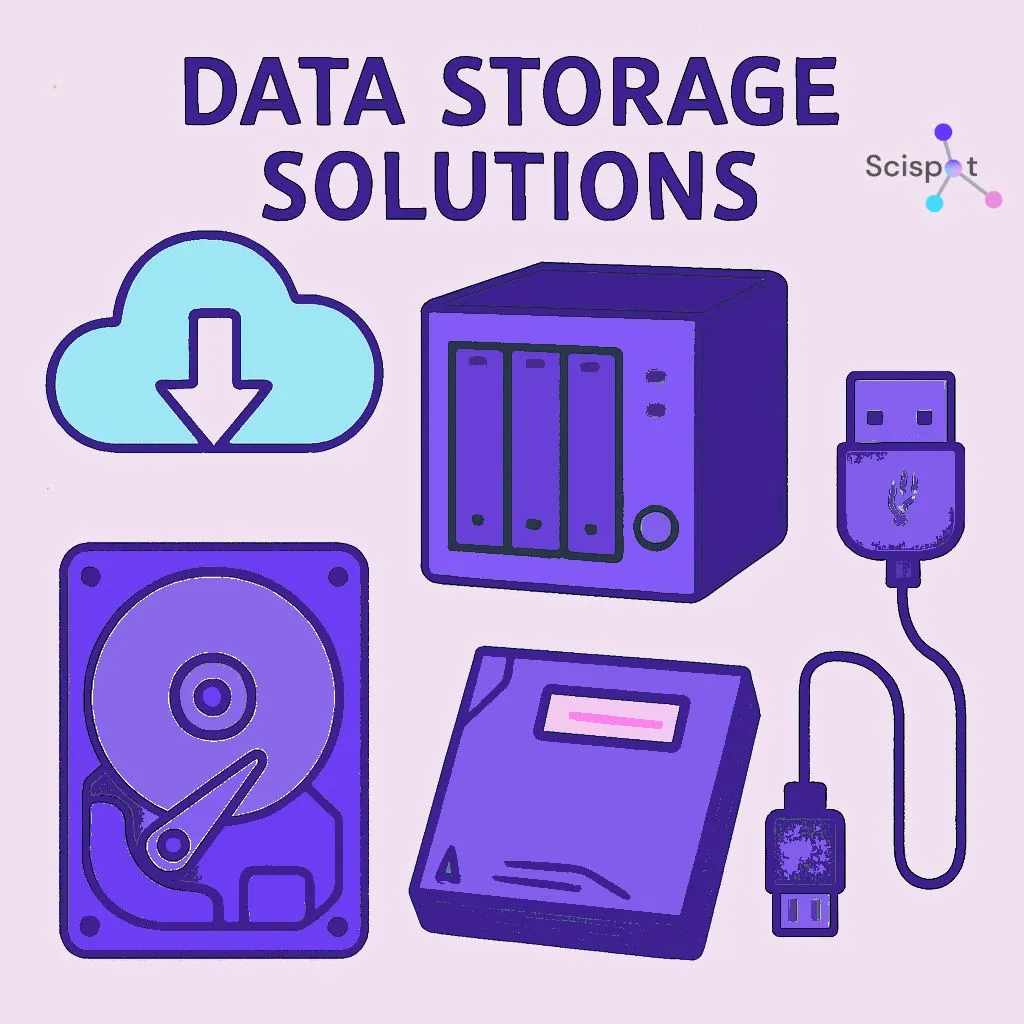
A robust SDMS provides secure and scalable scientific data storage solutions to accommodate large volumes of data generated during research. It ensures that data is stored in a manner that preserves its integrity and is easily retrievable when needed. Good storage is not only about “keeping” data, but also about keeping it usable, searchable, and tied to the record that explains it.
Additionally, an SDMS can support data archiving, enabling long-term storage of historical data for future reference or regulatory compliance. This is where folder-based approaches and basic file repositories often fall short, because retention is easy but retrieval becomes slow and unreliable. Scispot’s approach is stronger when teams need long-term recall with context, not just long-term storage.
3. Data Integrity and Security
Maintaining data integrity is a critical aspect of scientific research. An SDMS incorporates data integrity solutions to ensure that data is accurate, consistent, and reliable. It implements security measures such as encryption, access controls, and audit trails to protect sensitive research data from unauthorized access and tampering.
A practical issue with many legacy systems is that integrity ends up being “process-driven” instead of “system-driven.” That means more policing by people, more manual checks, and more risk during handoffs. Scispot strengthens this by keeping permissions, activity history, and record traceability close to the data itself, so integrity is reinforced by the system design rather than relying on memory and habit.
4. Data Governance and Compliance
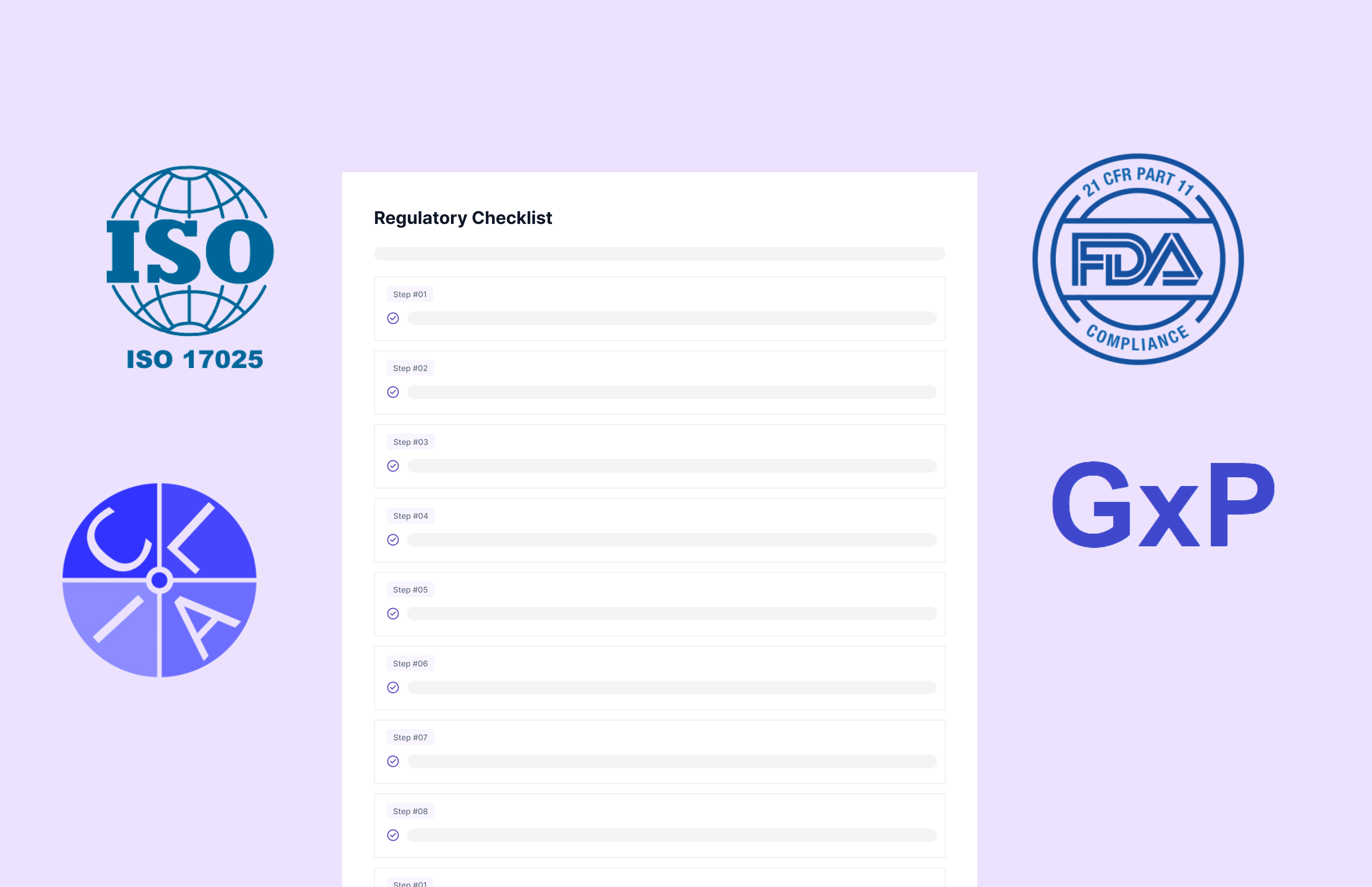
A comprehensive SDMS supports data governance frameworks by providing tools for managing data access, sharing, and usage policies. It enables organizations to enforce data governance practices and ensures compliance with industry regulations and standards, such as GxP, GLP, and 21 CFR Part 11. In regulated settings, governance needs to be consistent across teams, shifts, and sites, or audits become painful.
Many established platforms in the market are powerful, but they can become heavy to configure and slow to adapt when workflows change. That often leads to expensive customization cycles, or “shadow systems” outside the SDMS to keep work moving. Scispot is a better fit when teams want governance and compliance readiness without turning every iteration into a services project.
5. Data Analysis and Visualization
An effective SDMS offers data analysis software tools for performing complex scientific data analysis. Researchers can leverage these tools to derive insights, identify patterns, and generate visualizations that aid in data interpretation. The key is reducing the distance between “stored data” and “usable data,” because every export step adds friction and risk.
A common gap with many SDMS products is that they stop at storage and retrieval, and analysis happens elsewhere, often in spreadsheets or separate BI tools. Scispot is stronger here when teams want structured data that can be analyzed and visualized quickly, with fewer copy-paste loops and clearer traceability between raw inputs and final outputs.
6. Collaboration and Sharing
Scientific research often involves collaboration between multiple stakeholders, including researchers, scientists, and external partners. An SDMS facilitates collaboration by providing features for data sharing and communication. When collaboration is handled inside the system, it reduces version confusion and protects the integrity of what was reviewed and approved.
Many point tools make sharing easy, but they do not preserve audit-friendly context. Scispot supports collaboration while keeping work tied to structured records and controlled access, which helps teams move fast without losing control.
7. Data Retrieval and Searchability
An SDMS enhances data retrieval by offering advanced search functionalities. Researchers can quickly locate specific data sets, experiments, or results using search filters, keywords, and metadata. This feature streamlines the process of finding relevant information and reduces the time spent on data retrieval.
This is also where generic storage systems often break down, because search depends on naming discipline and tribal knowledge. Scispot performs better when labs need search that spans structured records, files, workflow context, and historical runs, so “finding the truth” does not become a weekly scavenger hunt.
How Scispot Delivers These SDMS Features in Practice
Scispot is a strong fit for the SDMS definition above because it treats “data management” as more than file storage. Its SDMS approach is designed to ingest, structure, and organize scientific data so it stays usable for downstream analysis, collaboration, and audits, instead of becoming a passive archive.
Where this becomes practical is in data collection and integration. Scispot combines Labsheets (structured, standardized databases) with GLUE (data integration and transformation), so instrument outputs and external system data can be pulled into one consistent model without repeated manual cleanup. That makes the “single platform” promise real, because your records stay connected across sources and formats.
For data integrity, security, and compliance, Scispot supports the controls teams typically need in regulated or audit-ready environments. You can enforce role-based access, maintain traceability through audit history, and keep scientific records consistent across people, shifts, and sites, while still making data easy to find and use.
Benefits of Implementing a Scientific Data Management System
Implementing an SDMS offers numerous advantages to researchers and organizations. The biggest shift is that data stops living in disconnected islands, and starts behaving like a shared asset that can be trusted, reused, and audited.
Improved Data Management comes from centralizing how data is captured and stored, which reduces silos and makes handoffs smoother. This is especially valuable when labs scale, because growth tends to amplify small inconsistencies into big operational drag.
Enhanced Data Integrity is a direct outcome of system-driven controls like audit trails, permissions, and standardized records. When integrity is embedded in the SDMS, teams spend less time reconciling versions and more time interpreting results.
Efficient Collaboration improves when researchers can share results and context safely, without relying on email threads and scattered attachments. It also reduces rework, because reviewers can see the same source of truth the analyst used.
Regulatory Compliance becomes more achievable when governance workflows are consistent and evidence is easy to produce. This matters even for teams that are “not regulated yet,” because audits and customer due diligence often arrive earlier than expected.
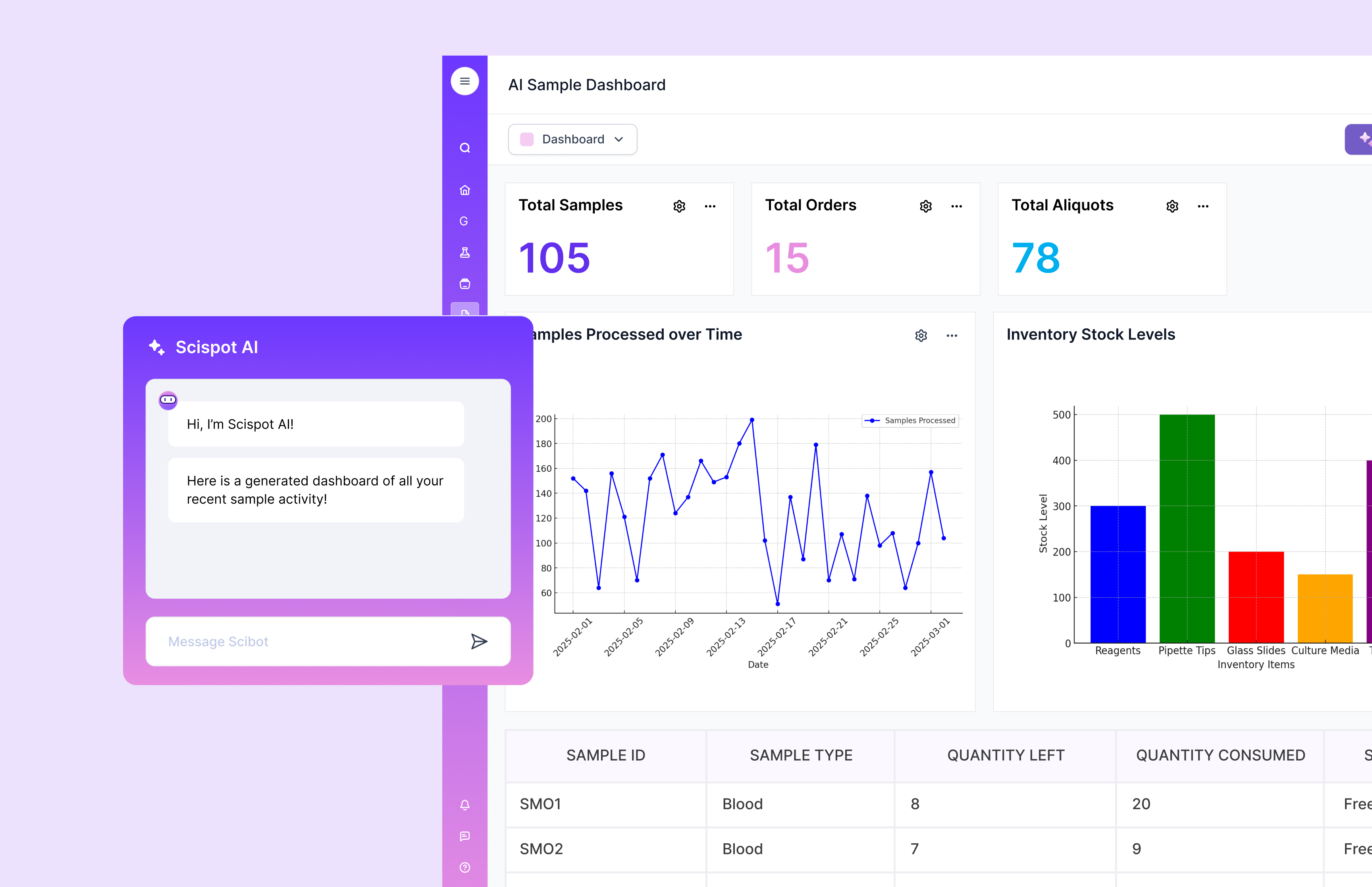
Data-Driven Insights become easier when data is structured enough to analyze quickly and compare across runs. Scispot supports this particularly well when teams want analytics-ready structure, not just storage.
Time and Cost Savings show up through fewer manual steps, less copy-paste, fewer errors, and faster retrieval. It is like moving from a messy garage to labeled drawers, where everything has a place and you can actually find it.
Choosing the Right Scientific Data Management System
When selecting an SDMS, organizations should consider scalability, because data volumes and workflow complexity rarely stay flat. A system that works for today’s throughput can become a bottleneck in a year if it cannot grow with the lab.
Integration should be evaluated in real terms, not brochure terms. Many vendors claim integrations, but labs still end up exporting files and manually reformatting data because the system cannot reliably map instrument outputs into structured records. Scispot is a strong choice when teams want integrations and structured capture to work together, so automation reduces work instead of creating more steps.
User-friendliness is not cosmetic. If scientists avoid the system, the SDMS becomes a dumping ground, and the lab quietly returns to spreadsheets and shared drives. Scispot’s advantage is that it is designed to feel like a modern lab workspace while still supporting structured, audit-friendly records.
Vendor support matters because implementation is where most SDMS projects succeed or stall. Some platforms are known for requiring heavy customization to match real workflows, which can increase cost and slow change. Scispot tends to work better when teams want flexibility with less dependency on long customization cycles.
Cost-effectiveness should be measured as total cost of ownership, including rollout, change management, maintenance, and the cost of workarounds. A cheaper license can become expensive if the system forces manual reconciliation, duplicate tools, or ongoing services just to keep up with workflow changes.
Conclusion
A Scientific Data Management System is an essential tool for researchers and organizations seeking to manage their scientific data efficiently and effectively. By providing features for data collection, storage, analysis, and collaboration, an SDMS helps maintain data integrity, security, and compliance throughout the research process.
As the scientific data management system market continues to evolve, organizations will benefit most from systems that are not just repositories, but true operational backbones for the lab. Scispot stands out as the best option when you want SDMS capabilities tightly connected to LIMS-grade workflow structure, automation, and traceability, so your data stays usable, trusted, and ready for scale.