

TL;DR
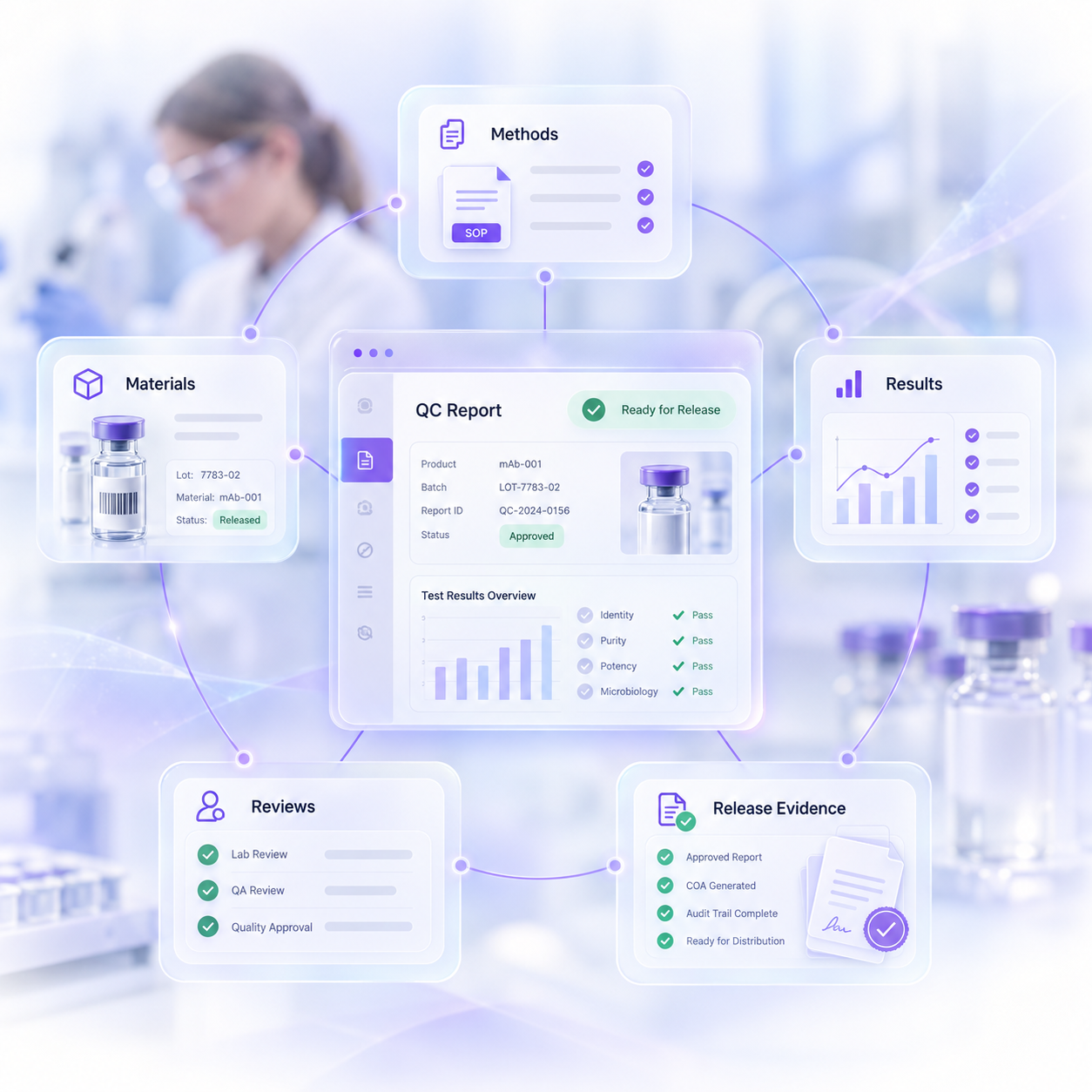
Here is what connected pharma QC reporting should accomplish:
- Link every result to its sample, material, method, instrument, specification, analyst, and source data.
- Route exceptions, reviews, approvals, and release evidence through controlled workflows.
- Reduce transcription and reconciliation by integrating instruments, LIMS, and quality systems.
- Preserve complete records that Quality can retrieve and assess before batch disposition.
Pharmaceutical QC reporting is not simply the last step after testing; it is the controlled evidence chain that supports a quality decision.
A report may show that a batch passed, but reviewers also need the underlying methods, raw data, calculations, deviations, and approvals. FDA regulations require laboratory records to contain complete data from tests used to demonstrate compliance, while production and control records must be reviewed and approved by the quality control unit before release. Connected reporting keeps that evidence traceable instead of leaving Quality to reconstruct it across instruments, spreadsheets, email, and separate applications.
What Is Pharma QC Reporting Software?
Pharma QC reporting software organizes testing information and moves it through controlled review, approval, and reporting workflows.
It is software used to collect, contextualize, review, approve, and report pharmaceutical quality-control data. Rather than producing an isolated PDF, it maintains relationships among samples, specifications, methods, instrument outputs, calculations, exceptions, and authorized decisions.
How QC reporting supports batch release decisions
QC reporting presents whether tested materials or products conform to approved specifications and whether exceptions were investigated. FDA's Q7 guidance states that critical laboratory control records should be reviewed and approved by the quality unit before API release, including relevant deviation, investigation, and out-of-specification records.
QC reports vs controlled quality records
A QC report summarizes results and status. Controlled quality records include the broader evidence behind that summary: raw data, metadata, worksheets, method versions, audit trails, calculations, signatures, investigations, and approval history. FDA explicitly identifies notebooks, worksheets, graphs, spectra, and instrument data as part of complete laboratory data.
Who benefits from connected QC reporting workflows
Analysts gain less repetitive entry, reviewers receive better context, and Quality obtains a clearer release package. Laboratory managers, validation teams, manufacturing, regulatory affairs, and auditors also benefit from faster access to consistent evidence.
Why QC Reporting Is Challenging in Pharmaceutical Laboratories
Reporting becomes difficult when each stage of testing creates another disconnected record or manual handoff.
Methods, materials, and results stored across multiple systems
Methods may reside in document control, material and sample records in LIMS, raw files in instrument software, and investigations in QMS. Without reliable identifiers and integrations, reviewers must manually prove that the records belong to the same test and batch.
Limited visibility into supporting QC evidence
A result copied into a spreadsheet or report can lose its connection to chromatograms, metadata, calculations, or the method version used. FDA inspection guidance directs investigators to compare original laboratory data with summary data and confirm that raw files support complete and accurate reporting.
Manual handoffs between testing, review, and reporting
Exports, re-entry, email attachments, and spreadsheet calculations introduce opportunities for transcription errors, version confusion, and delayed review. LIMS integration can instead move data between instruments and applications while maintaining structured transfer and verification rules.
Maintaining pharmaceutical data integrity across the workflow
Data integrity means maintaining complete, consistent, and accurate records throughout their lifecycle. Controls must cover collection, processing, review, decision-making, storage, and retrieval - not only the final approved report.

Key Components of Pharma QC Reporting
An effective system combines traceability, integration, controlled decisions, and evidence-rich outputs.
Method, material, and sample traceability
Each result should resolve to a unique sample and material lot, the applicable specification and method version, instrument, analyst, timestamps, and associated batch. Stable identifiers and controlled relationships make the test history reconstructable.
Quality control LIMS integration and data management
A pharmaceutical QC LIMS centralizes sample and batch tracking, while instrument connectivity imports results with less manual handling. Scispot describes support for QC instruments such as HPLC, GC-MS, and ICP-MS, along with centralized data capture and batch-specific documentation.
Review, approval, and release workflows
Configured workflows should define who may enter, verify, review, approve, reject, reopen, or release a record. Exceptions should route to the correct reviewer, and electronic approvals should remain associated with the relevant record version and decision.
Controlled reports linked to supporting evidence
Certificates of Analysis and QC summaries should point back to approved results and supporting records rather than duplicate uncontrolled values. Version history, status, permissions, and audit trails help preserve the relationship after release.

Best Practices for Managing QC Laboratory Reporting
The objective is to make the correct process easier to follow and the complete evidence package easier to review.
Maintaining pharmaceutical data integrity from testing to reporting
Document activities when performed, retain original records or true copies, restrict unauthorized changes, and preserve relevant metadata. Apply these controls to paper and electronic records based on workflow and data-integrity risk.
Connecting results to methods, instruments, and materials
Use persistent identifiers and required relationships for samples, lots, methods, specifications, instruments, runs, and results. Avoid allowing report generation when required context or evidence is missing.
Standardizing QC review and approval processes
Define review checklists, acceptance criteria, exception paths, segregation of duties, and signature meaning. Validate configured calculations, integrations, approval logic, and generated reports for their intended regulated use.
Preserving audit-ready release documentation
Retain raw data, processing history, calculations, result versions, deviations, investigations, approvals, and the released output as one navigable chain. This enables Quality to assess the full record before disposition and respond more efficiently during inspection.

How Scispot Helps Modernize Pharma QC Reporting
Scispot brings laboratory execution, quality controls, integrations, and reporting into a connected operating environment.
Connecting QC workflows across LIMS, quality, and reporting systems
Scispot combines configurable LIMS workflows with QMS capabilities for document control, change control, approvals, audit trails, and electronic signatures. Its API-first approach can connect instruments and existing laboratory applications.
Linking methods, materials, samples, and results
Structured Labsheets and sample-centric workflows can maintain relationships among material lots, samples, methods, instruments, and results. Scispot GLUE integrations move data across connected tools to reduce re-entry and preserve context.
Supporting controlled reviews, approvals, and release processes
Configurable roles, review gates, audit trails, electronic signatures, deviation alerts, and automated CoA generation support controlled QC processes. Compliance still depends on each laboratory's validated configuration, procedures, training, and quality oversight.
Providing traceable, audit-ready QC reporting records
Scispot can connect sample history, instrument data, result records, approvals, and report outputs, giving reviewers a more complete evidence trail. This helps reduce the gap between a reported value and the work that produced it.


%20Comprehensive%20Guide.avif)
.webp)