Your Lab Is Not Scaling. It Is Hiring People to Move Files.
More headcount will not fix a lab built on spreadsheets, manual handoffs, and disconnected systems.
Hiring scientists, analysts, and reviewers is often necessary as a lab grows. But if each increase in sample volume requires the same increase in people to download files, update trackers, reconcile data, follow up on reviews, and rebuild reports, the lab has added capacity. It has not built a scalable operating model.
Real scalability means throughput can grow faster than the manual work around each sample.
Some work will always rise with volume. Samples still need preparation. Instruments still need operators. Exceptions still need expert review. The problem starts when highly trained people spend much of their day moving data between systems that cannot carry the right context on their own.
The workflow may look digital, but it is still manual
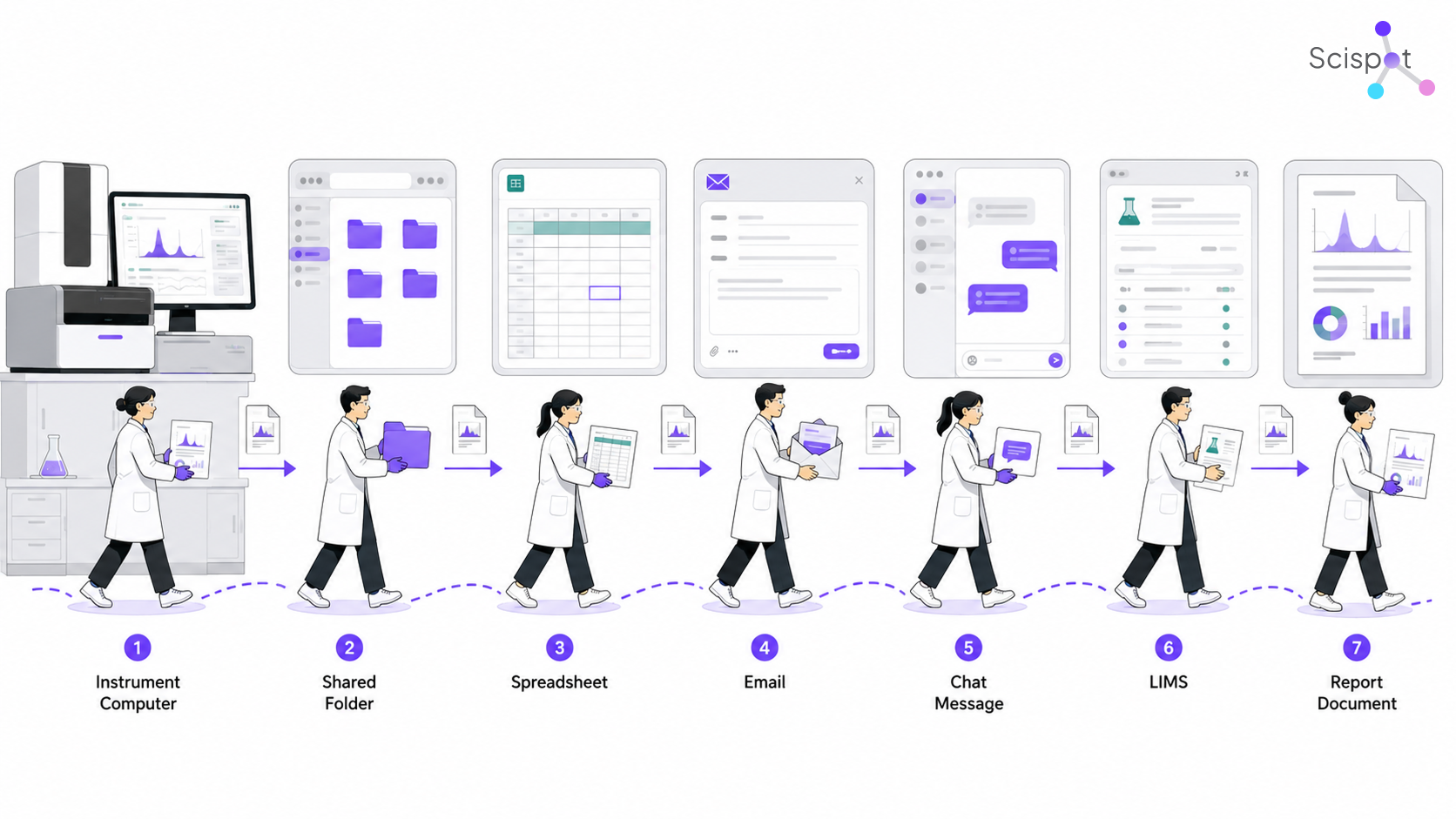
Consider what happens after an instrument run.
An analyst downloads the output, renames the file, and puts it in the right folder. They open a spreadsheet, paste in results, match sample IDs, and confirm the method used. They may need to check reagent information, instrument status, controls, calculations, and previous records before the result can move forward.
Then the review process begins. Someone updates a tracker, sends a message, follows up with a reviewer, and waits for approval. Once approved, the same data may be copied into another spreadsheet or document to create a client report.
A single result can move through instrument software, shared folders, spreadsheets, email, chat, an ELN, a LIMS, and reporting templates before it reaches the final recipient.
Each step may seem small. Across hundreds or thousands of samples, those small tasks become a major part of how the lab operates.
The lab may have digital tools, but its real integration layer is often still a person copying, checking, chasing, and reconciling information.
Manual data movement creates cost and risk
Manual work is not always wrong. Scientists and quality teams need to review data, investigate exceptions, and make decisions that require expertise.
But repeated data movement creates avoidable risk. Every export, upload, copy, rename, status update, and reconciliation introduces another chance to use the wrong file, select the wrong row, apply the wrong calculation, or attach a result to the wrong sample.
At low volume, experienced team members may catch many of these issues through careful work and familiarity with the process. As volume grows, however, the number of handoffs grows too.
A workflow that depends on one person remembering which spreadsheet is current, where the source file lives, or which reviewer owns a method is fragile. The process may work today, but it becomes harder to manage, train, review, and audit as the lab grows.
Hiring more analysts does not remove the work
When volume rises, the obvious response is to hire another analyst.
That person may increase output, but they often enter the same fragmented workflow. They still download files, reconcile sample IDs, update spreadsheets, follow up on approvals, and rebuild reports.
The lab has not removed the work. It has added another person to perform it.
This can look like scale because more samples move through the lab. But the cost and coordination required for each new sample remain closely tied to manual effort.
A scalable workflow creates leverage. Sample volume should be able to increase without coordination time, review delays, and manual data handling increasing at the same rate.
Fragmented workflows also make training harder. New team members must learn the scientific method, but they may also need to learn unofficial folder structures, naming rules, reporting preferences, spreadsheet logic, and workarounds that exist only in people’s memory.
As the team grows, so do the files, versions, messages, and handoffs.
Fragmentation can become a data integrity problem
Manual handoffs do more than slow down the lab. They can separate a result from the context needed to trust it.
A final number is more useful when it stays connected to the sample, method version, source file, instrument, calculation, quality checks, reviewer, exception history, and approval status.
When that context is spread across folders, spreadsheets, messages, and separate systems, it becomes harder to confirm that the record is complete and that the final decision is supported by the right evidence.
A shared folder is not a data strategy. A spreadsheet is not an integration layer. A person remembering where everything lives is not a control.
Labs need workflows that make it easier to trace how a result moved from sample to final report.
Real scale comes from fewer manual touches
The strongest sign of scalability is not the number of systems a lab has purchased. It is the amount of repetitive work the lab has removed.
In a lab workflow, a manual touch can include:
- Downloading and renaming an instrument file
- Uploading data into another system
- Copying values between spreadsheets
- Updating sample status by hand
- Reconciling records across tools
- Chasing reviewers for approvals
- Rebuilding approved data into a report
Each task may take only a few minutes. Across thousands of samples, the time adds up. So do the delays, rework, and opportunities for error.
The goal is not to ask people to work faster. It is to design workflows that remove unnecessary coordination work in the first place.
Automate data movement, not scientific judgment
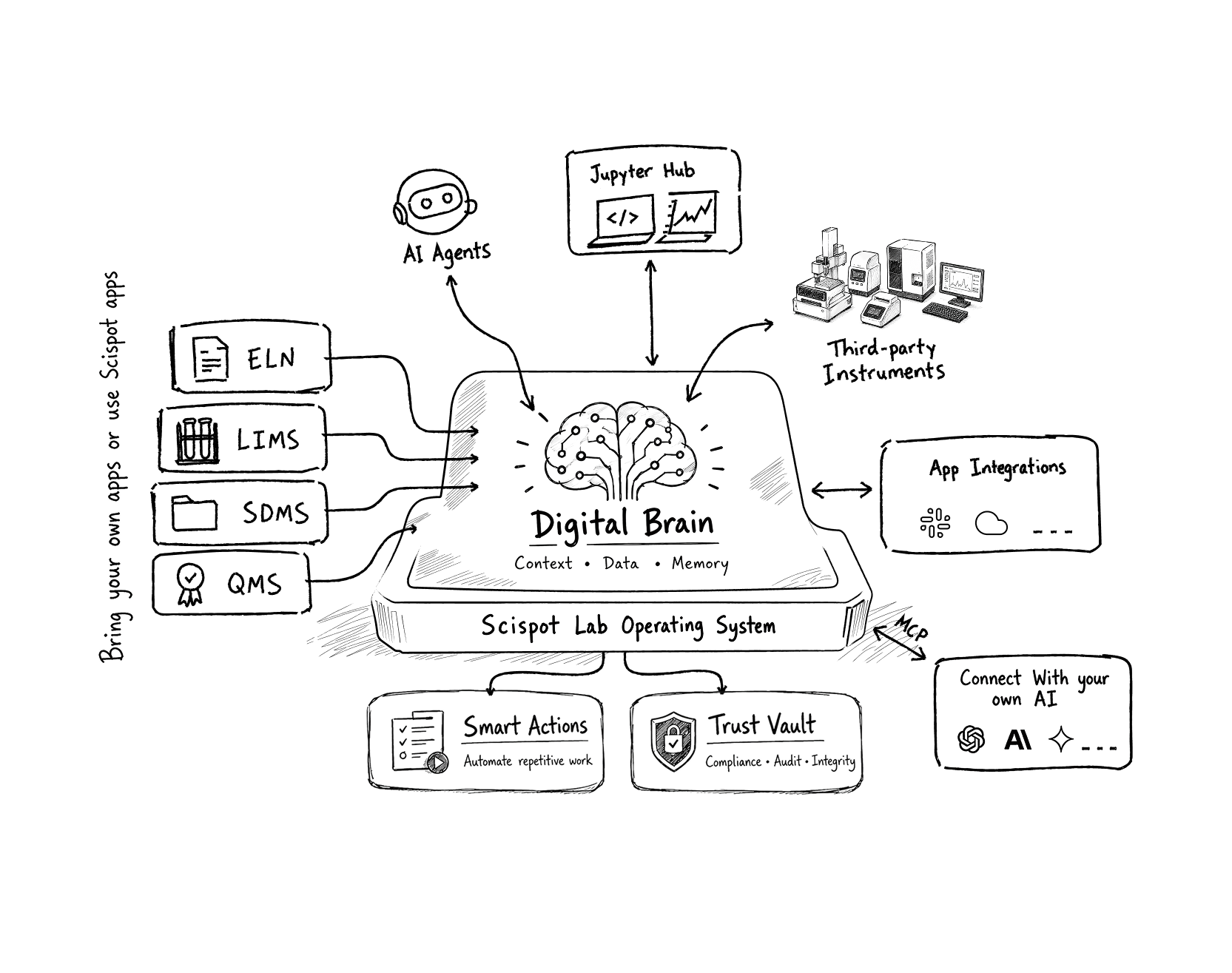
Laboratory workflow automation should not remove scientists from the process.
Scientific judgment should stay with scientists. Quality decisions should stay with qualified reviewers. Regulated approvals should remain with the people accountable for them.
The work that can be reduced is the digital labour around those decisions.
Instrument data can move into the right workflow without someone downloading and renaming every file. Source data can remain linked to the sample, method, instrument, and run. Controlled calculations can use approved logic rather than being recreated in separate spreadsheets.
Quality checks can help confirm that required fields are complete, controls have been reviewed, and the appropriate method version was used. Routine work can follow a defined review path, while exceptions can go to the right person.
Once a result is approved, reports can be generated from approved data rather than rebuilt manually.
People remain in control. They simply spend less time acting as couriers between systems.
Start with the process
Automation will not fix a process that has not been defined.
If sample identifiers are inconsistent, automation can move inconsistent identifiers faster. If calculation ownership is unclear, new software will not resolve the confusion. If approval rules are missing, automated routing may send work to the wrong person.
Before automating, labs should define:
- The source of truth for each part of the workflow
- Which steps need scientific or quality judgment
- Which rules can be standardized
- Which records and relationships need to remain connected
- How exceptions should be handled and reviewed
Then automation can be applied to repeatable steps with clear inputs, outputs, owners, and exception paths.
The goal is not simply to replace one spreadsheet with another screen. The goal is a connected workflow where the meaning and status of the work move with the data.
Ask what would break first
A useful question for any lab leadership team is simple: what would break first if sample volume doubled tomorrow?
Would analysts become the bottleneck because every run creates more files to process? Would review queues grow? Would spreadsheet versions multiply? Would reports take longer? Would quality teams spend more time tracing what happened? Would one experienced employee become the only person who knows how to assemble the final output?
The answers show whether the lab has a staffing problem or an operating-model problem.
Hiring may still be part of the answer. Growing labs need scientists, analysts, reviewers, and operators. But hiring into a fragmented workflow only makes that workflow larger.
A better measure of scalability is to compare volume growth with manual touches per sample, coordination time, review waiting time, rework, reporting time, and throughput per employee.
If volume grows while those burdens rise much more slowly, the lab is creating leverage. If every new sample creates the same amount of manual work, the lab is still scaling through headcount.
More people should mean more science
The goal is not a lab with fewer scientists. It is a lab where each scientist can do more science.
New hires should expand scientific capability, improve methods, investigate difficult exceptions, strengthen quality, and deliver better outcomes. They should not be hired mainly because the lab has created more files to rename, spreadsheets to update, reviewers to chase, and reports to rebuild.
Scispot helps labs build a connected operating layer across samples, instruments, methods, source data, calculations, quality checks, approvals, and reports. The goal is to reduce the coordination gap between the systems, people, and data that already run the lab.
More headcount can help a strong lab grow. It cannot fix a fragmented workflow.
Before hiring another person to move files, ask which parts of the workflow should no longer require a person at all.
Build the Digital Brain of your lab with Scispot.

%20Comprehensive%20Guide.avif)
.webp)