

The question used to be: "Do we need an ELN or a LIMS?" For teams that run on Python, Jupyter, and ML pipelines, the question has shifted. They ask: "Can our lab platform talk to our data stack? Can we query samples and experiments without leaving the tools we actually use?" The gap is real. Many lab systems were built for paper trails and forms, not for computational biologists who think in dataframes and APIs.
At Scispot we talk to a lot of AI-native biotechs - teams where discovery is driven by models, high-throughput screens, and integrated wet-dry workflows. They are not looking for another form-filling system. They are looking for a lab operating system that fits how they already work: API-first, scriptable, and ready for the next wave of AI tools. Here is what we hear when they choose a platform, and how we built for that.
The pain: lab data stuck outside the data stack
Computational biologists and discovery scientists live in a different toolchain than the one most legacy lab software assumes. They run analyses in Jupyter or RStudio. They version code in Git. They train models on data that often started in a freezer, a plate, or an instrument - but by the time it reaches the data lake or the notebook, it has been exported, re-typed, or copied from some other system. The sample ID that ties a wet-lab result to a computational run might live in a spreadsheet, an ELN, or a LIMS - and none of them speak the same language as the rest of the stack.
So scientists spend time on glue work: exporting sample lists, reconciling IDs, copying metadata into scripts, or building one-off integrations that break when the lab changes a process. The real work - building models, interpreting experiments, iterating on assays - gets delayed. And when the organization wants to add AI search, automated QC, or LLM-assisted documentation, the same problem shows up again: the lab system was not designed to be a first-class data source. It was designed to be a record-keeping system. For AI-native teams, that distinction matters.
What computational and AI-first teams actually want
When we ask computational biologists and discovery leads what they need from lab software, a few themes come up every time.
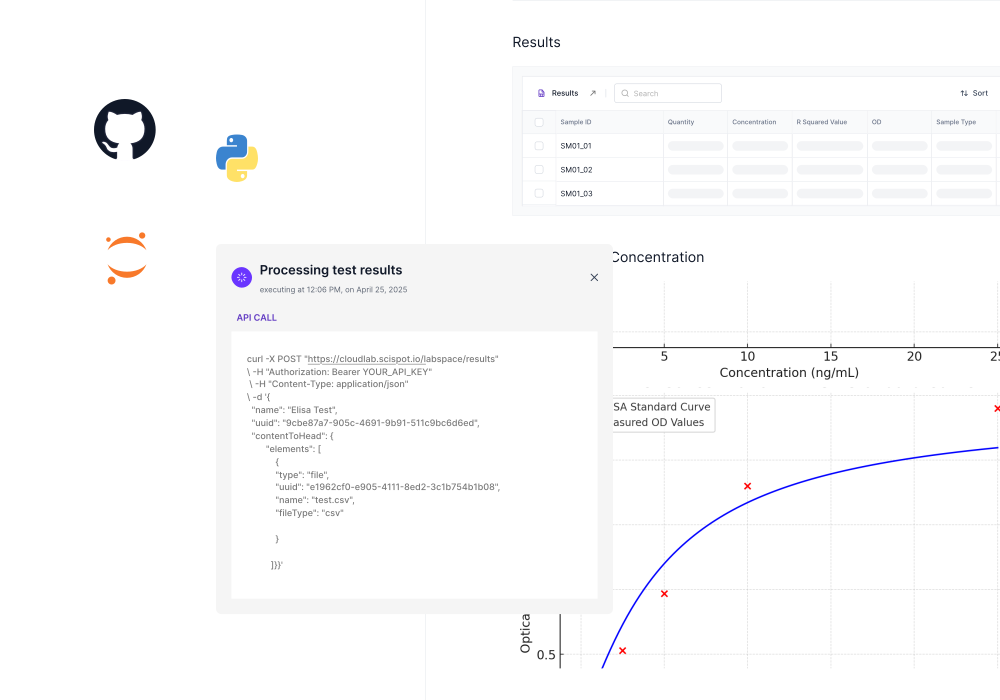
APIs by default. Every entity - samples, experiments, protocols, plates, storage locations - should be addressable via a stable API. Not a "we have an API" checkbox, but a platform where the UI and every integration use the same API. That way, scripts, pipelines, and AI tools can read and write lab data without custom middleware or export-import hacks.
Structured data that stays linked. Samples link to experiments; experiments link to protocols and results. When you query by sample ID or batch, you get the full graph - not a flat export. That structure is what makes traceability real and what makes it possible for downstream tools (including AI) to reason about context.
Familiar interfaces for day-to-day work. Bench scientists still need to log work quickly. A spreadsheet-like grid (like Labsheets) that can be configured without code reduces friction. But that grid should be the same data that the API exposes - one source of truth, whether you access it from the UI, a script, or an AI assistant.
Room for AI and automation. Teams want to plug in Jupyter, R, or the next AI tool without rebuilding the lab stack. That means APIs, webhooks, and - increasingly - protocols like MCP so that assistants like Claude can operate on lab data inside the same compliant workspace. The goal is not to replace scientists with AI; it is to let AI handle repetitive lookups and updates so scientists focus on interpretation and design.

Why we built Scispot API-first and AI-ready
Scispot was designed from the start to be a single source of truth that both wet-lab and computational teams could use. That meant a few non-negotiables.
One platform, one API. Labsheets, ELN, manifests, storage, and Labflow are all part of the same data model. When you call the API, you are not talking to a separate "integration layer" - you are talking to the same backend the UI uses. Permissions, audit trails, and data consistency are shared. There is no sync job that might lag or diverge.
Structured, linkable records. Every row in a Labsheet can be linked to an experiment, a protocol, or a storage location. That linkage is first-class: the API returns it, and downstream tools can follow it. So when a computational biologist pulls "all experiments that used batch X," they get real relationships, not a denormalized dump.
AI that operates inside the system. We added an MCP server so that tools like Claude can list labsheets, search rows, update experiments, and resolve manifests - all through the same API, with the same audit trail. The AI never takes a copy of your data out of Scispot. It acts inside the workspace. That is what AI-native teams have been asking for: speed without compliance trade-offs.
What to look for when you evaluate
If you are an AI-native biotech or a team with a heavy computational footprint, here is a short checklist when you evaluate lab software.

We built Scispot so that the answers to those questions are yes. Our platform is documented for developers; our MCP server is live with 27 tools; and we see teams start with Labsheets or ELN and then wire in scripts and AI without replatforming.
Proof: what is live today
For teams that want to see concrete proof:
AI-native biotechs do not have to choose between "lab software that checks the compliance box" and "a data stack that actually fits how we work." The right lab platform is the one that is both: API-first, structured, and ready for the next wave of AI tools. That is how we think about it at Scispot - and that is what we built for.
If you are evaluating lab software and your team runs on Python, Jupyter, or AI-assisted workflows, we would be happy to show you how the API and MCP server fit into your stack. Reach out or try the platform and see if it matches how you want to work.
%20Comprehensive%20Guide.avif)
.webp)