

.webp)
How does clinical diagnostics impact patient treatment?
You’ve sat on that crinkly paper-covered chair, watched a nurse fill a small vial with your blood, and then waited. What happens to that tiny tube once it disappears behind the lab doors? For many patients, the whole process feels like a black box, and they are left on the outside of it.
Clinical diagnostics is not a simple pass-or-fail check. It is one of the main tools doctors use to guide care. According to sources like the CDC, about 70 percent of medical decisions rely on lab results. These tests give doctors real evidence, so they are not working off symptoms and guesswork alone.
Finding a problem early can change the course of treatment. Routine testing can catch signs of trouble long before they turn into a crisis. When you understand how this system works, you stop feeling like a bystander and start taking a more active role in your care.

The Difference Between Searching and Finding: Why Screening and Diagnostic Tests Are Not the Same
When you walk into a clinic feeling fine, your doctor may still look for signs of a problem before you notice anything yourself. That is the point of screening. These routine checks scan healthy people for early warning signs, much like a smoke detector keeps watch in the background. When disease is found in this quiet stage, it is often easier to treat.
If that detector goes off, the next step is to find the source. That is the difference between screening and diagnostic tests. Screening looks for possible trouble. Diagnostic testing works out what is actually going on.
Here is how they compare:
Screening: Common screening tests for adults include mammograms and colonoscopies. They cast a wide net to catch early signs in healthy groups.
Diagnostic: If a screening result is abnormal, doctors order more focused tests, such as a tissue biopsy or specialized blood work, to identify the specific condition.
An abnormal screening result can feel scary, but it is not a final answer. It is more like a car’s check engine light. It tells your care team where to look next. After that, follow-up testing begins, and your sample moves through the system to find a clearer answer.

The Life of a Sample: Opening the 'Black Box' of Laboratory Analysis
The path to a reliable result starts before you even get to the clinic. Simple prep steps matter. You may need to fast, skip coffee, or drink more water before a blood draw. Experts note that specimen collection affects accuracy, and even one cup of black coffee can shift your baseline. That can affect specimen integrity, which means the sample stays as true to your body as possible.
Once the sample is collected, time matters. The lab has to protect it from heat, cold, and delay so the cells do not break down. Think of it like groceries in a car. Leave them out too long, and the quality drops. The same thing can happen to a sample.
Inside the lab, machines handle much of the testing. To prevent mix-ups, many labs use a clinical diagnostics LIMS, or Laboratory Information Management System. It works like a digital tracking system for each barcoded vial. Every movement is logged, which helps cut down human error.
At the end of that process, the sample becomes data. That data goes back to your doctor, who uses it to make care decisions. Once the sample completes its trip, the next step is to make sense of the numbers.
.webp)
Scispot’s Role in Faster, More Reliable Clinical Diagnostics
Scispot is a strong digital solution for clinical diagnostics because it helps labs move test results into action faster, with fewer errors and more consistency, which directly affects patient treatment. It brings sample intake, barcode-based tracking, workflow automation, instrument data, quality checks, and reporting into one system. That helps reduce delays, cut manual mistakes, and give care teams a clearer path from specimen to decision.
That matters in real clinical settings, where a missed handoff, a slow report, or disconnected data can delay the right treatment. With Scispot, diagnostic labs can build a more traceable and efficient process, so clinicians get dependable answers sooner and patients get care with more speed, confidence, and precision.
Cracking the Code: What 'Normal' Reference Ranges and Biomarkers Actually Mean
Logging into a patient portal can feel like walking into a wall of numbers. To make sense of lab results, it helps to understand biomarkers. A biomarker is a clue. It is a measured sign, like cholesterol or blood glucose, that gives your doctor a better sense of what may be happening in your body. On its own, it rarely tells the full story.
When a result is marked with a bold red “H” for High, it is easy to panic. But reference ranges are not hard lines between healthy and sick. They are based on averages across groups of healthy people. Stress, mild dehydration, or normal body variation can push a number a little outside that range without meaning disease is present. Labs also use different machines, so the same person can get slightly different results in different places.

Instead of letting one flagged number cause worry, use it as a starting point for a better conversation with your doctor. If a result is out of range, ask:
- Is this a small change or something more serious?
- Do my symptoms line up with this result?
- Should we repeat the test to see if this is just my normal baseline?
How fast you need an answer often shapes which kind of test gets used.
Speed vs. Precision: Choosing Between Point-of-Care and Full Lab Analysis
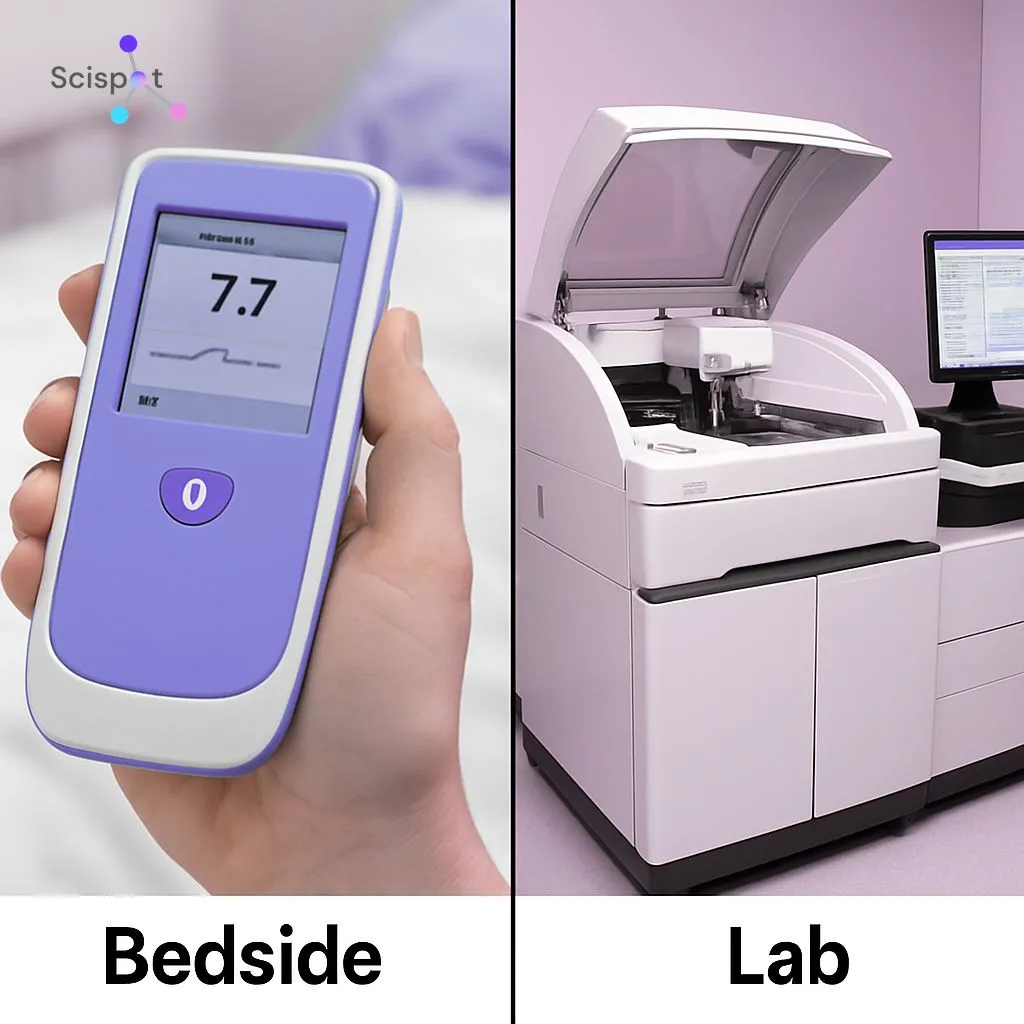
When you are sitting in a clinic with a high fever, waiting days for results may not work. In those cases, doctors often use Point-of-Care Testing, or POCT. These are fast tools, like a rapid strep swab, that can give results in minutes at the bedside. They are useful for quick decisions, though they may give up a bit of precision for speed.
This tradeoff comes down to sensitivity and specificity. Sensitivity is like a very jumpy car alarm. It catches every possible thief, but it may also go off when a truck drives by. Specificity is what keeps that alarm from going off unless there is a real break-in. Rapid tests often aim to catch problems quickly, but they may not be specific enough to rule out every false alarm.
That is why a positive rapid test often needs confirmation in a central lab, where the sample can go through more complete processing. When people compare point-of-care testing with full lab analysis, the central lab is still the final word in many cases. Still, the balance between speed and accuracy is a big part of modern care.
The Genetic Advantage: How Personalized Testing Removes the Medical Guesswork
Have you ever gotten a prescription and heard, “Let’s see if this works”? For a long time, picking the right medication often came down to trial and error. Today, genetic testing gives doctors a better way. Because your DNA works like your body’s instruction manual, these tests can show how you may respond to certain drugs before you take them.
This is part of a broader shift in medicine. Major health systems are adopting newer testing methods that can catch disease earlier and help reduce diagnostic mistakes. Three examples stand out:
Pharmacogenomics: This uses your genetic profile to help identify the drug and dose your body is more likely to handle well.
Liquid Biopsies: This blood test looks for tiny traces of tumor DNA, which can help detect cancer without surgical tissue removal.
AI-Assisted Pathology: Artificial intelligence acts as a second set of eyes, helping lab teams spot cell changes that may be hard to catch.
As these tools become more common, lab results are no longer something only scientists can talk about. Knowing how your own biology shapes care helps you ask better questions and make better decisions.

Your Results, Your Rights: How to Become an Active Partner in Your Diagnostic Journey
Medical testing does not have to feel like a black box. Once you know how samples are collected, handled, and analyzed, the process becomes easier to follow. You gain the words to ask better questions, and the confidence to understand the answers.
A simple checklist can help at your next appointment:
Prepare: Ask whether you need to fast or do anything else before the test.
Engage: Ask what each test is meant to find.
Review: Request a copy of your results and ask your doctor to explain any flagged numbers.
When you pair that with a standard guide to preventive screenings, it becomes easier to know which tests you may need at different stages of life. You are not just waiting for a portal alert anymore. You are taking part in your own care, with a clearer view of what these results mean and what to do next.