

.webp)
What is bioanalytical assay development?
When you swallow a pill for a headache, how do scientists know the medicine reached your brain and did not just disappear? Drug safety regulators require proof of how a drug moves through the body. That work depends on bioanalytical assay development. This field focuses on bioanalysis, the science of finding and measuring tiny amounts of medicine in living systems with precise analytical methods.
Finding that medicine is like looking for one grain of red sand in a swimming pool full of white sand. The body is a messy place, packed with proteins, cells, and other natural material. Scientists call this crowded biological mix the “matrix,” usually blood or saliva. The drug they want to find is the “analyte.”
Each drug has its own chemistry, so researchers cannot use one generic tool for all of them. To create pharmacokinetic assays, the tests used to track how long a drug stays in the body, they have to build a custom method for each new treatment.

Designing the perfect molecular ruler: how custom bioanalytical methods measure what we can’t see
When a new drug enters the bloodstream, scientists cannot buy a ready-made test to track it. Every drug molecule has its own shape, so researchers build a custom tool for each one. That process is assay development. In simple terms, it is writing a recipe for a molecular ruler.
Building these methods from scratch has three main parts:
- Choose the tool. Design the right ruler for the drug.
- Test the tool. Prove it gives the right reading each time.
- Clean the sample. Strip away enough of the body’s natural clutter to make the drug visible.
The last part is often the hardest. Human blood is crowded with proteins, fats, and cells. To find a drug in that mix, scientists use advanced sample prep methods. It is like filtering the pulp out of a huge vat of orange juice to spot one tiny apple seed at the bottom.
Once the sample is clean, scientists run quantitative analysis. That tells them exactly how much drug is in the body. Even then, they still need to know the test is measuring the right thing and not some stray bit of background material. That is where selectivity and specificity come in.
The security badge for your bloodstream: why selectivity and specificity matter
Think of blood as a crowded office building. To find one drug molecule inside it, scientists need a custom security badge. That badge has to do two things well. It needs selectivity, which means it picks out the right target. It also needs specificity, which means it ignores everything else. In complex matrices like blood, that is what keeps a test focused on the drug instead of vitamins, food byproducts, or something else in the sample.
Without that control, tests can get fooled. If an assay flags the wrong molecule, researchers run into cross-reactivity in immunoassays. That is a case of mistaken identity. To stop that, scientists test their methods against common impostors such as:
- Similar proteins already in the body
- Food-related material left over from recent meals
- Other drugs in the system
Even if the test is specific, the rest of the sample can still interfere with the signal. In mass spectrometry, matrix effects can hide the real amount of drug in the sample. Reducing those effects helps keep the measurement accurate. Once the test can ignore enough background noise, the next problem is sensitivity.
Finding a grain of sand in a swimming pool: how scientists handle assay sensitivity and quantitation
Picture a packed stadium. One person is whispering your name. That is what assay sensitivity looks like. The bloodstream is the noisy stadium. The drug molecule is the whisper. To hear it, scientists work on the signal-to-noise ratio in bioanalysis. They try to boost the drug signal and cut down the background noise from the sample.
Every test has a lower limit. In bioanalysis, that is often the Lower Limit of Quantitation, or LLOQ. Setting the LLOQ means finding the faintest signal the method can still measure with confidence. Below that point, the machine may detect something, but it cannot promise the result is real or accurate enough to trust.
This matters because doctors need to know when drug levels rise, fall, and finally clear the body. If the assay can track those last tiny traces, doctors can better judge when the next dose is safe. But lab accuracy does not depend on the instrument alone. It also depends on what happens to the sample before it gets there.
The stress test for medicine: why ICH M10 guidelines and stability testing matter
Building a good test in a clean lab is only part of the job. Scientists also have to prove that it still works under real-world conditions. That proof step is called validation. To keep standards consistent, labs follow the ICH M10 bioanalytical method validation guidelines. Those guidelines help make sure a drug tested in Tokyo is judged by the same standard as one tested in Toronto.
Before a new drug gets approved, the method used to measure it has to survive a set of stability tests in biological matrices like blood or saliva. These tests show whether the sample holds up long enough to be measured correctly. Common checks include:
- Heat. Does the drug stay stable if the sample gets warm in transit?
- Freeze and thaw. Can it survive storage and thawing without losing accuracy?
- Time. Does the sample still measure well after sitting for days?
If a method passes these tests, doctors can trust the result even when the sample was not measured right away. But once the sample reaches the lab, the next question is simple. How do researchers make sure it is not mixed up, spoiled, or lost?
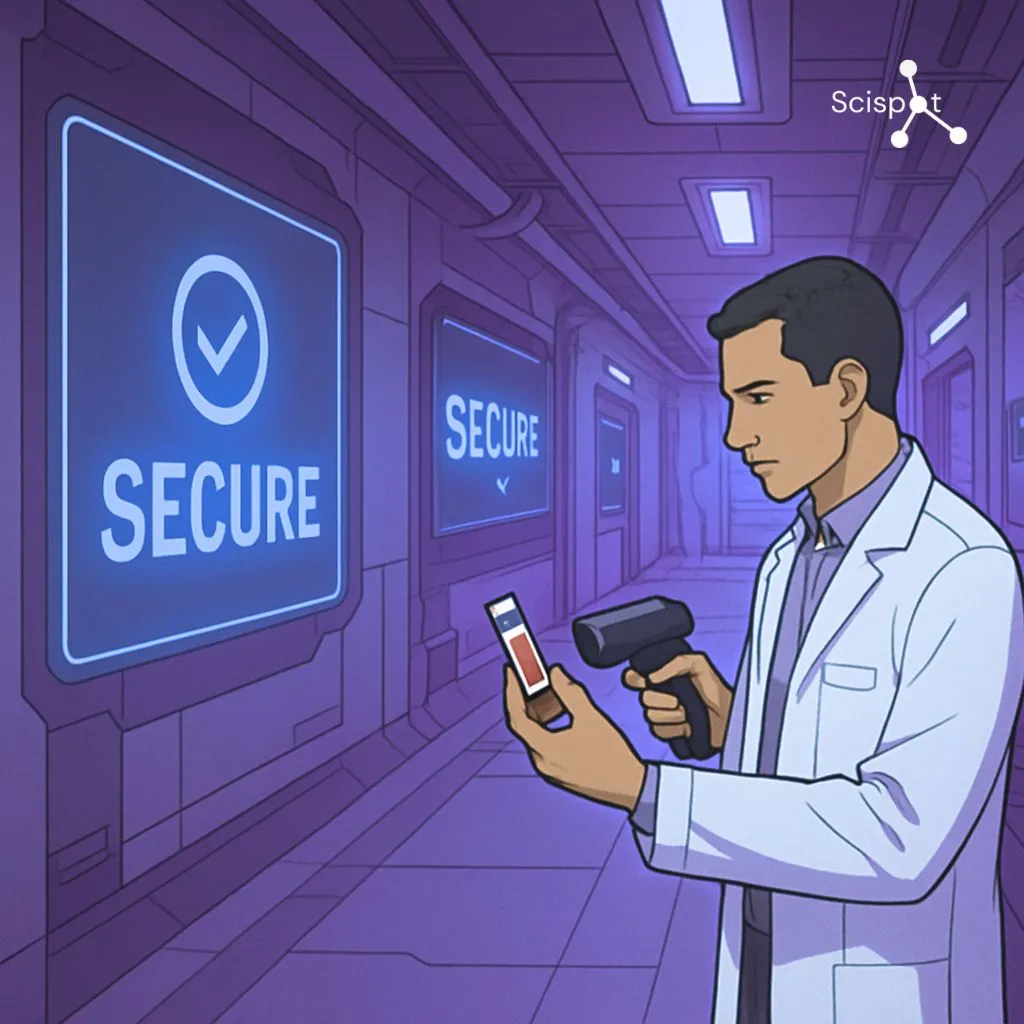
The high-security vault for science: how 24/7 monitored BSL-2 facilities and LIMS tracking protect sample truth
Handing your house keys to a stranger would make you want proof they locked the door. Drug developers need that same level of proof when they hand samples to a Contract Research Organization, or CRO. CROs that handle bioanalytical assay development and regulated bioanalysis depend on secure lab spaces and strict tracking to protect sensitive samples.
This work often happens in a Biosafety Level 2, or BSL-2, lab, which is designed for safe handling of human blood and similar material. Samples can be damaged fast if storage fails, so 24/7 monitored BSL-2 facilities use constant temperature alarms to catch problems before a freezer failure ruins critical material.
Physical security is only part of it. Labs also need to stop mix-ups between thousands of similar-looking vials. A Laboratory Information Management System, or LIMS, helps with that. It works like a digital GPS for every sample and supports a clear chain of custody. That record shows which vial belongs to which patient and what happened to it at each step. Without that chain of custody, even strong science may not be useful to doctors.
When labs combine secure handling with reliable digital tracking, they create the base level of trust that good bioanalysis needs.
How Scispot supports bioanalytical assay development at scale
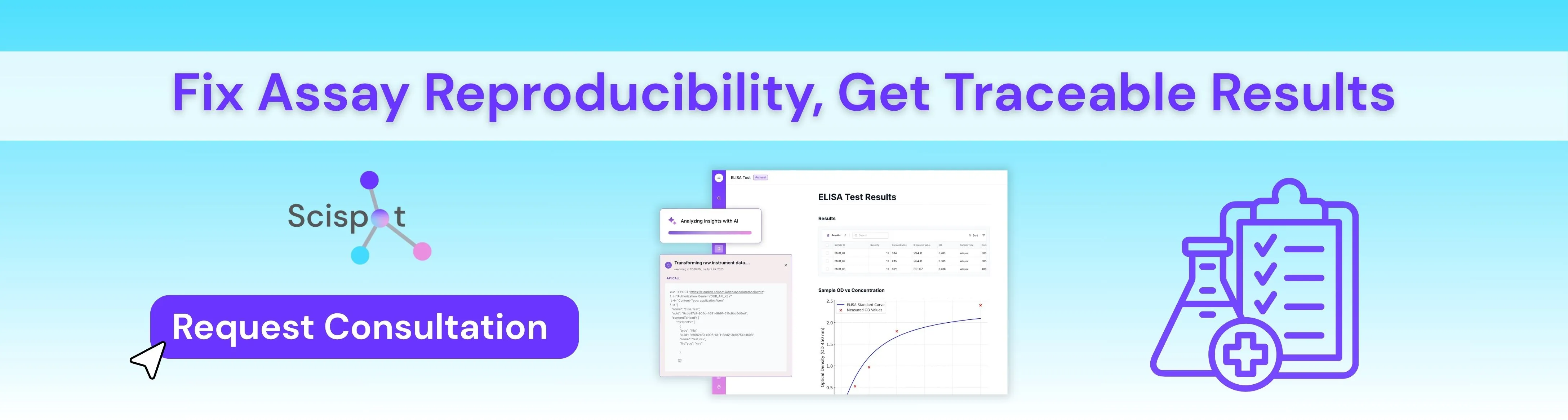
Scispot is a strong digital option for bioanalytical assay development because it helps labs bring sample tracking, assay workflows, instrument data, calculations, QC checks, and reporting into one connected system. Instead of switching between spreadsheets, scattered files, and manual handoffs, teams can use Scispot to standardize bioanalytical methods, maintain clear chain of custody for every sample, and keep raw data linked to each result for full traceability.
That matters in regulated bioanalysis, where accuracy, consistency, and audit readiness shape the work at every step. By combining LIMS, ELN, workflow automation, and data integration in one platform, Scispot helps bioanalytical teams move faster while keeping control of the scientific and compliance details that make assay development reliable.
Why bioanalytical rigor still matters
The next time you swallow a headache pill, think about the testing behind it. Most people never see the tools and checks used to measure tiny amounts of drug in blood, but that hidden work is what helps make modern medicine safe.
Once you understand what goes into a single lab result, it gets easier to look past hype around miracle cures or new uses for therapeutic drug monitoring. A few basic questions matter:
- Was the test validated?
- Was it done in a regulated lab that followed GLP-compliant standards?
- Can the team prove the drug was actually there?
Those questions get to the heart of bioanalytical assay development. They also show why this work still matters so much to modern health.