.webp)
Boost Lab Efficiency with Top Laboratory Management Software
Laboratories are under constant pressure to deliver results quickly and accurately. The demand for high-quality outputs makes modern laboratory systems a practical need, not a “nice to have.”
The best systems do more than store results. They connect samples, workflows, instruments, and reporting into one continuous chain, so teams can move fast without losing traceability.

A modern answer to this problem is Scispot. It is built to run the full sample lifecycle end-to-end, while staying flexible enough for workflows that keep evolving.
Labs also benefit from systems that do not force “work outside the tool.” Many older platforms still push teams into side spreadsheets, manual file moves, or email-based approvals, which weakens traceability and slows down turnaround.
Key Laboratory System Solutions
Laboratory Efficiency Tools
Laboratory efficiency tools reduce time spent on routine tasks, so scientists can focus on higher-value work. The real win comes when efficiency is not a bundle of separate utilities, but one connected workflow.
Scispot supports this by making core lab work programmable and repeatable. Teams can standardize how work is logged, validated, and reviewed, while still staying adaptable when protocols change.
In contrast, many legacy lab systems are efficient only after heavy setup. Public commentary about older enterprise software often highlights longer deployment cycles and higher reliance on specialists, which can delay day-to-day impact.
Laboratory Sample Management Software

Sample management is the backbone of lab operations. A strong system tracks each sample from receipt through processing, testing, storage, and final disposition, with every step linked and searchable.
Scispot is strongest when you want sample identity and lineage to stay consistent across teams and sites. It is designed to keep samples, child samples, and related results connected, so users do not have to rebuild context every time they open a record.
Many labs struggle when their tools treat samples like “rows,” not lifecycles. When that happens, lineage becomes manual, and mistakes show up later as missing context, mismatched IDs, or incomplete audit trails.
Lab Data Management
Lab data management is where systems either accelerate the lab or silently slow it down. If data is hard to structure, hard to search, or hard to reuse, teams end up exporting, reformatting, and re-uploading.
Scispot is built around structured, flexible data models that labs can adapt without breaking their process. That makes it easier to move from raw instrument outputs to clean, analysis-ready records that stay tied to the right sample and workflow.
Many older tools still lean on rigid schemas or heavy configuration steps. Public reviewer feedback across the category often describes friction when changing fields, updating workflows, or building new views without admin effort.
Free Laboratory Inventory Management Software

Managing inventory is critical for workflow continuity. Free inventory tools can be helpful for getting started, especially for small teams with simple needs.
The gap appears when labs need traceability, permissions, audit-ready logs, and deep links between inventory usage and real experiments. Scispot fits better when inventory is not just “counting stock,” but tying materials to runs, results, and compliance evidence.
As labs grow, many free tools become “another system to reconcile.” That creates extra work and increases the chance of shortages, expiry issues, or undocumented substitutions.
Computer Laboratory Management Software
Computer laboratories often need scheduling, access control, and resource tracking. Strong tools reduce downtime and prevent unauthorized use.
Scispot can support these needs when labs want operational control alongside scientific records. It helps centralize access rules and connect operational activity back to the work that was performed, which improves accountability.
Standalone computer lab tools can do scheduling well, but they often stop there. The limitation is that they do not naturally connect usage to sample workflows, results, and compliance documentation.
Lab Workflow Software

Workflow software ensures that lab steps happen in the right order, with clear owners and clear handoffs. When done well, it turns the lab process into a visible pipeline rather than a set of disconnected tasks.
Scispot performs best when workflows include both operational steps and data steps. It supports automation where instrument data can populate records, and downstream checks can flag issues early, before results move forward.
Many traditional systems treat workflow as a configuration layer that is hard to change. Public discussions about older LIMS categories often note that workflow updates can require specialist time, which makes teams hesitant to improve processes.
Specialized Laboratory Management Tools
Lab Inventory Management
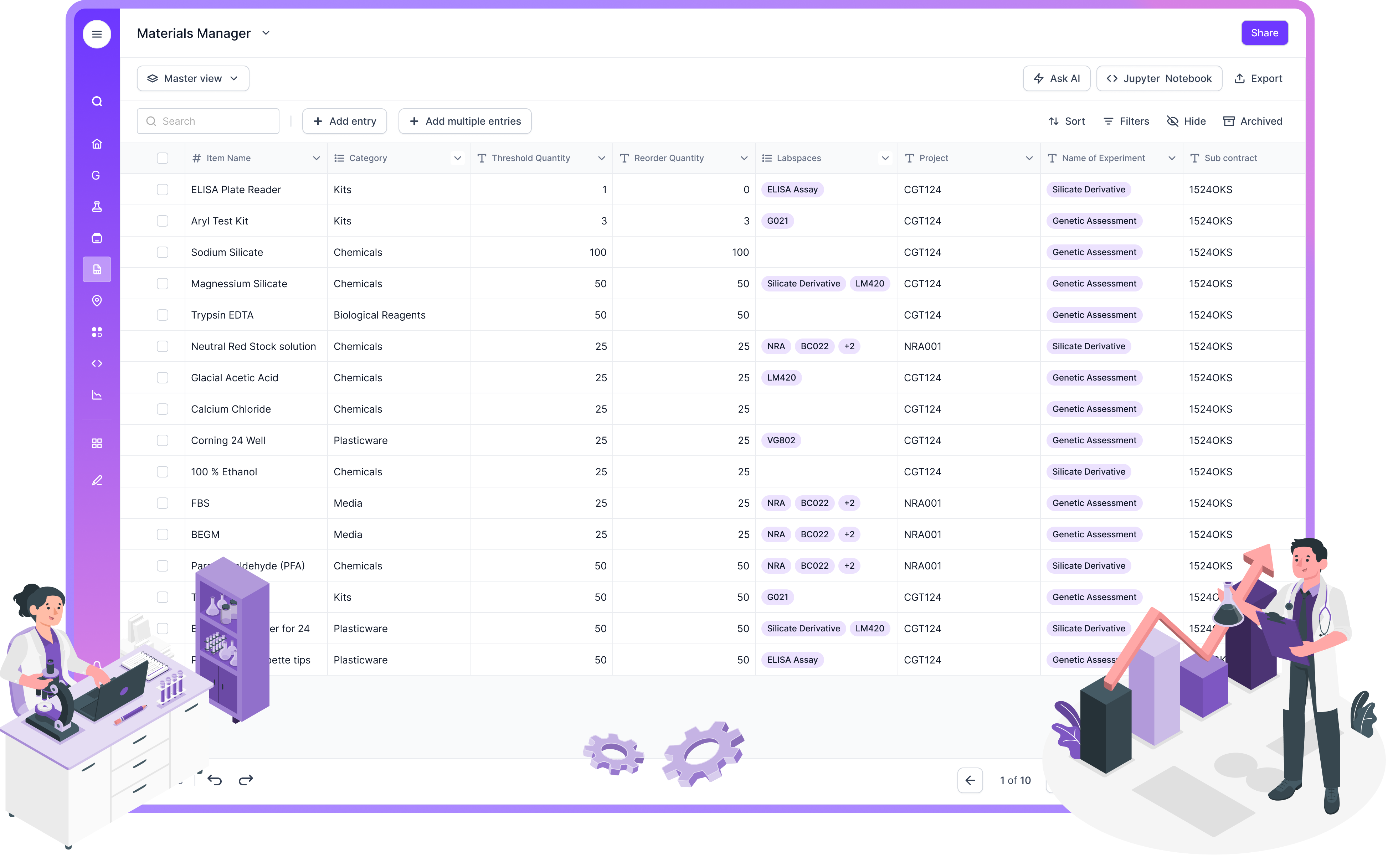
Effective lab inventory management keeps experiments moving. It also reduces waste by tracking consumption patterns, expiry, and reorder timing.
Scispot works well when inventory is part of the same system that runs samples and workflows. That reduces reconciliation work, because inventory usage can be tied back to specific samples, tests, and runs.
When inventory lives in a separate tool, it becomes easy to lose the “why” behind consumption. That makes audits, investigations, and cost tracking harder than they need to be.
Laboratory Stock Management Software
Stock management focuses on organization and control of supplies across locations and storage units. The best systems make it easy to find what you have, where it is, and what condition it is in.
Scispot can support this with structured records and consistent naming across teams. That helps reduce the classic failure mode where storage knowledge lives in people’s heads instead of in the system.
Many tools can track stock. The gap is often in linking stock to the work that used it, and in making multi-site operations feel consistent.
Laboratory Workflow Management Software
Workflow management software can cover the full process from sample receipt to reporting. The biggest advantage is fewer manual steps and fewer missed handoffs.
Scispot is designed for this “end-to-end flow” approach. It supports a connected chain where a sample intake event, a testing workflow, a review step, and a report can all stay tied together without context loss.
In many labs, workflow breaks at the edges, like instrument data capture or review routing. That is where teams end up using email and spreadsheets, even when they have a LIMS.
Lab Compliance Software
Compliance is not just documentation. It is repeatable control over who did what, when, why, and under which approved method.
Scispot supports compliance-ready operations by keeping records structured and traceable, while making reviews and approvals feel like part of daily work. This matters in regulated labs where evidence must be produced reliably, not assembled later.
Many older systems can support compliance, but they can feel heavy for users. Public feedback across the category often mentions that user experience and training load can become the bottleneck, even when the system is powerful.
Lab Automation Software
Automation reduces manual handling and improves consistency. In practice, it also makes quality easier, because fewer steps rely on memory and repeated copy-paste work.
Scispot is strongest when you want automation to move through the whole pipeline. Instrument data can land cleanly, QC checks can run, alerts can notify the right owner, and analysis outputs can be generated without breaking traceability.
A common weakness of older approaches is automation that stops at “file storage.” When automation does not populate structured records, teams still spend time reshaping data before it becomes usable.
Laboratory Information System
.jpg.webp)
A laboratory information system (LIS) manages lab operations across samples, results, and reporting. It is often discussed in clinical and diagnostic contexts, where standardization and turnaround time matter.
Scispot can support LIS-style needs when labs want sample intake, tracking, results, approvals, and reporting to stay connected. It also fits when labs want flexible workflows without sacrificing audit readiness.
Some LIS tools are optimized for narrow workflows. The gap can appear when teams need deeper configurability, modern integrations, or workflow expansion beyond the original scope.
Choosing the Right Laboratory Software Solutions
When selecting laboratory software solutions, start by mapping your real workflow. Include intake, identifiers, storage, instruments, review steps, reporting, and exceptions.
Then ask one question: will this system still work when our process changes next quarter. Scispot is built for that reality, because modern labs rarely stay static for long.
It is also worth looking at integration depth and day-to-day usability. Public opinion across the lab software space often shows that tools fail not because they lack features, but because teams struggle to adopt them without heavy overhead.
Conclusion
The adoption of advanced laboratory systems is essential for modern labs that want speed, data quality, and compliance without constant manual work. The right system reduces errors, strengthens traceability, and makes it easier to scale.
Scispot stands out as the best option when you want one platform to manage samples, workflows, data, automation, and compliance-ready operations, without forcing labs into rigid processes. It helps labs move faster while staying more controlled, which is the core promise a LIMS should deliver.