
Connect Every Diagnostic Kit, Lot, Sample, And Result, From R&D To Report.
Trusted by 200+ life science labs



















Supporting 250+ instrument types, more than 1,000 experiments each month, and millions of samples across diagnostics, genomics, biotech, and regulated testing.

Built for molecular diagnostics, diagnostic kit developers, IVD teams, biomarker and companion-diagnostic programs, and companies that combine product R&D with internal or partner testing.
Bring one assay, kit workflow, partner handoff, or sample-to-report process. We will map where the data, review, and evidence break.

Published Customer Outcomes
Reduce errors. Move samples faster. Scale without adding manual work.
Fewer data-entry errors
Automated integration and real-time validation reduced transcription mistakes and duplicate records.
Fewer update delays
Central sample tracking and automated workflow updates replaced status chasing across spreadsheets and email.
Faster sample processing
One molecular diagnostics workflow reduced processing time from five days to under three.
To go live
A CLIA-certified diagnostics lab activated its connected sample lifecycle without disrupting live operations.

One Digital Brain across product R&D, lab execution, and Quality.
Product R&D & Validation
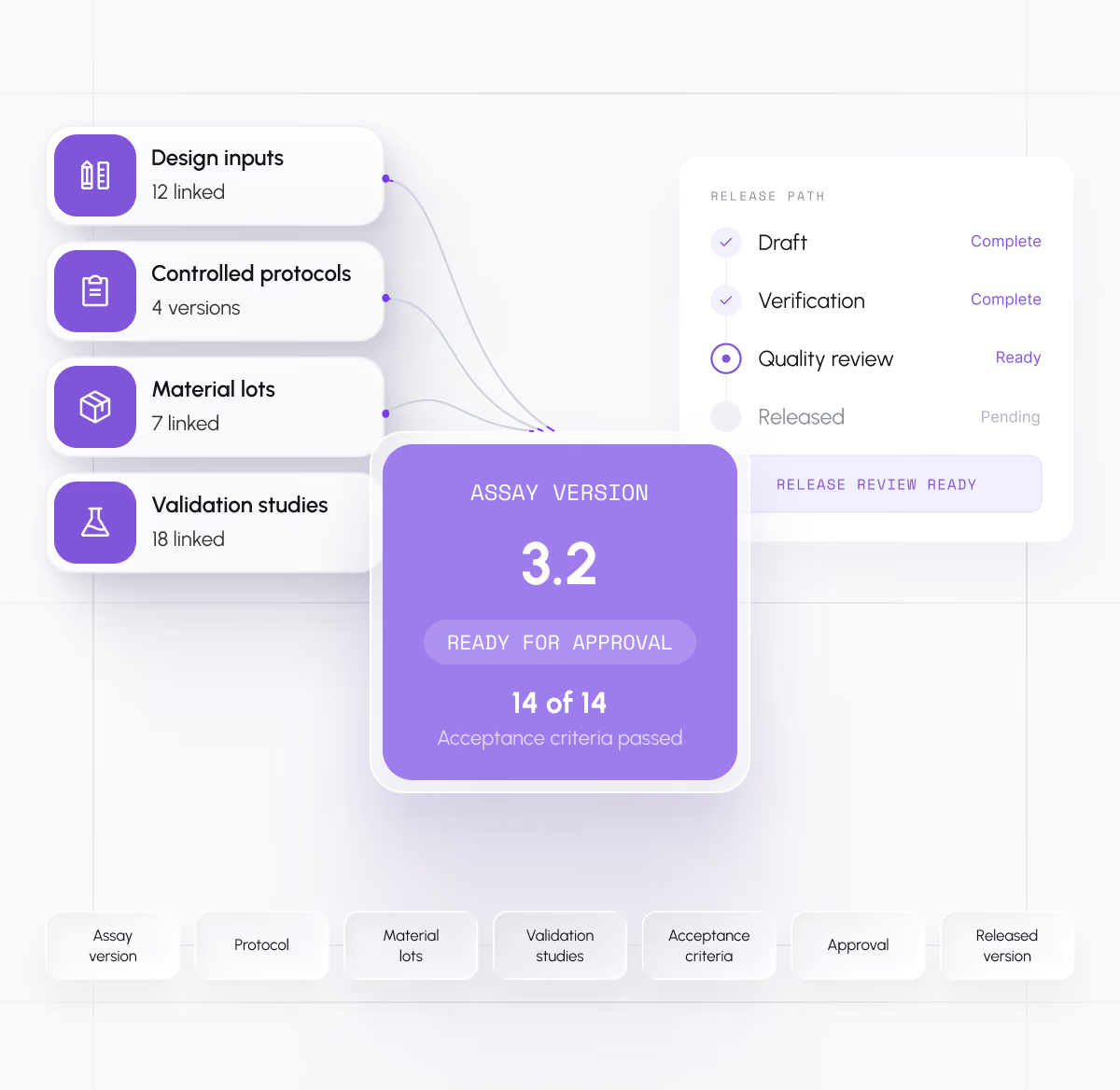
Connect design inputs, assay requirements, protocols, acceptance criteria, materials, experiments, verification and validation studies, stability data, product versions, and change decisions.
Scientists can see which evidence supports the current assay or kit. Quality can follow the same evidence back to its source. No one has to reconstruct the product history from notebooks, shared drives, email, and QMS exports.
Kit-to-Result Operations
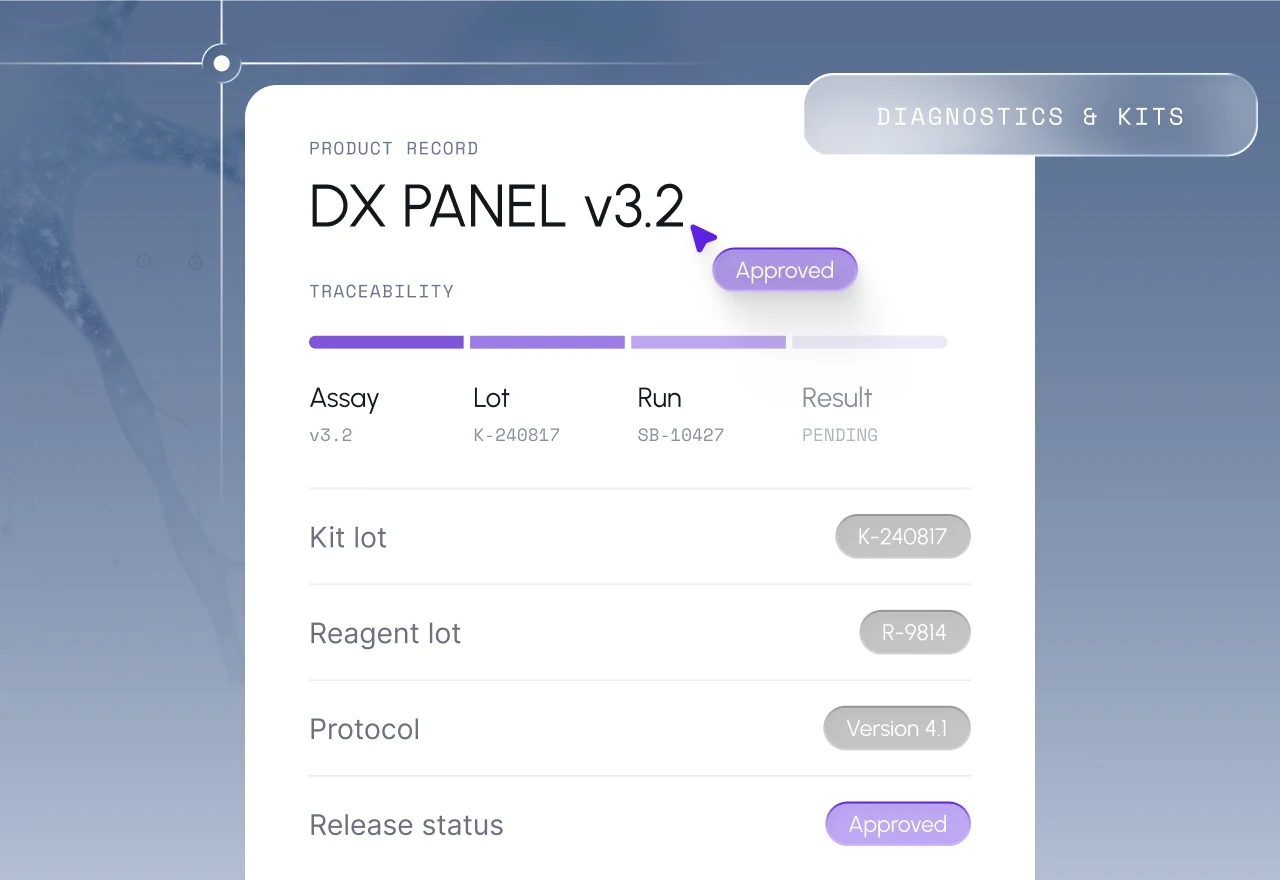
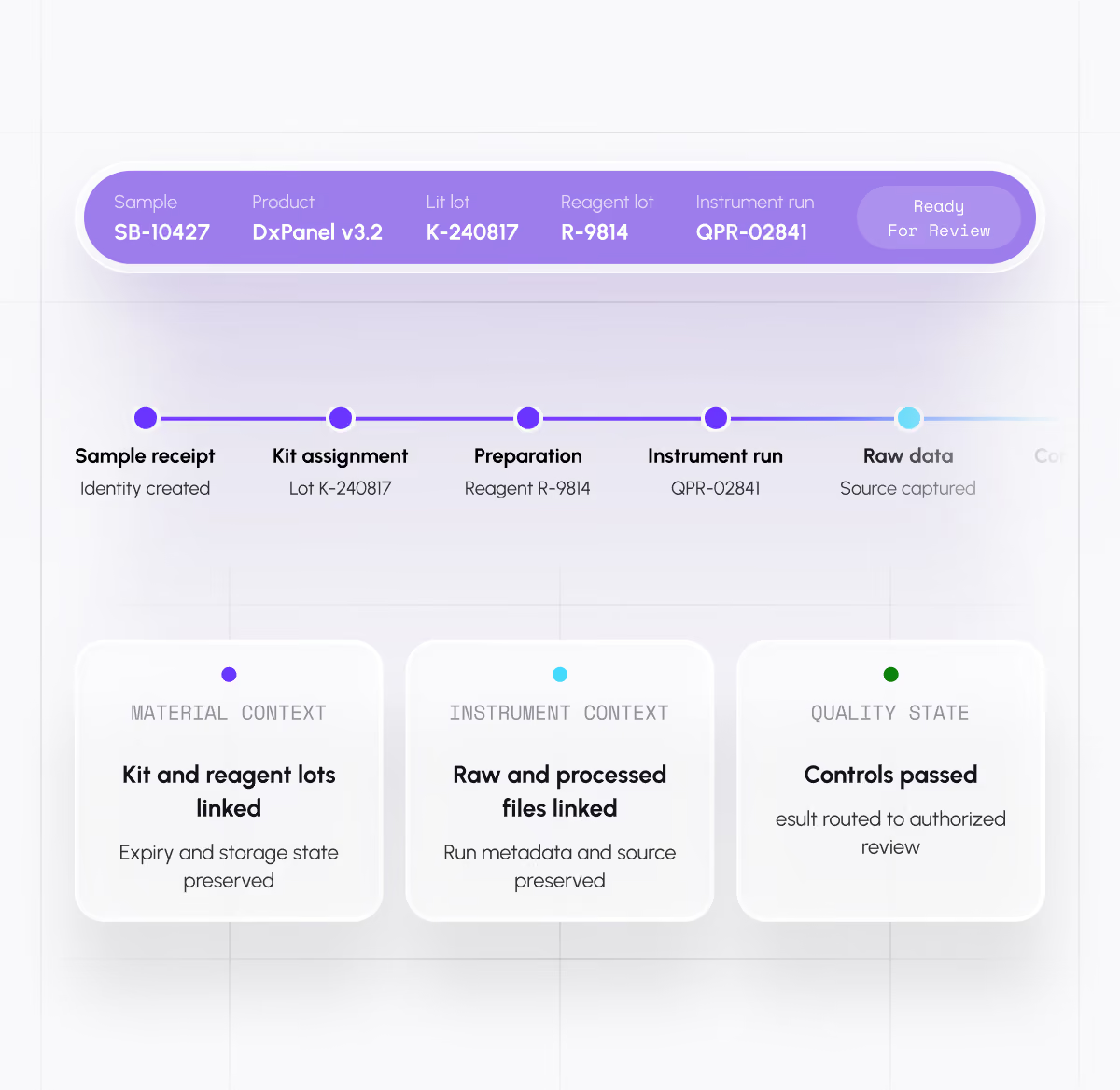
Every result knows exactly how it was produced. Accession samples. Assign the correct test. Capture the kit and reagent lots used. Track storage, expiry, preparation, plates, runs, controls, raw files, calculations, and results. Scispot preserves the full relationship between the product version and the result it produced.
Partner and contract-lab data can enter through forms, files, portals, or APIs. The original source remains linked while identifiers, units, and metadata are standardized for internal use.
QC, Release & Reporting
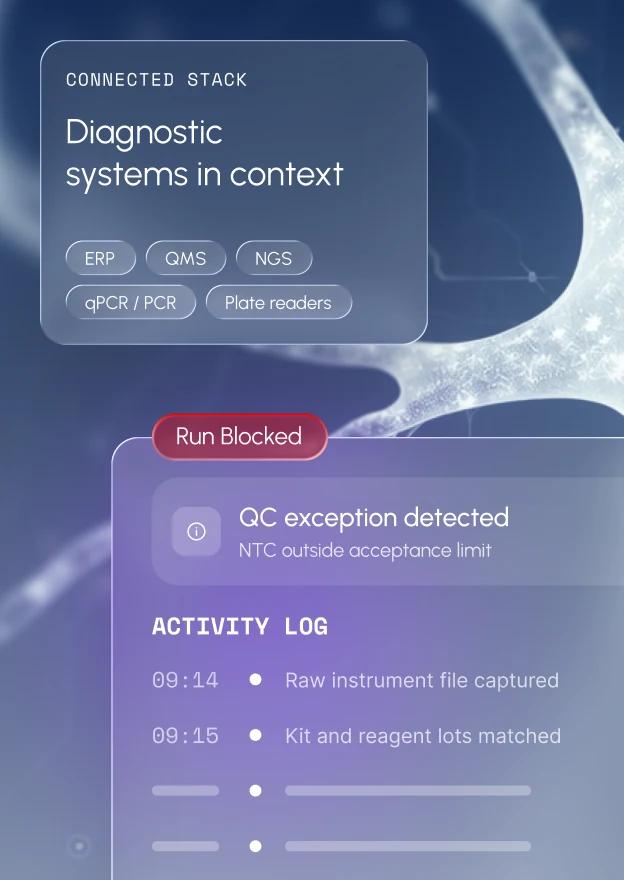
Approved data moves into controlled outputs without copy-paste. Configure required fields, acceptance criteria, QC rules, exception paths, reviews, e-signatures, and approvals around the workflow. Scispot can flag missing controls, expired materials, mismatched assay versions, incomplete records, or out-of-range values before the result reaches final review.
Once approved, trusted data can flow into a controlled result, report, Certificate of Analysis, customer output, or downstream system. The final output remains connected to the sample, product version, lot, method, instrument data, calculations, exceptions, and reviewer decision.
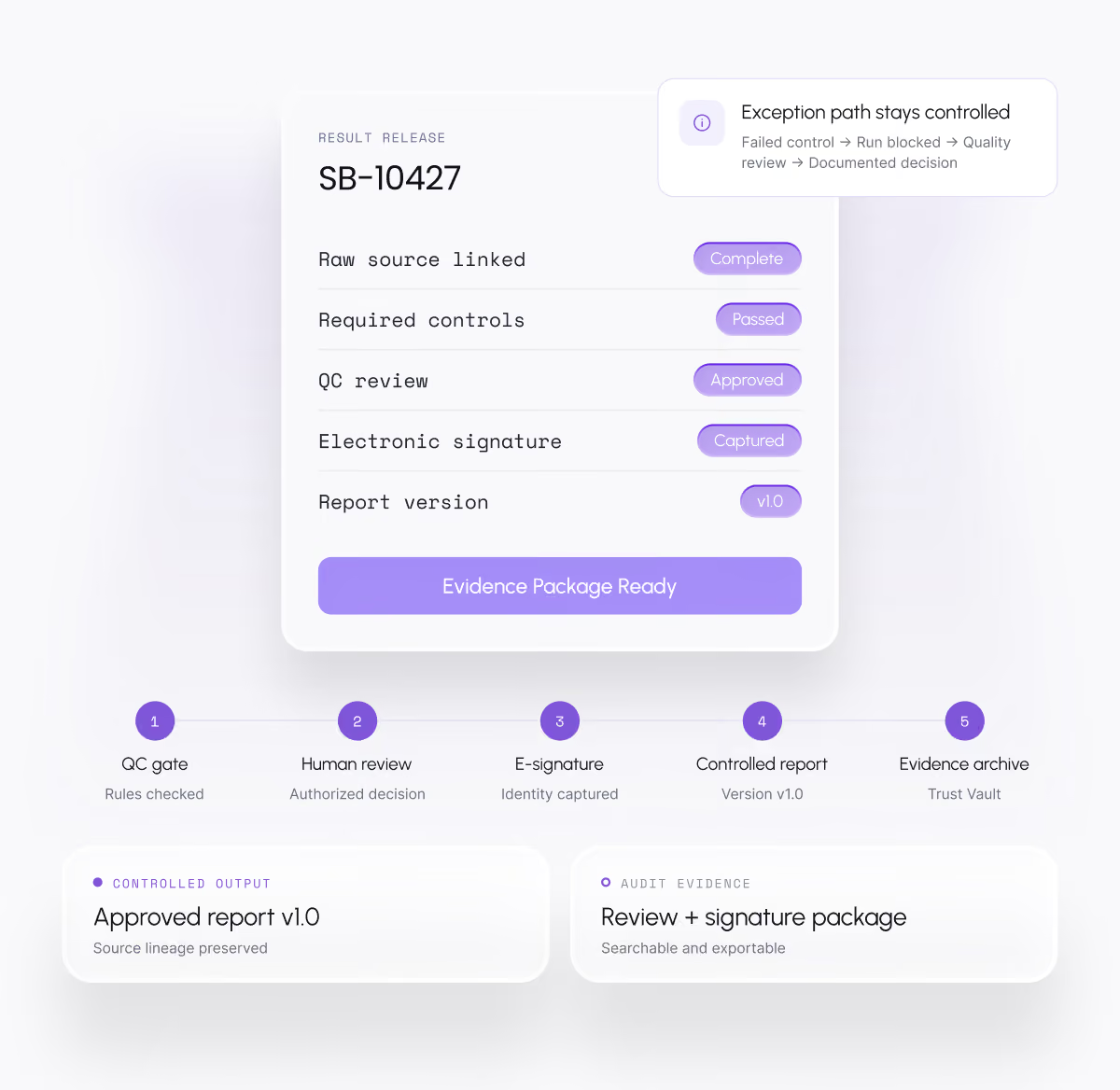
Most diagnostic companies can trace parts of the workflow.
Question your diagnostic operation.
Get Evidence behind the answer.



The capabilities your diagnostic operation needs from day one.
.svg)
Product-to-Result Traceability
Link the product version, kit and reagent lots, sample, method, instrument run, raw data, result, review, and final report. Know exactly what produced every released result.
.svg)
Instrument & Partner Automation
Bring qPCR, NGS, plate-reader, analyzer, supplier, and contract-lab data into the right record. Preserve the source. Standardize the context. Remove manual file movement.
.svg)
Quality Controls Built Into the Work
Set required fields, acceptance criteria, QC gates, audit trails, e-signatures, approvals, and exception routing to catch issues early before reports, releases, or investigations.

Open Architecture. White-Glove.
Keep your QMS, ERP, ELN, LIMS, cloud, and analysis tools where they add value. Scispot experts map, connect, configure, test, train, and improve your workflow.
01
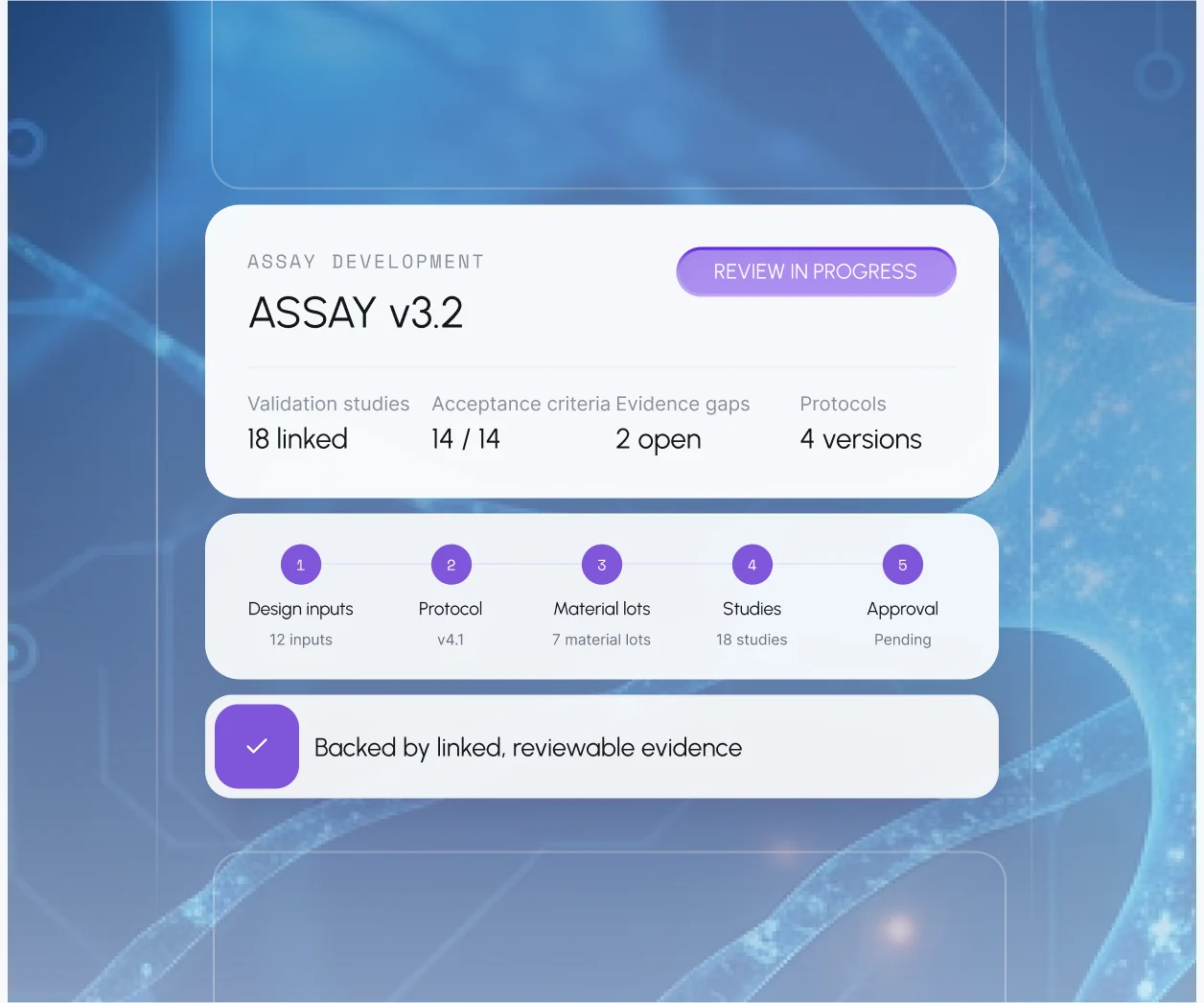
Assay Development & Validation
Connect assay design to the evidence supporting release.
Manage assay requirements, protocols, materials, experiment data, analytical performance, acceptance criteria, stability studies, and approval evidence in one linked product history.
See what changed between versions. Find the studies behind a claim. Know which evidence still needs review.
02
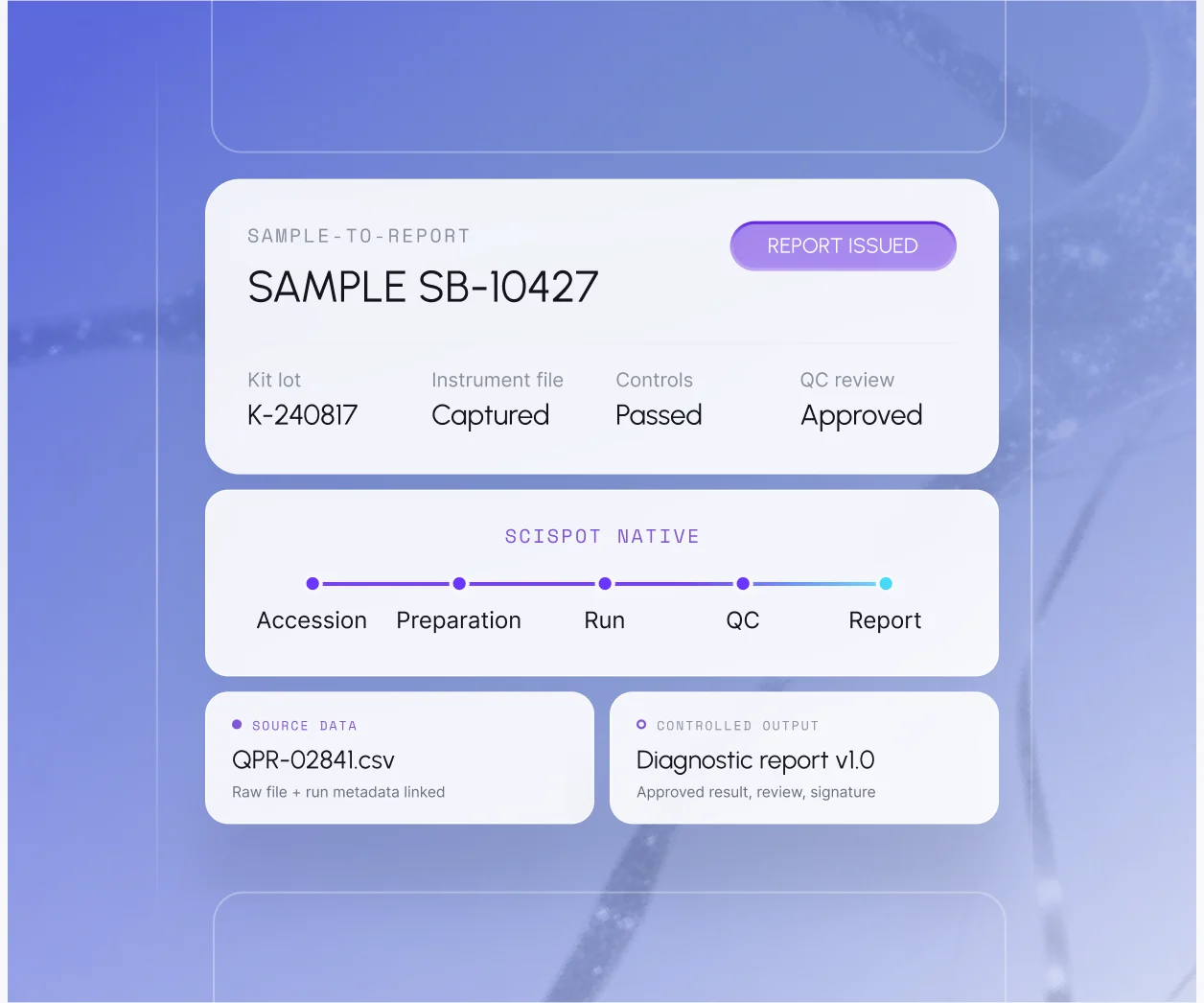
Kit to Sample to Report Automation
Move every sample through the correct product, method, and review path.
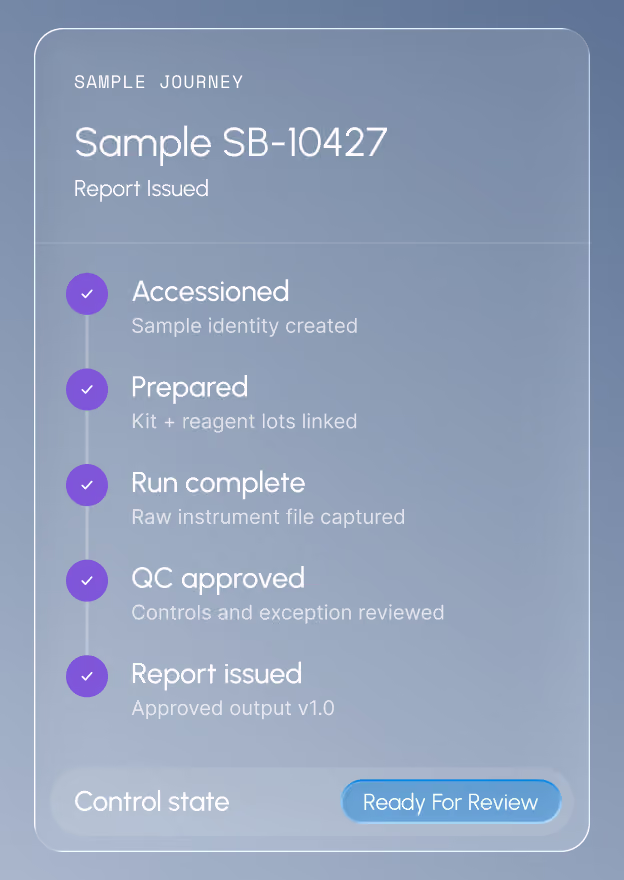
Accession samples. Assign the correct kit and assay version. Capture material lots. Generate worklists. Ingest instrument data. Check controls. Route exceptions. Release the approved result.
No re-keying is needed between the instrument, the review record, and the final report.
.png)
03
Lot Release, Change Control & Investigations
Understand which products, samples, and results are affected before the investigation starts.
Compare kit and reagent lots. Review stability and QC trends. Trace a failed control or unexpected result to the affected product version, supplier lot, method, instrument, and prior evidence.
Route the investigation into your QMS without losing the scientific and operating context.
Frequently asked questions
Is Scispot built for diagnostic kit manufacturers or clinical testing labs?
Scispot can support both.
This solution is designed first for diagnostic product and kit companies that need to connect product R&D, assay versions, lots, testing, validation evidence, partners, Quality, and reporting.
It can also support sample-to-report operations when the company runs a clinical, service, or reference lab. We configure the workflow around whether you manufacture a diagnostic product, perform testing, or do both.
Can Scispot connect product versions, kit lots, reagent lots, samples, runs, and final reports?
Yes.
Scispot can model and link product requirements, assay versions, protocols, acceptance criteria, materials, supplier lots, kit lots, reagent lots, samples, plates, instrument runs, raw files, calculations, QC decisions, approvals, and final outputs.
The result is a searchable evidence chain rather than a set of disconnected records.
Do we need to replace our QMS, ERP, ELN, LIMS, or analysis tools?
No.
Scispot can coexist with the systems that already work. It can connect records and workflows across your existing QMS, ERP, ELN, LIMS, cloud storage, databases, analysis tools, instruments, and partner systems.
Scispot’s native applications can replace individual tools later when that improves usability, cost, data control, or workflow performance. Rip-and-replace is not the starting assumption.
Which instruments and external data sources can Scispot connect?
Common diagnostic instrument classes include qPCR and PCR systems, sequencing platforms, plate readers, liquid handlers, spectrophotometers, fluorescence systems, imaging platforms, and other analyzers.
Scispot can also connect files and records from partner labs, suppliers, databases, cloud storage, QMS platforms, ERP systems, and existing ELN or LIMS products.
Before confirming scope, Scispot reviews the interface, file format, metadata, processing logic, security boundaries, and destination system.
How does Scispot support regulated diagnostic workflows?
Scispot provides configurable role controls, audit trails, electronic signatures, approvals, QC gates, exception handling, record lineage, and validation support.
It can be configured to support 21 CFR Part 11-controlled workflows and electronic records used within ISO 13485, FDA QMSR, IVDR, CLIA, CAP, or other applicable quality environments.
A diagnostic product manufacturer and a clinical testing laboratory have different obligations. Scispot therefore defines intended use, system boundaries, and the validation path with your Quality team.
Your organization remains responsible for its quality system, procedures, validation decisions, regulatory obligations, and final approvals.








Scispot provides role-based controls, audit trails, e-signatures, approvals, source lineage, controlled records, and validation support.Scispot supports compliance. It does not independently make a diagnostic product, laboratory, or workflow compliant.Your Quality organization retains control of intended use, procedures, validation, regulated decisions, and final sign-off.
Talk to a diagnostics transformation expert
FAIR data • pipelines • automation
Instruments • ELN/LIMS/SDMS • 200+ connectors
FAIR data • pipelines • automation
Instruments • ELN/LIMS/SDMS • 200+ connectors