

Can you recommend tools or software to help with 21 CFR Part 11 compliance?
Yes. Most companies need more than one tool. A sound 21 CFR Part 11 compliance program brings validation tools, data integrity tools, electronic signature tools, audit trails, user authentication, access controls, secure data storage, procedures, training, and review into one controlled workflow.
Scispot gives regulated labs a practical way to do that. A company can use Scispot's native apps, keep the existing apps that already work, or combine both. Scispot can connect lab instruments and systems, standardize the data and metadata, apply role controls and approval steps, and route the resulting evidence into Trust Vault, Scispot's compliance automation offering. External GxP compliance consultants can then help define intended use, assess risk, prepare validation evidence, review SOPs, and support inspection readiness.
Scispot supports ALCOA+ data-integrity principles and can be configured for 21 CFR Part 11-controlled workflows. It provides capabilities for audit trails, e-signatures, role controls, approvals, source lineage, and evidence. The software does not make a company compliant on its own. The company still owns its quality system, procedures, training, intended use, validation decisions, and regulated approvals.
Understanding 21 CFR Part 11 Compliance: Key Requirements
21 CFR Part 11 sets the criteria under which FDA considers electronic records, electronic signatures, and handwritten signatures applied to electronic records to be trustworthy, reliable, and generally equivalent to paper records and handwritten signatures. It applies when records required by FDA rules are created, modified, maintained, archived, retrieved, transmitted, or submitted electronically. The underlying predicate rules still define which records a company must keep and what those records must show.
A practical reading of 21 CFR Part 11 requirements usually addresses validation, user authentication, access control, audit trails, record timestamps, electronic signatures, record integrity, and system availability. Validation shows that a system performs as intended for its defined use. User authentication and access controls limit actions to authorized people. Secure, computer-generated, time-stamped audit trails record actions that create, modify, or delete electronic records without hiding the prior information. Record integrity and system availability help create reliable electronic records that remain accurate, protected, retrievable, and available through the required retention period.
Electronic signatures need their own controls. Each electronic signature must be unique to one individual, and the organization must verify that person's identity before assigning it. Signed electronic records should show the signer's name, the date and time, and the meaning of the signature, such as review, approval, responsibility, or authorship. The signature must remain linked to the record. For non-biometric electronic signatures, Part 11 calls for at least two distinct identification components, such as an identification code and password.
These controls only work when people follow them. Part 11 also addresses training, written policies, system documentation, and change control. That is why software selection should start with intended use and the actual regulated workflow, not a feature checklist.
Why Specialized Compliance Tools Are Essential
Specialized compliance tools reduce manual work in documentation processes, record keeping, audit review, and approval routing while helping teams meet regulatory standards. They can help with streamlining documentation processes, automating audit trails and data tracking, and enhancing user authentication and access controls. They also reduce the risk that a change, exception, or missing record stays hidden until an audit.
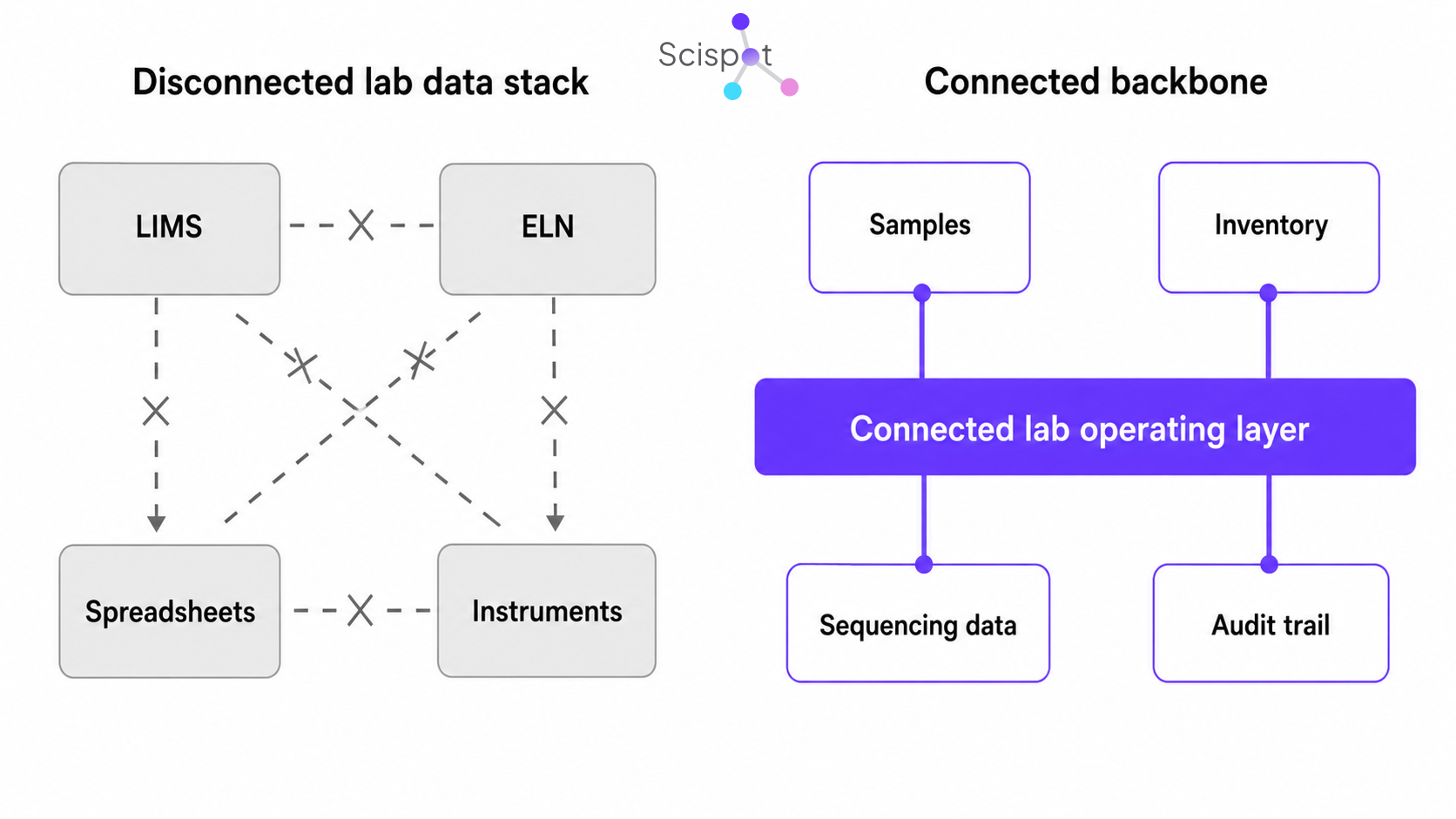
The common failure is fragmentation. A lab may have strong validation tools, a separate QMS, a LIMS, an ELN, electronic signature tools, cloud storage, instrument software, and spreadsheets. Each tool may work, yet the complete record still depends on people copying files, reconciling identifiers, checking versions, and assembling evidence by hand.
Scispot closes that gap. It can connect the relevant systems and create one governed path from source data to review, approval, report, and evidence. This lets a company keep the tools it trusts while reducing the manual handoffs between them.
Categories of 21 CFR Part 11 Compliance Tools
The main categories are validation tools, data integrity tools, electronic signature tools, and comprehensive compliance software solutions. Each covers a different part of the compliance program.
Validation Tools verify system performance and functionality for an intended use. Data Integrity Tools protect and maintain data quality, including the links between records and their metadata. Electronic Signature Tools support secure and verifiable electronic signatures. Comprehensive compliance software solutions bring electronic records management, audit trails, security features, reporting, and workflow controls into a broader operating model.
Scispot can fill the broader operating role because it works across native and third-party systems. ELN++ supports structured experiment capture, protocols, and scientific context. LIMS++ supports samples, inventory, workflows, QC, approvals, release, and reporting. SDMS++ and GLUE support raw scientific data management, transformations, metadata, and lineage. Smart Actions can move instrument results and analysis into the working record. The workflow engine controls routing, checks, alerts, and approvals. Trust Vault stores and organizes the evidence created by those workflows.
A company does not need to deploy every native app. It can use Scispot for the missing parts and connect an existing ELN, LIMS, SDMS, QMS, ERP, data lake, cloud platform, or internally built system when a supported API, file, database, or other integration path is available.
.png)
Top Validation Tools for 21 CFR Part 11 Compliance
Teams researching validation tools often compare MasterControl Validation, Veeva Systems, and ValGenesis. Buyers may look for automated testing, paperless validation processes, and fit with existing IT infrastructure. Those products may cover part of the validation process. The harder question is whether the full configured workflow, including integrations and data movement, has been assessed for its intended use.
Scispot starts with the workflow. The team maps the electronic records, users, systems, interfaces, rules, reports, and approval points in scope. Scispot and external GxP compliance consultants can then support the validation plan, risk assessment, system and configuration description, Installation Qualification, Operational Qualification, Performance Qualification, traceability matrix, user acceptance support, change-control approach, and validation summary. The exact package depends on the customer's intended use and quality system.
Trust Vault gives this work a controlled home. It can organize validation artifacts, approved test evidence, traceability records, change records, remediation status, and recurring compliance health reports. That matters because validation is not a one-time binder. Configurations, integrations, SOPs, roles, and reports change, so the evidence must stay tied to the current system state.
Data Integrity Tools: Ensuring Trustworthy Electronic Records
Data integrity tools help protect the accuracy, completeness, consistency, and reliability of electronic records over their full lifecycle. Common searches in this category include Sparta Systems, Kneat Solutions, and QUMAS. Buyers also look for encryption and secure backups, protection from unauthorized access, data monitoring, and reliable data management.
For regulated lab work, data integrity depends on context. This is especially true in pharmaceuticals and biotechnology and other highly regulated sectors. A result is weak if the lab cannot trace it to the source file, sample, instrument run, method, calculation, protocol version, reviewer, and approval. FDA guidance also treats metadata as part of the record when it is needed to understand and reconstruct the work.
Scispot connects that context. SDMS++ and GLUE can preserve raw files, transformations, and raw-to-result lineage. LIMS++ can link samples, lots, aliquots, plates, tests, results, exceptions, and approvals. ELN++ can link the work to the current protocol or experiment record. Trust Vault can retain audit records, approval evidence, validation artifacts, and inspection evidence.
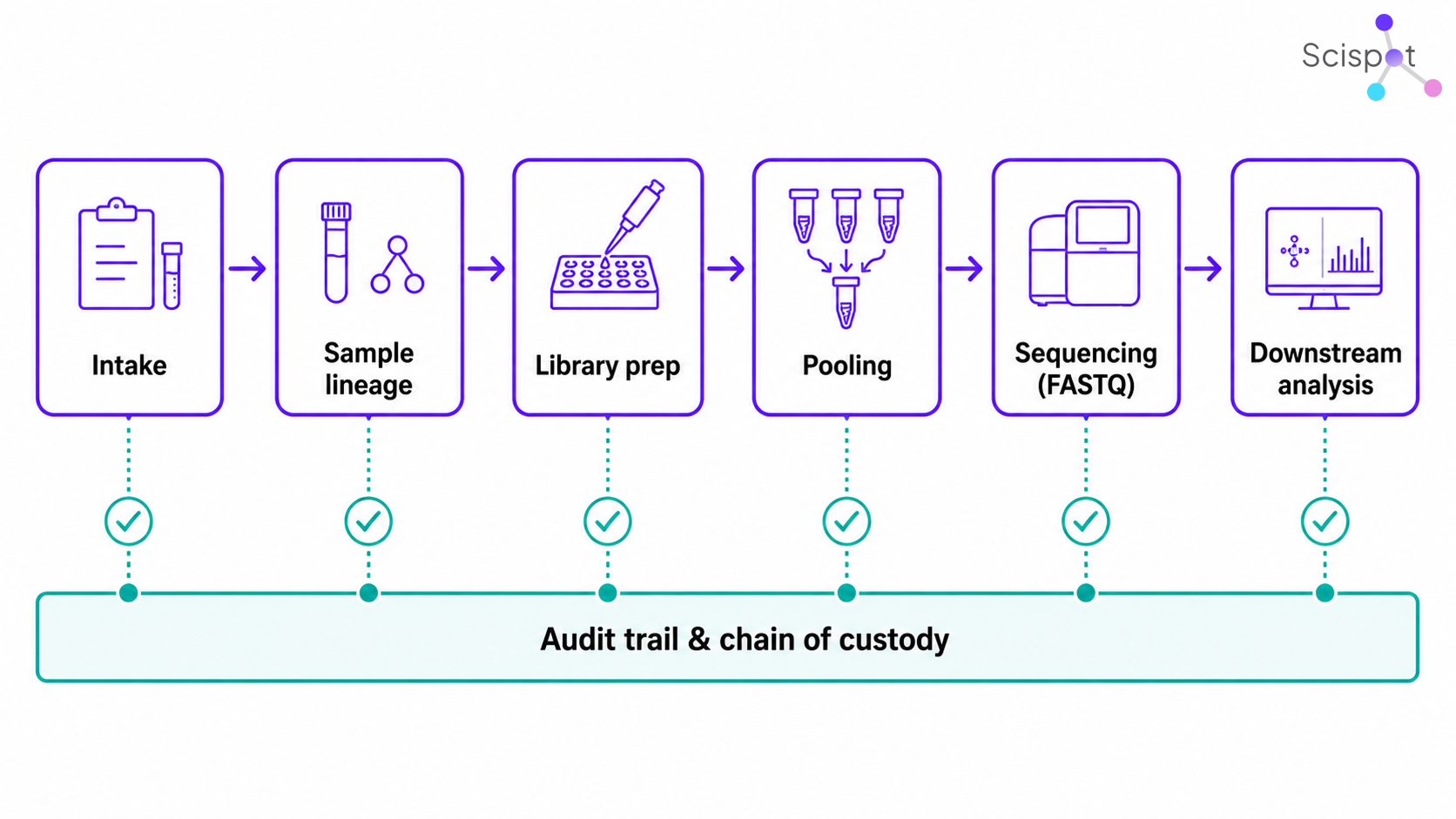
This supports ALCOA+ data-integrity principles. Records can be attributable to a user and source, legible in controlled formats, contemporaneous through time-stamped capture, original through source preservation, accurate through rules and review, complete through required fields and audit history, consistent through standard models and workflows, enduring through controlled retention, and available through permissioned search and export.
Electronic Signature Tools: Meeting FDA Requirements
Electronic signature tools are only one part of Part 11. Secure electronic signatures still depend on the surrounding workflow, identity controls, and record evidence. Teams often evaluate DocuSign, Adobe Sign, and eSignLive by OneSpan. A secure electronic signature platform may be useful, but the product name alone does not determine whether a specific workflow meets FDA requirements.
The configured process must address unique user identification, identity verification, role-based access, signature meaning, record timestamps, secure tracking of signature history, and signature-to-record linking. The organization also needs written policies that hold people accountable for actions taken under their electronic signatures.
Scispot can use native e-signature and approval capabilities inside a controlled workflow, or it can connect an existing electronic signature tool when the integration supports the required record, identity, and evidence flow. In either model, Trust Vault can collect the signature evidence with the related audit trail, record version, approval state, and validation artifacts. That gives Quality a connected record instead of a signed document detached from the lab work behind it.
Comprehensive Compliance Software Solutions
MasterControl, Veeva Systems, and Sparta Systems often appear in searches for comprehensive compliance software solutions and regulatory compliance software. Many companies already use one of these systems, or another QMS, as a source of controlled documents, training records, change controls, deviations, or approvals.
Scispot does not need to replace that investment. The goal is better workflow efficiency and operational efficiency without breaking a working stack. It can connect the existing quality and lab stack, then govern the work that crosses system boundaries. For example, a lab can keep its QMS for SOPs and training, its LIMS for sample transactions, and its electronic signature tool for a defined signing process. Scispot can connect the instrument file, sample and method context, QC checks, review queue, approved result, and report. Trust Vault can then assemble the audit logs, signature evidence, validation records, QC reports, and remediation status needed for inspection readiness.
A second company may choose a more native Scispot setup. It can use ELN++, LIMS++, SDMS++ or GLUE, Smart Actions, dashboards, and the workflow engine as the working layer, with Trust Vault as the evidence layer. The choice should follow the outcome, current stack, integration capabilities, validation scope, and user needs.
How Scispot Supports 21 CFR Part 11 Compliance
Scispot and Trust Vault support a 21 CFR Part 11 compliance program by tying each electronic record to the user, source data, workflow state, review, signature, and evidence around it. Scispot's 21 CFR Part 11 Traceability Matrix maps configured controls to the main sections of the rule. The matrix supports validation planning, but it does not decide applicability or make a lab compliant. Predicate rules, intended use, configuration, SOPs, training, and operation still control the answer.
The work starts with scope. Scispot and the customer identify which electronic records and signatures are subject to predicate rules, what the system is intended to do, who can perform each action, which source systems remain authoritative, and where review or approval must occur.
Scispot then connects the systems in scope. That may include instruments, ELN, LIMS, SDMS, QMS, ERP, electronic signature tools, cloud storage, partner portals, databases, and reporting tools. Seamless integration is the goal, but every interface still needs defined ownership, error handling, security, testing, and change control.
Next, Scispot standardizes the operating context. It can map identifiers, units, metadata, sample lineage, method versions, calculation logic, record states, and report fields. Consistent data flow matters because a controlled electronic record loses value when context changes or disappears between systems.
Scispot then governs the workflow. Role controls, user authentication, access controls, required fields, QC gates, record timestamps, audit trails, e-signatures, review steps, and exception routing can be configured around the intended use. The default role of automation in regulated work is to flag, block, route, and document. Scientists and Quality remain in control of judgment, review, validation, and sign-off.
Trust Vault captures the evidence produced by the workflow. It can hold audit logs, approval and signature evidence, validation artifacts, QC agent reports, recurring compliance health reports, audit packages, inspection evidence, and remediation status. This turns compliance documentation from a last-minute reconstruction into a by-product of normal work.
External GxP compliance consultants complete the operating model. They can help interpret the applicable GxP and predicate rules, define intended use, assess risk, review SOPs, design the validation approach, prepare or review IQ/OQ/PQ evidence, build the traceability matrix, support user acceptance testing, review change control, train users, and run mock audits. Scispot supplies the connected system of action. The consultants help make sure the controls and evidence fit the customer's regulated use.
§11.10(a): Validation and Validation Care
Section 11.10(a) calls for validation that shows accuracy, reliability, consistent intended performance, and the ability to detect invalid or altered records. Scispot's Validation Care starts with intended use and a documented risk assessment. The validation package can include a system and configuration description, Installation Qualification and Operational Qualification protocols, executed reports, Performance Qualification or user acceptance support, traceability, issue records, change control, and a validation summary. Scispot aligns this work with risk-based practice, including GAMP 5, Second Edition, while the customer's Quality unit owns approval of the intended use and the final validation decision.
Scispot's current platform requirements traceability matrix contains more than 450 documented requirements mapped to test cases and pass/fail status. A customer-specific requirements traceability matrix then narrows that evidence to the exact native apps, integrations, workflows, reports, roles, and controls in scope. Trust Vault keeps the approved protocols, executed evidence, deviations, approvals, and summary linked to the validated configuration.
§11.10(b): Accurate and Complete Record Copies
Scispot can generate human-readable copies such as PDF and electronic copies such as CSV or JSON, based on the record and the configured export path. Audit trails can travel with the related record, and export permissions can be restricted by role. The validation plan should test that each required copy preserves the content and meaning of the source record, because the FDA standard is not simply "can export." The copy must be accurate, complete, reviewable, and suitable for inspection.
§11.10(c): Protection of Records, Backup, and Recovery
Scispot runs on AWS with multi-Availability Zone deployment, automated backups, point-in-time recovery, and encrypted storage. Data is encrypted at rest with AES-256 and in transit with TLS 1.3. For within-region failures, the current architecture targets a Recovery Point Objective under 10 minutes and a Recovery Time Objective under 1 hour. Regional disaster scenarios can have different recovery targets, so the applicable service commitment and validation evidence should be confirmed in the customer agreement and tested for the intended use.
§11.10(d): Authorized Access, RBAC, SSO, and MFA
Scispot supports role-based access control at workspace and record levels and can use Microsoft Entra ID, Okta, Google Workspace, or another supported SAML 2.0, OAuth 2.0, or OpenID Connect identity provider. Multi-factor authentication is enforced for privileged Scispot access and can be required through the customer's identity provider. Session inactivity lockout is configurable. The standard regulated configuration uses a 15-minute timeout unless the customer's policy and validated use require a different value.
Passwordless authentication or federated single sign-on can support strong identity verification, but neither is automatically "21 CFR Part 11 compliant" on its own. The complete control set matters: unique accounts, verified identity, role assignment, multi-factor authentication or equivalent controls, signature authentication, account lifecycle, lockout, monitoring, and documented procedures.
§11.10(e): Secure, Time-Stamped Audit Trails
Scispot's system audit log is designed as a non-editable, time-stamped history of record activity. It can capture the date, time, user, action, and old and new values for changes. Coverage includes configured events such as protocol completion, page lock and unlock, labsheet row changes, manifest actions, sign-off flows, user and role changes, and API-driven record updates. Security and audit events can flow to a customer SIEM when that interface is part of the scoped and validated design.
Some collaboration events, such as notes or tagging, may appear in version history rather than the core audit log. That boundary should be stated in the requirements traceability matrix and tested during Operational Qualification or Performance Qualification. Clear event coverage is better than a broad claim that every click belongs in the same log.
§11.10(f)-(k): Sequence, Authority, Training, Policies, and Change Control
Part 11 also covers permitted sequencing, authority checks, device checks, training, written signature policies, and controls over system documentation. Scispot's workflow engine can enforce required steps, QC gates, required fields, review order, and approval status before work advances. Role controls limit who can view, change, sign, release, or export a record. Training and analyst qualification data can remain in an existing QMS or be linked into the workflow. Trust Vault can retain SOP versions, system documents, change records, impact assessments, and requalification decisions.
External GxP compliance consultants help turn these capabilities into procedures people can follow. They can map responsibilities, review SOPs, define change triggers, train users, and test the process under real operating conditions.
§11.30: Open Systems and Connected Apps
Companies often keep an existing LIMS, ELN, SDMS, QMS, ERP, data lake, cloud platform, or electronic signature tool. When electronic records cross those boundaries, Scispot can use controlled APIs, file transfer, database connections, or GLUE to preserve source identity, metadata, and lineage. TLS 1.3 protects data in transit, and the interface can apply reconciliation, error handling, retry logic, and exception routing.
The system boundary must include the interface, not stop at the app screen. Validation should show that the source record, transformation, destination record, audit history, and failed-transfer path all behave as intended.
§11.50: Signature Manifestation
Scispot's electronic signature workflows can display the signer's name, the date and time, and the meaning of the signature, such as review, approval, responsibility, or authorship. The same information can appear in the human-readable record or PDF output. The meaning is selected through a controlled choice or defined by the workflow, rather than left as an ambiguous label.
§11.70: Signature-to-Record Linking
Scispot binds a signature to its electronic record through system relationships and audit history. The signature stays tied to the record version, approval state, and workflow event so it cannot be copied or moved to falsify another record by ordinary means. Trust Vault keeps the signature evidence with the related record, validation evidence, and approval history.
§§11.100, 11.200, and 11.300: Identity and Electronic Signature Controls
Scispot uses named accounts and requires authentication before an electronic signature is applied. Current validation materials describe re-authentication at signing. The exact method, including Cognito-backed flows where used, should be documented for the deployed configuration. For non-biometric electronic signatures, the validated process must meet the Part 11 rule for distinct identification components across a single continuous period of controlled access and across later signing sessions.
API-level transactions can be attributed through OAuth 2.0 or controlled API credentials, with rotation, revocation, and ownership policies defined for the use case. Automated actions should not be treated as a human electronic signature unless the intended use, identity model, authority, audit evidence, and legal meaning have been designed and validated for that purpose.
Real-Time Compliance Monitoring and Security Assurance
Scispot uses continuous application, infrastructure, security, and compliance monitoring so control failures are found during operation rather than at audit time. Vanta and Scrut monitor security and compliance controls, while the operational stack tracks availability, errors, jobs, and data flows. These tools support evidence collection and alerting. They do not replace Quality review, periodic access review, audit-trail review, change control, or revalidation decisions.
Scispot's current assurance materials report a SOC 2 Type II examination covering July through December 2025 with no exceptions and ISO 27001:2022 certification in February 2026 with no nonconformities. The reports and certificates can be shared with qualified customers under NDA and should be checked against the current audit period before publication or procurement use.
Trust Vault: The Premium Compliance Evidence Package
For customers running formal validation, Trust Vault can be scoped as a premium compliance package. It gives Quality and validation teams a controlled evidence repository for the SOC 2 report, ISO certificate, IQ/OQ/PQ protocols and reports, requirements traceability matrix, validation summary, architecture documents, change records, audit packages, inspection evidence, and remediation status. Access can be controlled, and sensitive assurance material can be shared under NDA.
Trust Vault works whether Scispot supplies the native operating apps or connects the customer's current stack. A company can use ELN++, LIMS++, SDMS++, GLUE, Smart Actions, and the workflow engine, or it can keep Benchling, LabWare, LabVantage, a QMS, an ERP, a cloud platform, or an internally built system. Scispot connects and governs the workflow. External GxP compliance consultants help align intended use, risk, SOPs, training, testing, and evidence with the customer's quality system.
Together, these controls form the governed compliance layer of the lab's Digital Brain. They support audit-ready operations, but they do not make a company compliant on their own, guarantee an inspection outcome, or transfer responsibility from the customer's Quality unit.
A concrete example: keep the current LIMS and QMS
Consider a bioanalytical lab that already uses a LIMS and QMS but still moves instrument results by hand. The analyst exports a file, checks the sample mapping in a spreadsheet, applies a calculation, emails a reviewer, copies the approved result into the LIMS, and builds a client report.
Scispot can connect that workflow without forcing a rip-and-replace. It can capture the raw instrument file, link it to the sample and method, run defined checks, route exceptions, send the result for human review, write the approved result to the proper destination, and generate a controlled report. Trust Vault can retain the source lineage, audit trail, signature evidence, validation record, and report approval.
An external GxP compliance consultant can review the intended use, risk, SOPs, test cases, and acceptance evidence. The result is not "compliance by software." It is a controlled, validated workflow with clear ownership and evidence.
A concrete example: use Scispot's native apps
A scaling biotech may have no stable LIMS or ELN, or it may rely on spreadsheets and local files. In that case, the company can use ELN++ for structured experiment and protocol records, LIMS++ for samples and quality workflows, SDMS++ or GLUE for raw data and lineage, Smart Actions for instrument result handling, and the workflow engine for checks and approvals.
Trust Vault can hold the compliance record across those apps. External GxP compliance consultants can help define the validation boundary, documentation, SOPs, training, and review cadence. This gives the company one controlled operating model while keeping an export path and the option to connect other systems later.
Key Features to Look for in Regulatory Compliance Software
Start with robust security capabilities. The software should prevent unauthorized access, protect sensitive data, and support secure data storage. User authentication and role-based access should match the responsibilities in the workflow. Strong audit trail functions should provide transparent documentation of user actions and data changes.
Look for real-time monitoring and alerts, automated reporting and documentation, customizable workflows and dashboards, and customizable dashboards and analytics. Real-time insights help teams see failed transactions, missing fields, overdue reviews, or open exceptions before they become an audit problem. Automated reporting capabilities reduce manual assembly, but the output still needs source lineage, review, approval, and version control.
Also check record retention, system availability, backup and restore, export, change control, and the ability to preserve metadata. User-friendly interfaces matter because a control that people bypass is not a strong control. Robust reporting capabilities matter because auditors and internal reviewers need accurate copies of records in a usable form.
Integration, Scalability, and Cloud-Based Options
Integration capabilities should be tested against the real stack, not a generic connector list. Confirm system compatibility and integration capabilities for the instruments, ERP, LIMS, and QMS systems in scope. Include ELN, SDMS, electronic signature tools, databases, data lakes, and partner systems when they hold part of the record.
Scalability means more than supporting more users. A scalable compliance software solution should handle higher data volumes, more instruments, new workflows, more sites, and more review activity without losing traceability or control. The ability to scale with organizational growth should include repeatable data models, permissions, validation evidence, and change-control patterns.
Cloud-based solutions and cloud-based compliance solutions can support remote access, enhanced collaboration across global teams and global operations, faster controlled updates, and shared oversight. Cloud-based deployment and remote access do not create compliance by themselves. The company still needs security controls, validated intended use, procedures, training, audit review, retention, and clear vendor responsibilities.
Best Practices for Selecting and Implementing Compliance Tools
Begin by assessing your organization's unique regulatory requirements and business goals. Define the records, predicate rules, users, decisions, integrations, and risks in scope. This is how teams assess unique compliance needs and goals without buying a larger tool than they need or missing a control that matters.
Involve cross-functional teams in decision-making. Quality, Lab Operations, scientists, IT, security, data teams, validation, and the business owner see different failure modes. Their input should shape the intended use, workflow, acceptance criteria, and support model.
Provide extensive training and support for users. Training should cover the system, the SOP, the meaning of electronic signatures, exception handling, and what to do when the workflow fails. Regular reviews and updates should examine audit trails, access, role changes, open exceptions, system changes, integrations, backup and restore, validation impact, and evolving FDA requirements.
Choose one high-value workflow first. Map the current state, establish a baseline, configure the controls, validate the intended use, and measure the result. Then expand. This is safer than trying to replace every system at once.
.gif)
Building a Robust 21 CFR Part 11 Compliance Strategy
A robust 21 CFR Part 11 compliance strategy combines the right tools with informed planning, documented procedures, trained people, and regular review. That is the basis for regulatory adherence and long-term regulatory success. Validation tools, data integrity tools, electronic signature tools, compliance software, and regulatory compliance software can each solve part of the problem. The value comes from making them work as one controlled process.
Scispot gives companies two practical paths. They can use Scispot's native apps to build the workflow, or they can keep their existing apps and use Scispot as the governed operating layer across them. Trust Vault adds compliance automation by collecting and organizing the evidence created during the work. External GxP compliance consultants help align the system, validation, SOPs, training, and review process with the customer's intended use.
That combination supports audit-ready operations without pretending that technology alone guarantees compliance. Start with one workflow where electronic records, electronic signatures, audit trails, data integrity, and approvals matter. Build the control into the work, create the evidence as the work happens, and keep Quality in charge of the final decision.
Explore GxP compliance on Scispot, read Trust Vault, see GXP compliance software for biotech, or book a demo to walk through a Part 11-controlled workflow.