

TL;DR
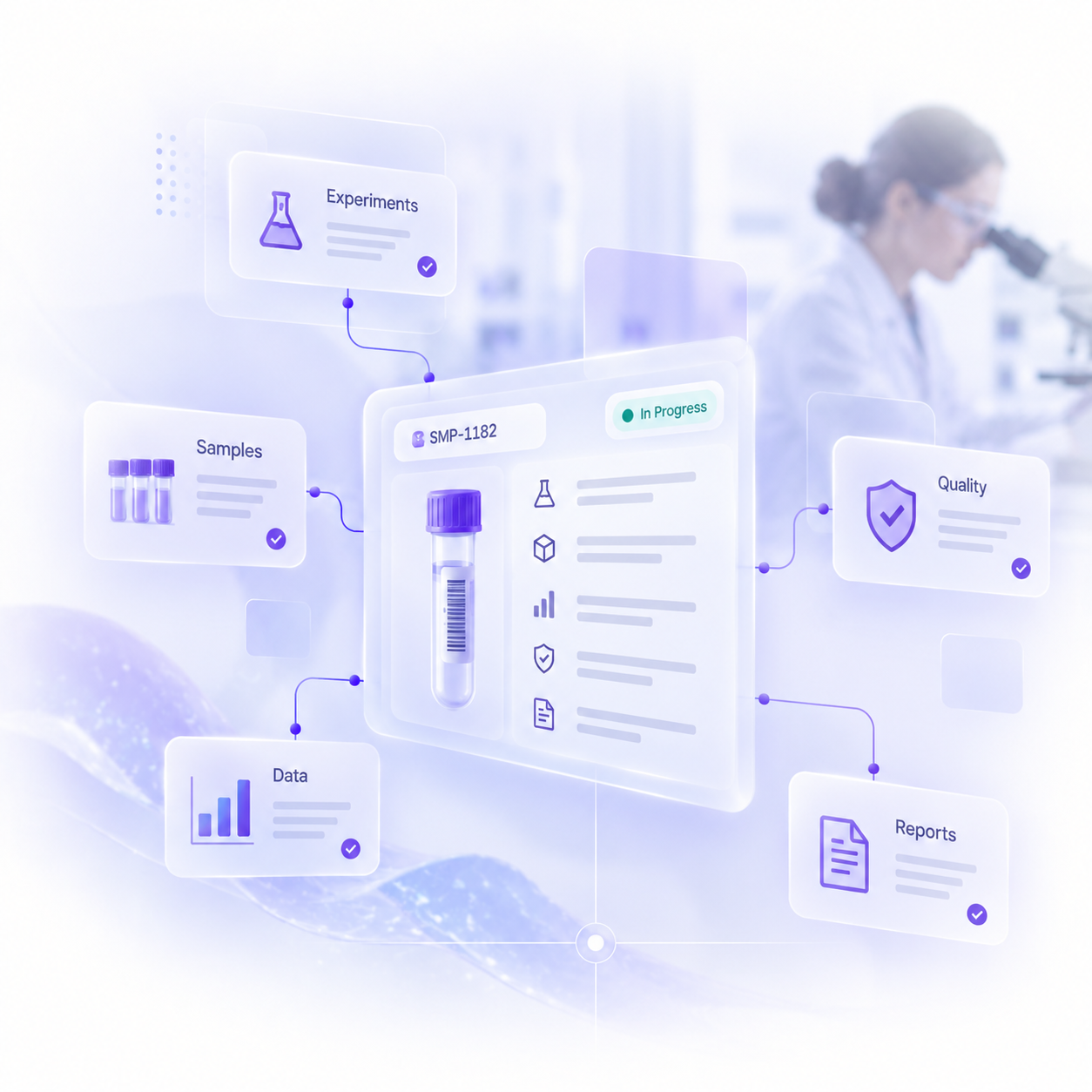
- A connected laboratory record links experiments, samples, raw data, quality events, approvals, and reports through shared identifiers and traceable data flows.
- It replaces manual handoffs between LIMS, ELN, QMS, SDMS, LIS, instruments, and spreadsheets with connected workflows.
- The goal is not necessarily one software application; it is one reliable operational view across the laboratory lifecycle.
- Labs can begin by connecting high-value workflows, standardizing identifiers, and reducing duplicate entry before pursuing a larger platform modernization.
What Is a Connected Laboratory Record?
Definition and purpose
A connected laboratory record is a linked digital record of the work performed across a laboratory. It connects an experiment to the samples used, the materials and instruments involved, the raw and processed data generated, quality or approval events, and the final report.
Instead of asking users to search through several tools, shared drives, and spreadsheets, a connected record makes relationships visible. A reviewer should be able to trace a result back to the original sample, method, operator, raw file, calculation, and approval history.
How connected records differ from standalone systems
Standalone systems often manage one part of the laboratory process well. A LIMS may track samples, an ELN may document experiments, an SDMS may store instrument files, and a QMS may manage deviations and CAPAs.
The issue is what happens between those applications. If users manually copy sample IDs, attach files, email results, or reconcile spreadsheets, the record is fragmented. A connected model uses shared identifiers, automated data flow, and linked records so information can move without losing context.
Linking scientific, operational, and quality data
A connected record brings together three essential data layers:
- Scientific data: Experiments, protocols, observations, assay results, methods, and instrument outputs.
- Operational data: Samples, inventory, locations, batches, equipment, workflow status, and turnaround times.
- Quality data: SOPs, deviations, CAPAs, training, approvals, audit trails, and report release records.
This linkage improves the ability to reconstruct what happened, when it happened, who performed it, and which data supported a final conclusion. Traceability guidance commonly emphasizes unique record identifiers and links between experiment plans, materials, methods, personnel, raw data, processed data, and final reported results.
Who benefits from a connected laboratory record
A connected laboratory record benefits scientists who need experiment context, lab managers who need workflow visibility, QA teams who need traceability, and IT or informatics teams that must maintain reliable data exchange.
It is particularly useful for growing biotech companies, CROs, molecular diagnostics labs, regulated QC teams, and multi-site labs where data must move across instruments, people, departments, and external partners.
Why Laboratory Records Become Disconnected
Experiments, samples, and reports managed in separate systems
Many labs separate experiments, sample tracking, instrument files, and reports into different applications. This arrangement can work initially, but the burden grows with sample volume, instruments, team size, and reporting requirements.
A sample may be registered in the LIMS, used in an ELN experiment, analyzed on an instrument, stored as a raw file in an SDMS, reviewed through a QMS process, and issued in a final report. Without persistent links, users must manually reconstruct the complete story.
Data silos between LIMS, ELN, QMS, SDMS, and spreadsheets
Data silos emerge when systems do not share consistent identifiers, data models, or integration pathways. The same sample name may appear differently in multiple tools, and spreadsheets often become temporary bridges that turn into permanent systems of record.
A LIMS can improve traceability by maintaining sample information, test results, and associated metadata, while barcodes and data mapping can reduce manual entry errors. However, traceability becomes more difficult when the LIMS is disconnected from the ELN, instrument data environment, and quality processes.
Manual handoffs between scientific and operational workflows
Manual handoffs introduce delays and opportunities for error. Scientists may export a CSV file from an instrument, rename it, upload it to storage, update a spreadsheet, and then enter a result into the LIMS. QA may later request evidence that requires the same team to locate source files and reconstruct the sequence.
A connected approach automates these handoffs where appropriate. For example, Scispot GLUE can pull data from instruments, ELNs, LIMS, LIS platforms, and legacy tools, then push it to databases, data lakes, and apps through API, SFTP, ASTM, or HL7 connections.
Limited visibility across the laboratory lifecycle
Disconnected records make it difficult to answer operational questions quickly:
- Which experiment used this sample lot?
- Which instrument file supports this reported result?
- Has the result passed the required quality review?
- Which samples, methods, or reports are affected by a deviation?
- Where is the latest approved version of the record?

Key Components of a Connected Laboratory Record
Experiment and sample traceability
The foundation is a shared identifier strategy. Each sample, experiment, batch, run, method, instrument file, and report should have a unique, consistent ID that can be referenced across systems.
When a scientist uses a vial in an experiment, the connected record should show which vial was used, who used it, when it was used, what result it produced, and where the supporting data lives. This minimizes re-entry while creating a clearer chain of custody.
Laboratory data integration across systems
Connected records require reliable integration - not just occasional exports. Data should move between systems through defined mappings, rules, validation, monitoring, and ownership.
Scispot GLUE is positioned as a laboratory data integration layer that standardizes data models, automates ETL pipelines, harmonizes data from instruments and applications, and preserves end-to-end data lineage.
Quality, compliance, and approval workflows
Quality records should not live separately from the work they govern. A connected model can link SOPs, deviations, CAPAs, review status, approvals, electronic signatures, and audit trails to relevant samples, experiments, and reports.
For regulated laboratories, this makes audit preparation more efficient because teams can navigate from a reported result to the supporting documentation rather than collecting evidence manually.
End-to-end visibility from data generation to reporting
A complete laboratory record should follow the lifecycle from initial request or sample receipt through experiment execution, instrument output, data processing, quality review, and final reporting.
Scispot's LabOS describes this connected model through configurable LIMS, ELN, LIS, QMS, and SDMS applications, integration tools, centralized data, connected instruments, and audit-ready workflows.

Best Practices for Building a Connected Lab Operating System
Creating a single source of operational truth
A single source of truth does not require forcing every piece of data into one database. It means defining which system owns each record type and making that record reliably available to connected workflows.
For example, the LIMS may own sample status, the ELN may own experimental narrative, the SDMS may own raw files, and the QMS may own controlled quality events. The connected layer should preserve links between those records.
Connecting scientific workflow management processes
Start with one high-value workflow, such as sample intake to testing, experiment execution to instrument output, or raw data to final report. Map the handoffs, assign shared IDs, and automate the most repetitive transfers first.
Scispot's LabOS includes workflow automation, sample management, inventory automation, instrument and application connectors, and an integration dashboard to track data synchronization and connection status.
Reducing duplicate data entry and manual reconciliation
Prioritize recurring duplicate tasks:
- Re-entering sample details in an ELN and LIMS
- Uploading instrument files manually
- Copying results into reports or spreadsheets
- Reconciling quality status across separate systems
- Searching for the latest approved record
Automation should remove repetitive handoffs while retaining the review steps and approvals that matter for data quality and compliance.
Maintaining traceability across the laboratory lifecycle
Maintain consistent identifiers, role-based access, version history, audit trails, and clear ownership of integrations. Test workflows using realistic exceptions - not only ideal scenarios - and regularly review data synchronization logs.

How Scispot Helps Build a Connected Laboratory Record
Scispot helps laboratories create connected records through its Lab Operating System, which brings together modular LIMS, ELN, LIS, QMS, and SDMS capabilities with GLUE, its data integration toolkit.
GLUE can connect instruments, existing laboratory systems, data lakes, and external applications while automating extraction, transformation, and routing of laboratory data. It also supports lineage by linking relationships such as batch, run, sample, and assay across connected workflows.
This approach can help laboratories reduce spreadsheet dependency, eliminate manual handoffs, and modernize progressively. Rather than replacing every system immediately, teams can connect valuable existing applications first and introduce new capabilities where gaps create measurable operational risk.