
Tips and Tricks

TetraScience Review and Features

Scibot
Sep 30, 2026
xx
min read
TetraScience Review and Features

TL;DR

  • TetraScience is a scientific data and AI platform focused on connecting, standardizing, contextualizing, and engineering laboratory data.
  • Tetra OS connects instruments, ELNs, LIMS, analytics platforms, and scientific applications while preparing data for analytics and AI.
  • TetraScience also supports workflow automation, scientific data applications, data lineage, and GxP-oriented environments.
  • Scispot is an alternative for labs that want scientific data connected directly with samples, laboratory workflows, quality processes, reporting, automation, and AI.

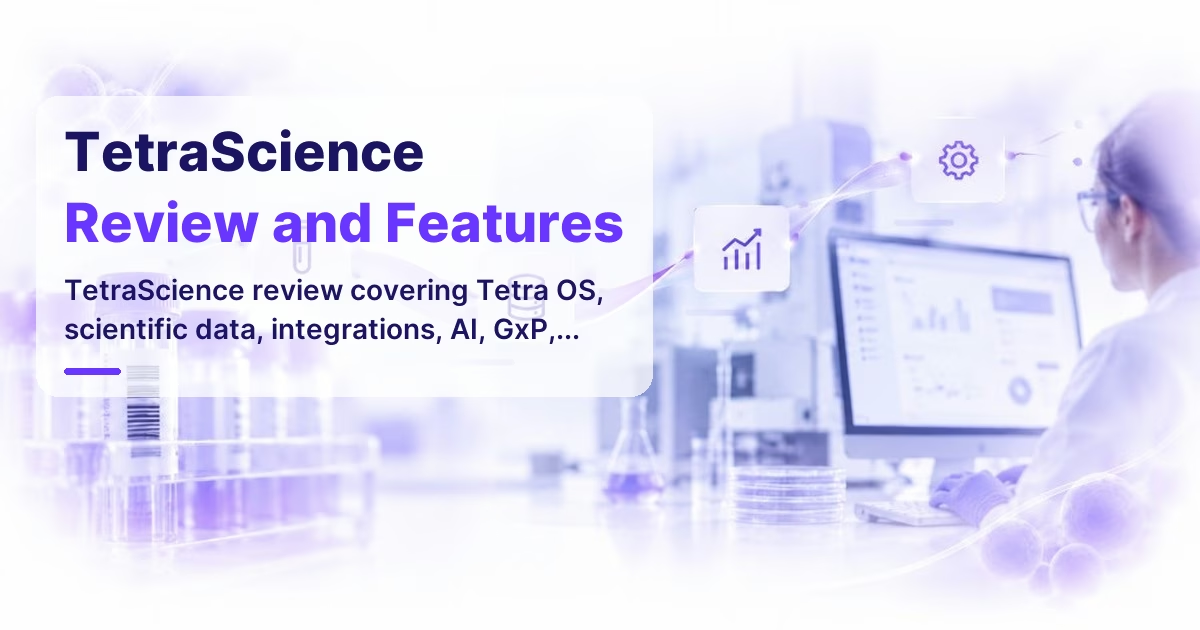
This TetraScience review covers Tetra OS, scientific data management, instrument integration, Scientific AI, GxP capabilities, pricing, and what life sciences organizations should evaluate before selecting a scientific data platform.

TetraScience is different from a traditional ELN or LIMS. Its primary focus is creating an open scientific data foundation across laboratory instruments, applications, and analytics systems.

For buyers, the key question is:

Does TetraScience fit how your organization needs to collect, transform, govern, analyze, and activate scientific data?

What Is TetraScience?

TetraScience is a scientific data and AI company focused on life sciences.

Its current platform, Tetra OS, is designed to move scientific data from fragmented instrument and application environments into standardized, contextualized, and AI-ready datasets.

Core capabilities include:

  • Scientific data ingestion
  • Instrument connectivity
  • Application integrations
  • Data replatforming
  • Scientific data engineering
  • Data contextualization
  • Workflow automation
  • Analytics
  • Scientific AI
  • Data governance and lineage
  • GxP-oriented data workflows

TetraScience describes this progression as moving scientific information from raw data to replatformed data and then into engineered, AI-native scientific data.

Need Scientific Data Connected With the Actual Lab Workflow?

Scientific data is most useful when it remains connected with samples, instruments, experiments, approvals, and downstream actions.

Scispot SDMS connects scientific data with broader laboratory operations.

Book a Scispot demo

What Is Tetra OS?

Tetra OS is TetraScience's operating system for scientific intelligence.

It is organized around four major areas:

Data Replatforming

TetraScience collects data from scientific instruments and applications and centralizes it within its scientific data environment.

The goal is to move information out of proprietary or disconnected data silos while maintaining scientific context.

Data Engineering

Raw scientific data can be transformed into structured, harmonized formats using scientific schemas, taxonomies, and ontologies.

This makes information easier to reuse across analytics, applications, and AI.

Data Analytics

Engineered scientific data can be used in dashboards, visualization tools, and analytical applications.

Scientific AI

TetraScience positions AI as a downstream outcome of a well-structured scientific data foundation.

Its platform is designed to provide AI systems with contextualized and governed scientific data rather than isolated files.

How Does TetraScience Handle Instrument Data?

Instrument connectivity is a major part of TetraScience's platform.

Tetra Integrations can collect and transfer scientific data between instruments and applications while centralizing the information in Tetra OS.

Its integration architecture includes:

  • Tetra Agents
  • Tetra Connectors
  • Data Capture App
  • Data Sync Utility
  • Tetra Data Pipelines

Supported use cases span equipment such as plate readers, flow cytometers, chromatography systems, balances, cell counters, mass spectrometry software, and other laboratory instruments.

TetraScience also connects with ELNs, LIMS, cloud storage, analytics applications, and scientific software.

Too Many Instruments and Applications to Connect Manually?

Scispot can connect laboratory instruments, ELNs, LIMS platforms, databases, cloud storage, analytics tools, and custom applications across complete workflows.

Too Many Instruments and Applications to Connect Manually?

Does TetraScience Support Scientific Data Management?

Yes.

Scientific data management is central to TetraScience's platform.

Tetra OS can centralize scientific data while preserving metadata and experimental context and converting proprietary data into standardized formats.

This can support use cases such as:

  • Chromatography
  • High-throughput screening
  • Flow cytometry
  • Bioprocess development
  • Formulation development
  • Quality testing
  • CRO data management
  • Instrument-data automation

Tetra Data Apps can then give scientists interfaces for exploring and analyzing data stored within the platform.

Does TetraScience Support AI?

Yes.

TetraScience positions Scientific AI as a major outcome of Tetra OS.

The platform is designed to turn raw laboratory data into AI-ready datasets by adding scientific context, taxonomies, ontologies, provenance, and structured data models.

TetraScience also supports AI-driven scientific applications and workflows where governed data can be used by models and agents.

For organizations pursuing AI, this makes the underlying data architecture an important part of the evaluation.

Building AI on Fragmented Laboratory Data?

AI requires more than access to raw files.

The Scispot Lab Operating System connects samples, metadata, lineage, instruments, workflows, approvals, and scientific records to create governed context for AI.

Book a Scispot demo

Does TetraScience Support GxP Environments?

Yes.

TetraScience provides capabilities designed for regulated scientific data environments.

Its GxP offering includes areas such as:

  • 21 CFR Part 11-oriented audit trails
  • Data integrity controls
  • Traceability
  • System logs
  • Validation documentation
  • Controlled releases
  • Dedicated validation environments
  • GxP verification and validation packages

TetraScience also maintains ISO 9001 and ISO 27001 certifications and SOC 2 Type II reporting.

Organizations remain responsible for validating their configured workflows and intended use against their own regulatory requirements.

Need Quality Workflows Connected With Scientific Data?

Scispot connects scientific records with quality workflows, approvals, audit trails, QC gates, evidence, reporting, and laboratory operations.

Need Quality Workflows Connected With Scientific Data?

How Much Does TetraScience Cost?

TetraScience does not publish a standard public enterprise price list.

Organizations are directed to engage with TetraScience for a personalized consultation and commercial proposal.

The total scope can depend on areas such as:

  • Instrument integrations
  • Application integrations
  • Scientific data requirements
  • Data engineering
  • Workflow automation
  • GxP requirements
  • Implementation
  • Professional services
  • Cloud infrastructure
  • Ongoing platform requirements

For a detailed commercial breakdown, read the TetraScience Pricing Guide.

TetraScience vs Scispot: What Should You Compare?

TetraScience primarily focuses on scientific data infrastructure, data engineering, analytics, and AI readiness.

Scispot focuses on connecting scientific data with broader laboratory operations.

Compare:

  • Instrument connectivity
  • Scientific data ingestion
  • Data contextualization
  • Sample traceability
  • LIMS and ELN workflows
  • Quality processes
  • Workflow automation
  • Analytics
  • AI readiness
  • APIs and integrations
  • Compliance requirements
  • Implementation
  • Total cost

The systems can also play different architectural roles, so the evaluation does not always need to be a direct replacement decision.

Want Scientific Data Connected With Day-to-Day Lab Operations?

Scispot can connect instruments, samples, workflows, existing systems, quality processes, reporting, and AI through one governed operating layer.

Book a Scispot demo

What Should You Evaluate Before Choosing TetraScience?

Use a representative scientific data workflow during the evaluation.

Test how the platform handles:

  1. Capturing instrument data
  2. Preserving raw files
  3. Extracting metadata
  4. Adding experimental context
  5. Standardizing data
  6. Connecting ELN or LIMS information
  7. Automating downstream workflows
  8. Supporting analytics
  9. Preparing data for AI
  10. Maintaining lineage and traceability

Also evaluate integration scope, data models, GxP requirements, implementation resources, governance, and total cost.

For a broader shortlist, read the TetraScience Alternatives Guide.
Share this case study
Subscribe to our newsletter
Insights, trends, and product updates from our team.
Thank you! Your submission has been received!
Oops! Something went wrong while submitting the form.
Back to blogs
Tips and Tricks

TetraScience Review and Features

September 30, 2026
4 min read
TetraScience Review and Features

TL;DR

  • TetraScience is a scientific data and AI platform focused on connecting, standardizing, contextualizing, and engineering laboratory data.
  • Tetra OS connects instruments, ELNs, LIMS, analytics platforms, and scientific applications while preparing data for analytics and AI.
  • TetraScience also supports workflow automation, scientific data applications, data lineage, and GxP-oriented environments.
  • Scispot is an alternative for labs that want scientific data connected directly with samples, laboratory workflows, quality processes, reporting, automation, and AI.

This TetraScience review covers Tetra OS, scientific data management, instrument integration, Scientific AI, GxP capabilities, pricing, and what life sciences organizations should evaluate before selecting a scientific data platform.

TetraScience is different from a traditional ELN or LIMS. Its primary focus is creating an open scientific data foundation across laboratory instruments, applications, and analytics systems.

For buyers, the key question is:

Does TetraScience fit how your organization needs to collect, transform, govern, analyze, and activate scientific data?

What Is TetraScience?

TetraScience is a scientific data and AI company focused on life sciences.

Its current platform, Tetra OS, is designed to move scientific data from fragmented instrument and application environments into standardized, contextualized, and AI-ready datasets.

Core capabilities include:

  • Scientific data ingestion
  • Instrument connectivity
  • Application integrations
  • Data replatforming
  • Scientific data engineering
  • Data contextualization
  • Workflow automation
  • Analytics
  • Scientific AI
  • Data governance and lineage
  • GxP-oriented data workflows

TetraScience describes this progression as moving scientific information from raw data to replatformed data and then into engineered, AI-native scientific data.

Need Scientific Data Connected With the Actual Lab Workflow?

Scientific data is most useful when it remains connected with samples, instruments, experiments, approvals, and downstream actions.

Scispot SDMS connects scientific data with broader laboratory operations.

Book a Scispot demo

What Is Tetra OS?

Tetra OS is TetraScience's operating system for scientific intelligence.

It is organized around four major areas:

Data Replatforming

TetraScience collects data from scientific instruments and applications and centralizes it within its scientific data environment.

The goal is to move information out of proprietary or disconnected data silos while maintaining scientific context.

Data Engineering

Raw scientific data can be transformed into structured, harmonized formats using scientific schemas, taxonomies, and ontologies.

This makes information easier to reuse across analytics, applications, and AI.

Data Analytics

Engineered scientific data can be used in dashboards, visualization tools, and analytical applications.

Scientific AI

TetraScience positions AI as a downstream outcome of a well-structured scientific data foundation.

Its platform is designed to provide AI systems with contextualized and governed scientific data rather than isolated files.

How Does TetraScience Handle Instrument Data?

Instrument connectivity is a major part of TetraScience's platform.

Tetra Integrations can collect and transfer scientific data between instruments and applications while centralizing the information in Tetra OS.

Its integration architecture includes:

  • Tetra Agents
  • Tetra Connectors
  • Data Capture App
  • Data Sync Utility
  • Tetra Data Pipelines

Supported use cases span equipment such as plate readers, flow cytometers, chromatography systems, balances, cell counters, mass spectrometry software, and other laboratory instruments.

TetraScience also connects with ELNs, LIMS, cloud storage, analytics applications, and scientific software.

Too Many Instruments and Applications to Connect Manually?

Scispot can connect laboratory instruments, ELNs, LIMS platforms, databases, cloud storage, analytics tools, and custom applications across complete workflows.

Too Many Instruments and Applications to Connect Manually?

Does TetraScience Support Scientific Data Management?

Yes.

Scientific data management is central to TetraScience's platform.

Tetra OS can centralize scientific data while preserving metadata and experimental context and converting proprietary data into standardized formats.

This can support use cases such as:

  • Chromatography
  • High-throughput screening
  • Flow cytometry
  • Bioprocess development
  • Formulation development
  • Quality testing
  • CRO data management
  • Instrument-data automation

Tetra Data Apps can then give scientists interfaces for exploring and analyzing data stored within the platform.

Does TetraScience Support AI?

Yes.

TetraScience positions Scientific AI as a major outcome of Tetra OS.

The platform is designed to turn raw laboratory data into AI-ready datasets by adding scientific context, taxonomies, ontologies, provenance, and structured data models.

TetraScience also supports AI-driven scientific applications and workflows where governed data can be used by models and agents.

For organizations pursuing AI, this makes the underlying data architecture an important part of the evaluation.

Building AI on Fragmented Laboratory Data?

AI requires more than access to raw files.

The Scispot Lab Operating System connects samples, metadata, lineage, instruments, workflows, approvals, and scientific records to create governed context for AI.

Book a Scispot demo

Does TetraScience Support GxP Environments?

Yes.

TetraScience provides capabilities designed for regulated scientific data environments.

Its GxP offering includes areas such as:

  • 21 CFR Part 11-oriented audit trails
  • Data integrity controls
  • Traceability
  • System logs
  • Validation documentation
  • Controlled releases
  • Dedicated validation environments
  • GxP verification and validation packages

TetraScience also maintains ISO 9001 and ISO 27001 certifications and SOC 2 Type II reporting.

Organizations remain responsible for validating their configured workflows and intended use against their own regulatory requirements.

Need Quality Workflows Connected With Scientific Data?

Scispot connects scientific records with quality workflows, approvals, audit trails, QC gates, evidence, reporting, and laboratory operations.

Need Quality Workflows Connected With Scientific Data?

How Much Does TetraScience Cost?

TetraScience does not publish a standard public enterprise price list.

Organizations are directed to engage with TetraScience for a personalized consultation and commercial proposal.

The total scope can depend on areas such as:

  • Instrument integrations
  • Application integrations
  • Scientific data requirements
  • Data engineering
  • Workflow automation
  • GxP requirements
  • Implementation
  • Professional services
  • Cloud infrastructure
  • Ongoing platform requirements

For a detailed commercial breakdown, read the TetraScience Pricing Guide.

TetraScience vs Scispot: What Should You Compare?

TetraScience primarily focuses on scientific data infrastructure, data engineering, analytics, and AI readiness.

Scispot focuses on connecting scientific data with broader laboratory operations.

Compare:

  • Instrument connectivity
  • Scientific data ingestion
  • Data contextualization
  • Sample traceability
  • LIMS and ELN workflows
  • Quality processes
  • Workflow automation
  • Analytics
  • AI readiness
  • APIs and integrations
  • Compliance requirements
  • Implementation
  • Total cost

The systems can also play different architectural roles, so the evaluation does not always need to be a direct replacement decision.

Want Scientific Data Connected With Day-to-Day Lab Operations?

Scispot can connect instruments, samples, workflows, existing systems, quality processes, reporting, and AI through one governed operating layer.

Book a Scispot demo

What Should You Evaluate Before Choosing TetraScience?

Use a representative scientific data workflow during the evaluation.

Test how the platform handles:

  1. Capturing instrument data
  2. Preserving raw files
  3. Extracting metadata
  4. Adding experimental context
  5. Standardizing data
  6. Connecting ELN or LIMS information
  7. Automating downstream workflows
  8. Supporting analytics
  9. Preparing data for AI
  10. Maintaining lineage and traceability

Also evaluate integration scope, data models, GxP requirements, implementation resources, governance, and total cost.

For a broader shortlist, read the TetraScience Alternatives Guide.
On this page
Ready to scale?

Run your lab without adding manual work.

See how Scispot connects your workflows, data, and quality processes.

Book a Demo

ArrowRight

Frequently Asked Questions About TetraScience

What Is TetraScience Used For?

keyboard_arrow_down

TetraScience is used for scientific data integration, instrument connectivity, data replatforming, scientific data engineering, workflow automation, analytics, and AI-ready data.

What Is Tetra OS?

keyboard_arrow_down

Tetra OS is TetraScience's scientific data and AI operating system for connecting, standardizing, engineering, analyzing, and activating scientific data.

Is TetraScience a LIMS?

keyboard_arrow_down

TetraScience is primarily a scientific data and AI platform rather than a traditional LIMS. It can integrate with existing LIMS and ELN platforms.

Does TetraScience Connect Laboratory Instruments?

keyboard_arrow_down

Yes. TetraScience provides integrations for laboratory instruments, scientific applications, ELNs, LIMS, analytics tools, and other data sources.

Does TetraScience Support GxP?

keyboard_arrow_down

Yes. TetraScience provides GxP-oriented functionality including audit trails, validation documentation, data integrity controls, and regulated deployment support.

Does TetraScience Support AI?

keyboard_arrow_down

Yes. Scientific AI is a central part of the TetraScience platform strategy, with Tetra OS designed to create structured and contextualized AI-ready scientific data.

What Are Alternatives to TetraScience?

keyboard_arrow_down

Alternatives depend on whether your priority is scientific data, instrument connectivity, LIMS, workflow automation, or AI. Scispot, Scitara, Ganymede, L7 Informatics, Dotmatics, Sapio Sciences, and other platforms can be evaluated against the same scientific workflows. Book a demo

keyboard_arrow_down

Check Out Our Other Blog Posts

View all