


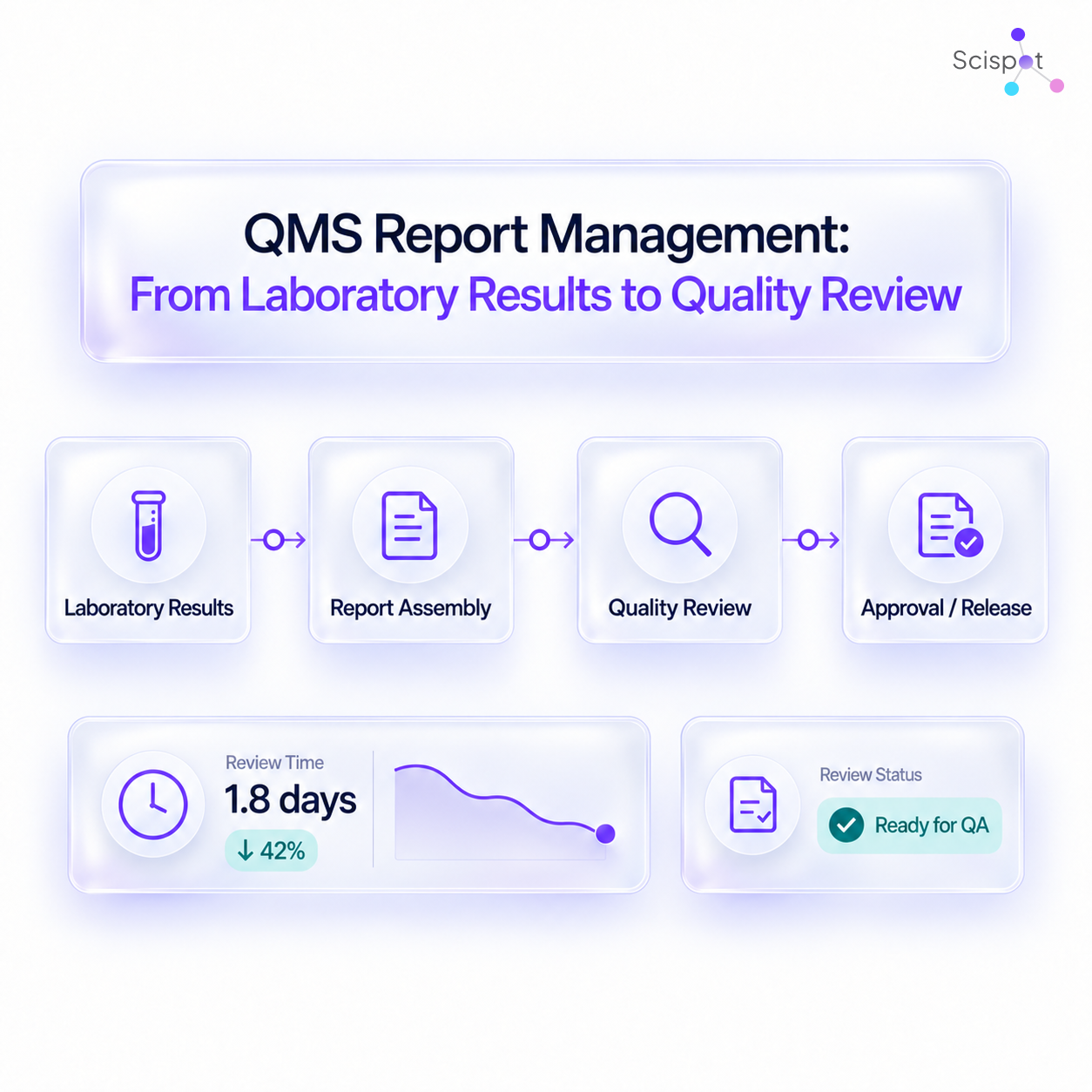
QMS Report Management: Connecting Quality Controls to Results
The laboratory completes the assay. Then a second workflow begins: export the result, create a quality record, attach the evidence, explain the issue, and wait for a decision.
That handoff is where quality review can become disconnected from the work it is meant to control.
QMS report management should keep quality rules, exceptions, evidence, and authorized decisions tied to the laboratory result. The objective is not to move every scientific activity into a quality application. It is to give Quality the right context and return the right disposition to the lab without rebuilding the record in both places.

What Is QMS Report Management?
In this laboratory context, QMS report management means controlling how laboratory results and reports connect to the quality management system. It includes the relevant quality checks, exceptions, investigations, review evidence, approvals, and reporting decisions.
The term can also refer to management-review reports or quality dashboards. This guide focuses specifically on quality controls around laboratory results and their reports, not general management reporting.
A LIMS typically holds important sample and testing records. A QMS may own procedures, quality events, training, and formal dispositions. The exact division varies. A useful laboratory quality workflow makes that division explicit rather than duplicate the same decision in two systems.
Quality requirements also vary by activity. For drug manufacturing, 21 CFR §211.192 addresses production and control record review and investigation of unexplained discrepancies or failures. It should not be presented as the governing rule for every research assay or diagnostic workflow.
Why Traditional QMS Processes Create Reporting Delays
A QMS does not inherently create delays. The problem is often a late or poorly defined handoff between laboratory execution and quality review.
Imagine that an analyst identifies a result outside an expected range. The lab marks it for review. A quality coordinator then creates a separate event, copies the result, attaches a screenshot, and asks for the method and sample history. By the time the source result changes, the attachment may be out of date.
Three distinct delays can follow.
Context delay: Quality cannot begin until someone assembles the evidence.
Decision delay: The responsible owner, required review, or disposition authority is unclear.
Return-path delay: Quality has made a decision, but the lab does not receive a reliable status update and continues chasing it.
Buying more QMS functionality may not fix these problems. First define where context and decisions need to cross the system boundary.
What Should Be Connected Between the Laboratory and QMS?
Connect enough information to support the quality decision without creating an uncontrolled second copy of the entire scientific record.
This is a design map, not a universal list of mandatory fields. The customer should determine which controls apply and which systems are authoritative.
Avoid linking only to a current procedure or live result table when the question concerns historical work. FDA's data-integrity guidance explains the importance of preserving the data and metadata needed to reconstruct an activity.
How QMS Controls Can Start With the Laboratory Result
Starting quality controls with the result does not mean waiting until a result exists to establish procedures. It means applying the relevant checks and capturing quality context as the scientific workflow runs, rather than creating a disconnected review package at the end.
Check readiness before work proceeds
Where required, verify that the workflow has the correct method, sample information, and relevant authorization or equipment status. Those checks require reliable source records. A “qualified” badge without a source and applicable time relationship is weak evidence.
Evaluate defined conditions when data arrives
Apply agreed checks for completeness, units, identifier mapping, control status, and other rule-based conditions. A missing unit and a potentially invalid assay require different handling.
Automated checks should identify defined issues. They should not silently correct regulated data or decide that an unusual result is acceptable.
Open or link the appropriate quality activity
Route the issue using the laboratory's procedures. Some conditions require a simple correction or technical review. Others may require a formal investigation or quality event.
Do not create a CAPA for every QC flag by default. Conversely, do not reduce a substantive quality failure to a dismissible notification. The process owner and Quality organization define the classification and required response.
Return an authorized disposition to the workflow
A quality record should communicate more than “closed.” The laboratory may need to know whether work is accepted, remains on hold, requires additional investigation, or needs another authorized action.
The return path must identify the affected result and version. A disposition for yesterday's result should not automatically authorize a newly changed report.
LIMS QMS Integration: Connecting Laboratory Data and Quality
LIMS QMS integration is the controlled exchange of records or status between a laboratory information management system and a quality management system. Its value depends on the meaning, ownership, and use of the information exchanged—not merely whether an API connection exists.
Define the handoff contract
Use this Scispot editorial integration framework to specify what crosses the boundary.
These are integration-design recommendations. Their exact realization depends on the systems and interfaces in scope.
Keep one authority for each decision
The QMS may remain authoritative for an investigation and its disposition. The LIMS may remain authoritative for the analytical result. A controlled report approval workflow may own final release.
That division is workable when the relationships are explicit. It becomes risky when several systems each display a generic “approved” status with different meanings.
Test failures as well as successful transfers
Repeat a message to test duplicate handling. Interrupt the connection after the source event is created. Change a result while its quality event is open. Close an event without satisfying an attached release condition.
The objective is not merely to transfer a record. It is to prevent incomplete or stale information from being mistaken for an authorized decision.
Common Challenges With Disconnected QMS and Laboratory Systems
- The same data is maintained twice. Manual copying creates two records that can diverge. Prefer controlled source references or synchronized representations with clear ownership.
- Every issue arrives without scientific context. Quality must repeatedly ask which sample, run, method, or calculation is involved. Define the minimum evidence required at event creation.
- A hold does not reach the report workflow. A QMS disposition and a report-release decision are separate events. The connection must enforce the relationship the procedure requires.
- Historical qualifications are unclear. Current training or equipment status may not establish status at execution. Preserve the appropriate event or version relationship.
- Interface errors are invisible. A silent failed transfer can leave the lab and Quality with different views. Make failed or unacknowledged handoffs visible to a named owner.
- Success is measured only by event closure. A fast closure rate may hide repeat issues or incomplete evidence. Pair speed with quality and completeness measures.
For an initial scorecard, track time from result flag to quality triage, evidence completeness at triage, unacknowledged handoff age, time from disposition to resumed workflow, and reopened-event rate. Keep result flags, formal investigations, and CAPAs as separate populations.

How Scispot Supports QMS Report Management
Scispot combines expert-led lab transformation with an AI-native operating platform. Its Digital Brain connects the quality decision to the laboratory context that makes the decision possible. It can provide native quality capabilities or work alongside an existing QMS. The purpose is to improve the result-to-quality-to-report process, not force a replacement decision before addressing the handoff.
Scispot's quality capabilities include document control, training relationships, adaptable change workflows, audit trails, and electronic signatures. GLUE provides the integration and data-standardization layer around agreed sources.
Bring laboratory and Quality teams into one workstream
A forward-deployed scientist helps identify which scientific context a reviewer actually needs. Engineers map the records and handoffs. Quality defines the rules, authority, and evidence. This avoids treating LIMS QMS integration as a technical ticket that is considered complete when data first crosses an API.
The recommended workstream outputs include an ownership matrix, event and status mappings, evidence references, exception routing, failed-transfer handling, and representative test cases.
That is where Scispot's combination matters: lab software, scientific understanding, integration engineering, and ongoing delivery responsibility are organized around the same Scispot's outcome engagement model.
Make the work usable for each role
An analyst should see the missing information or action needed to progress. A reviewer should see the result and the evidence relevant to the decision. An operations leader should see where work is waiting.
Scispot's adaptable operating layer can support role-specific workflows on shared lab records. This reduces the need to create another spreadsheet or standalone app whenever a team needs a different Scispot platform view.
Keep regulated decisions governed
Defined rules can flag a problem, block a specified transition, route it to the responsible role, and document the event. The Quality organization retains its judgment and regulated sign-off.
For illustration, an instrument import with an unresolved sample mapping should not simply flow into a client report. The target design would retain the source, expose the mismatch, route it for resolution, and prevent the agreed downstream action until the condition is satisfied. This is a proposed design example, not a universal preconfigured rule.
Improve the operating loop after activation
When a method, source system, or quality procedure changes, the mapping and workflow need review. Managed Lab Brain Ops can be scoped to monitor handoffs, maintain the agreed controls, and improve recurring sources of rework.
Scispot supports compliance and validation activities. It does not make a laboratory compliant by installing a connection. The measurable result should be fewer incomplete handoffs, less evidence reconstruction, and clearer movement from a quality decision to the next authorized lab action.