

TL;DR
- Lab-specific workflows are not always “edge cases.” A custom CRO data intake process, QC review, scientific calculation, or exception rule may be central to how your lab works.
- When important workflows live in spreadsheets, email threads, shared drives, or manual checklists, teams can lose context around sample lineage, data review, workflow status, and decisions.
- A standard LIMS, ELN, or SDMS can support core lab operations, but labs often need flexible tools for the last-mile processes that make their operations distinct.
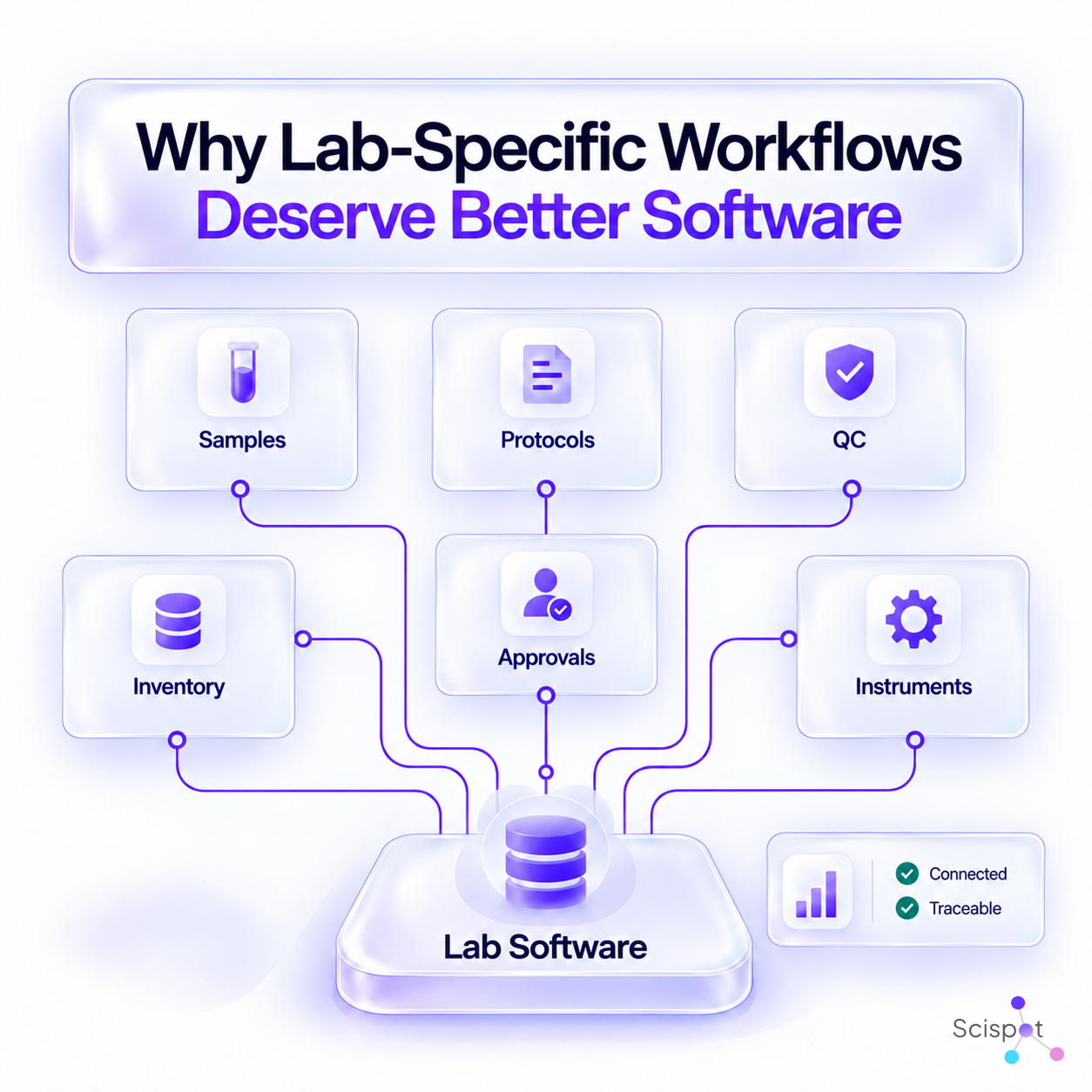
- Scispot’s Digital Brain provides a connected foundation for lab data, workflows, rules, relationships, history, sample traceability, and operational context.
- Jazz helps labs create purpose-built applications for custom needs such as CRO data management, QC workflows, reporting, exception handling, automation, and downstream analysis handoffs.
- Bringing unique processes into a connected lab operating system can help teams standardize repeatable work, preserve data relationships, improve visibility, and reduce reliance on disconnected tools.
The workflow that only your lab uses may be one of the most valuable workflows you have.
Maybe your team has a specific way to receive and review data from CROs. Maybe one assay needs a different QC review path. Maybe your scientists rely on a calculation they have refined over several years. Or maybe there is an exception process that only your team knows how to handle correctly.
That workflow may matter to one team in one organization. It may not be useful to every lab using a LIMS, ELN, SDMS, or laboratory data platform.
For a software company building a broad product, that kind of request has often been called an edge case. In many situations, that label makes sense. Not every lab workflow should become a default feature that every user sees.
But an edge case for a software vendor can be a core advantage for the lab that created it.
Your workflow exists because your team learned something. You found a better way to manage a process. You built a spreadsheet to close a gap. You added review rules to protect quality. You created a workaround because the standard process did not reflect how your scientists actually work.
Over time, that workaround became part of your lab’s operating model.
The real question is not whether every other lab needs that workflow. The question is whether your lab has the tools to support it without pushing it back into spreadsheets, email threads, shared drives, or disconnected systems.
The Problem With Treating Every Workflow as an Edge Case
Labs do not run on standard processes alone.
Even labs that use the same instruments, assays, sample types, or research models can have very different operational needs. Their teams may work with different CROs. They may use different review criteria. They may follow different protocols, data structures, handoff rules, and reporting requirements.
A generic laboratory information management system can support core workflows such as sample registration, inventory tracking, chain of custody, and audit trails. Those capabilities matter. But labs often need more than a standard LIMS configuration.
They need a system that can reflect how they actually operate.
For example, a lab may need to:
- Receive CRO data through a specific intake and validation process.
- Flag samples that need an extra QC review before downstream analysis.
- Capture custom metadata for a specialized assay.
- Apply internal rules before data moves to the next stage.
- Build reports that combine sample data, project details, assay results, and review status.
- Track exceptions without losing the original sample lineage or audit trail.
- Connect lab workflows with APIs, automation tools, analytics systems, and downstream data pipelines.
- Give scientific, operational, and technical teams a shared view of the same work.
These are not always product gaps. Often, they are signs that a lab has developed a more precise way to manage its science and operations.
The issue starts when that knowledge lives outside the main system of record.
When a lab-specific workflow depends on a spreadsheet, a shared inbox, a set of informal handoffs, or one person’s memory, it becomes harder to scale. The workflow may still work well, but it becomes harder to trace, review, repeat, and improve.
Your Unique Workflow May Be Part of Your Advantage
A lab’s operating model reflects years of decisions.
Scientists refine calculations because they have learned what produces reliable results. Lab operations teams create intake rules because they know where data quality issues tend to appear. Bioinformatics teams define data handoffs because downstream analysis depends on consistent metadata and file relationships.
These processes are often built one practical decision at a time.
A team may start with a simple spreadsheet to track sample status. Then it adds columns for assay batches, project context, QC decisions, and exceptions. Later, it builds scripts, templates, review checklists, and reporting logic around that spreadsheet.
Eventually, the process becomes too important to live outside the lab’s software.
At that point, a lab should not have to choose between two poor options:
- Force the team to abandon a workflow that works.
- Keep the workflow outside the system of record.
There is a better option. The lab can bring its unique workflow into the same operating layer that holds its data, sample relationships, inventory, workflow rules, and history.
That is where a flexible lab operations platform matters.
Why Standard Lab Software Often Falls Short
Traditional lab software tends to solve a defined set of problems. A LIMS may manage samples and inventory. An ELN may help document experiments. An SDMS may store and organize scientific data. A workflow tool may support task tracking.
Each tool can serve a useful purpose.
The challenge appears when a lab needs to connect them. A sample moves through intake, processing, QC, review, reporting, and downstream analysis. Along the way, the team needs to preserve sample lineage, capture metadata, apply rules, document exceptions, and make the right information available to the right people.
If the system cannot support a lab’s last-mile workflow, the team often creates a workaround.
That workaround may live in:
- Spreadsheets for calculations, trackers, and sample status.
- Email threads for review and approval.
- Shared folders for reports and data exports.
- Custom scripts that are difficult to maintain.
- Separate databases with incomplete sample relationships.
- Manual checklists that sit outside the audit trail.
- Informal knowledge held by a small number of experienced team members.
These tools can solve an immediate problem. But they can also fragment the lab’s data model and make it harder to understand what happened, why it happened, and what should happen next.
A connected lab operating system should help teams manage the standard workflow and give them room to formalize the workflow that is specific to their lab.
How Scispot Helps Labs Bring Workflows Into the System of Record
Scispot customers have shared many ideas over the years. Those ideas often center on reporting, integrations, automation, sample traceability, review processes, and how scientists want to work with their data.
Not every request should become a universal product feature. A workflow that fits one lab perfectly may add unnecessary complexity for another.
But each workflow can reveal something important about how labs operate.
Scispot’s ecosystem is shaped by that reality. The platform is built to help labs connect scientific data, operational workflows, sample lineage, inventory, rules, history, and system integrations in one place.
Scispot’s Digital Brain provides the underlying foundation. It can hold the data relationships, workflow logic, history, and operating context that a lab needs across its work.
Jazz extends that foundation by giving labs a way to create purpose-built applications for their specific workflows.
This matters because the final part of a workflow is often where generic software stops being useful.
A lab may already have a structure for samples, projects, assays, inventory, instruments, results, and users. But it may need a custom application for one of the following:
- A CRO data receipt and review workflow.
- A QC exception process for a specific assay.
- A project report that follows the lab’s internal format.
- A custom calculation that scientists rely on.
- A scientific data review queue.
- A sample disposition workflow.
- A protocol-specific tracking process.
- A handoff between lab operations and downstream analysis.
- A dashboard for a specialized internal team.
Jazz gives that unique last mile a place inside the Scispot ecosystem.
Instead of treating the workflow as something separate from the lab’s data and system of record, teams can build around the data structures and relationships already in Scispot.
A Practical Example: CRO Data Intake and Review
Consider a lab that receives data from external research partners.
The lab may need to confirm that incoming data matches the right project, sample IDs, assay batches, and expected file structure. It may need to check whether metadata is complete before the data enters a downstream analysis workflow. Some files may require a scientific review. Others may need to be sent back for clarification.
A generic file upload process may not be enough.
The lab may need a workflow that can:
- Associate incoming data with the correct samples and projects.
- Verify required metadata fields.
- Track the source and timing of the incoming data.
- Route records to the right reviewer.
- Capture review decisions and comments.
- Flag exceptions without losing context.
- Maintain an audit trail of the review process.
- Trigger follow-up tasks or notifications.
- Make approved data available for downstream analysis.
That process may be highly specific to the lab. It may depend on the type of data, its relationship to the assay, the partner involved, and the lab’s own quality rules.
With Scispot’s connected operating layer and Jazz, the lab can create a purpose-built workflow that fits this process instead of forcing the process into a generic form.
The goal is not to make every lab work the same way. The goal is to give each lab a better way to run the workflows that matter to it.
Why This Matters for Lab Operations
Lab-specific workflows are often where operational knowledge becomes visible.
They show how a team handles uncertainty, protects quality, manages exceptions, and turns scientific work into reliable data. They also reveal where a lab’s systems are too rigid, too disconnected, or too dependent on manual work.
When teams can formalize those workflows in their lab software, they gain a clearer operating model.
That can help create:
- Better visibility into sample status, data review, and workflow progress.
- More consistent execution of internal rules and procedures.
- Stronger sample traceability across connected workflows.
- A more complete history of changes, decisions, and exceptions.
- Less dependence on disconnected spreadsheets and email threads.
- Easier collaboration between scientists, lab operations, data teams, and external partners.
- A more useful system of record for scientific operations.
- A clearer foundation for automation, integrations, APIs, and future workflow improvements.
The value is not in customization for its own sake. The value comes from making a lab’s proven process easier to use, easier to trace, and easier to improve.
A Better Way to Think About “Edge Cases”
When a team says, “This is very specific to us,” that should not automatically end the conversation.
It may be a sign that the team has developed knowledge that deserves to be reflected in its software.
Some workflows should remain local. Some should stay simple. Some may not need a dedicated application at all.
But when a workflow affects data quality, sample traceability, review, reporting, scientific decisions, partner coordination, or operational scale, it deserves a closer look.
The right question is:
Should this workflow remain outside the system of record, or should it become part of how the lab operates?
For many labs, the answer is clear.
If the workflow is important enough to maintain, refine, teach, and repeat, it may be important enough to build into the platform that supports the rest of the lab.
Build the Last Mile Around How Your Lab Works
Labs should not have to flatten their best processes to fit generic software.
Scispot helps teams build a connected foundation for scientific operations. Its Digital Brain brings together the data, relationships, workflows, rules, and history that support day-to-day lab work. Jazz gives teams a way to turn their specific operational needs into purpose-built applications within that foundation.
That may mean a custom CRO workflow. A more structured QC review. A report that reflects the way a scientific team makes decisions. An exception process that preserves context and sample lineage. Or a workflow that has lived in a spreadsheet for too long.
Your lab has already done the hard part. You created the process, learned what works, and refined it through real scientific and operational work.
Scispot and Jazz give that knowledge a place inside your lab operating system.
If your lab has a workflow that works well but sits outside your core systems, talk with the Scispot team about how it could fit into a connected system of record.